

35 kg Rubber Block Unloading from Conveyor to Cage in Thailand
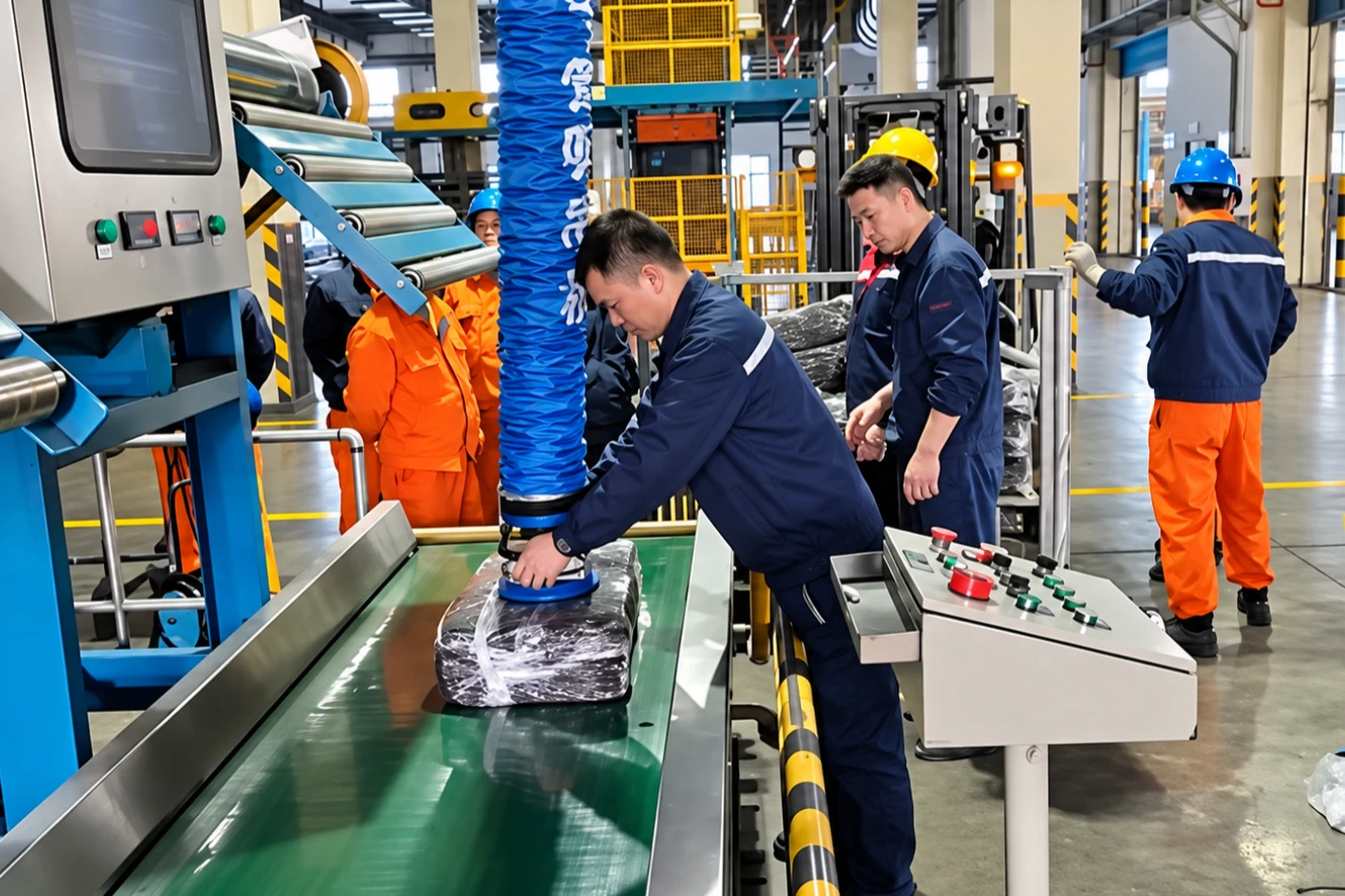
A rubber raw-material producer in Thailand needed to unload 35 kg rubber blocks from a conveyor and arrange them neatly in material cages. The blocks were still warm at handling, with a reported surface temperature of 40–50°C. Their weight and temperature made manual handling demanding.
For this 2024 project, WOLIFT supplied a WO-QGDD120 vacuum tube lifter rated for 50 kg, supported by a 3 m column-mounted jib crane. A single silicone multi-lip suction cup grips the film-covered block, while the operator guides the transfer and placement.
The application combines warm-surface gripping, access to a cage as it fills, and free 360° suction-head rotation for horizontal positioning. No tilting is required.
Project specifications
| Item | Supplied project configuration |
|---|---|
| Industry | Rubber raw-material production |
| Application | Conveyor unloading and orderly placement in material cages |
| Country / project year | Thailand / 2024 |
| Workpiece | Film-covered rubber raw-material block |
| Actual workpiece weight | 35 kg |
| Approximate block dimensions | 670 × 330 × 200 mm |
| Reported surface temperature | 40–50°C during handling |
| Contact surface | Uneven, with a protective film layer |
| Tube lifter | WO-QGDD120 |
| Rated load | 50 kg for the supplied configuration |
| Suction cup | One 120 × 315 mm silicone multi-lip cup |
| Vacuum source | Vacuum blower |
| Supporting system | Column-mounted jib crane with aluminium rail |
| Column height / arm length | 3,300 mm / 3,000 mm |
| Conveyor height | 900 mm |
| Cage dimensions | 1,200 × 1,000 × 890 mm |
| Reported maximum stacking height | Approximately 900 mm |
| Cup height above floor | 150–1,850 mm |
| Effective vertical travel | 1,700 mm |
| Positioning movement | Free 360° suction-head rotation; no tilting |
| Height adjustment | Unloaded and loaded hover settings |
The handling problem: weight, warmth and cage access
At this station, the conveyor presents individual rubber blocks for unloading. Workers need to move each block away from the line and place it in an orderly arrangement inside a cage.
The task involves more than a single pickup height. The destination changes as blocks accumulate, and the operator needs room to guide the block past the cage boundary and into its intended position. The 35 kg weight adds physical effort, while the reported 40–50°C contact temperature is relevant to suction-cup selection and the operator's handling procedure.
WOLIFT configured the lifting attachment and jib around this local transfer task. The installation remains operator-controlled: the worker selects the contact position, guides movement and completes placement.
Why a silicone multi-lip suction cup was selected
The 120 × 315 mm cup uses a silicone sealing material and a multi-lip profile. WOLIFT selected the silicone material for the temperature conditions of this project. The multiple flexible lips help accommodate local unevenness beneath the protective film.
Temperature suitability and seal formation are separate checks. The material must suit the contact conditions, and the profile must make an effective seal on the actual block surface. Film condition, surface irregularity and contamination can affect the contact.
The 40–50°C figure describes the workpiece in this installation. It is not a published maximum temperature rating for the complete lifter, nor evidence that any silicone cup is interchangeable with the selected part.
For comparison, WOLIFT's 30 kg rubber block loading project in Spain uses a nitrile rubber multi-lip cup. The two projects illustrate application-specific cup selection rather than one cup material being universally preferable.
Conveyor-to-cage operating sequence
The 3 m jib arm supports movement between the conveyor and the adjacent cage. The operator uses the following sequence:
- Position the cup on a suitable contact area of the block on the conveyor.
- Establish suction and raise the block according to the operating procedure.
- Guide the suspended block towards the cage.
- Use the freely rotating head to adjust horizontal orientation when needed.
- Lower the block into the intended position and release after it is supported.
The suction head can rotate freely through 360°. This allows orientation adjustment without turning the block from horizontal to vertical. The rotation is used for positioning; this case does not describe powered rotation or a tilting attachment.
Working heights and adjustable hover
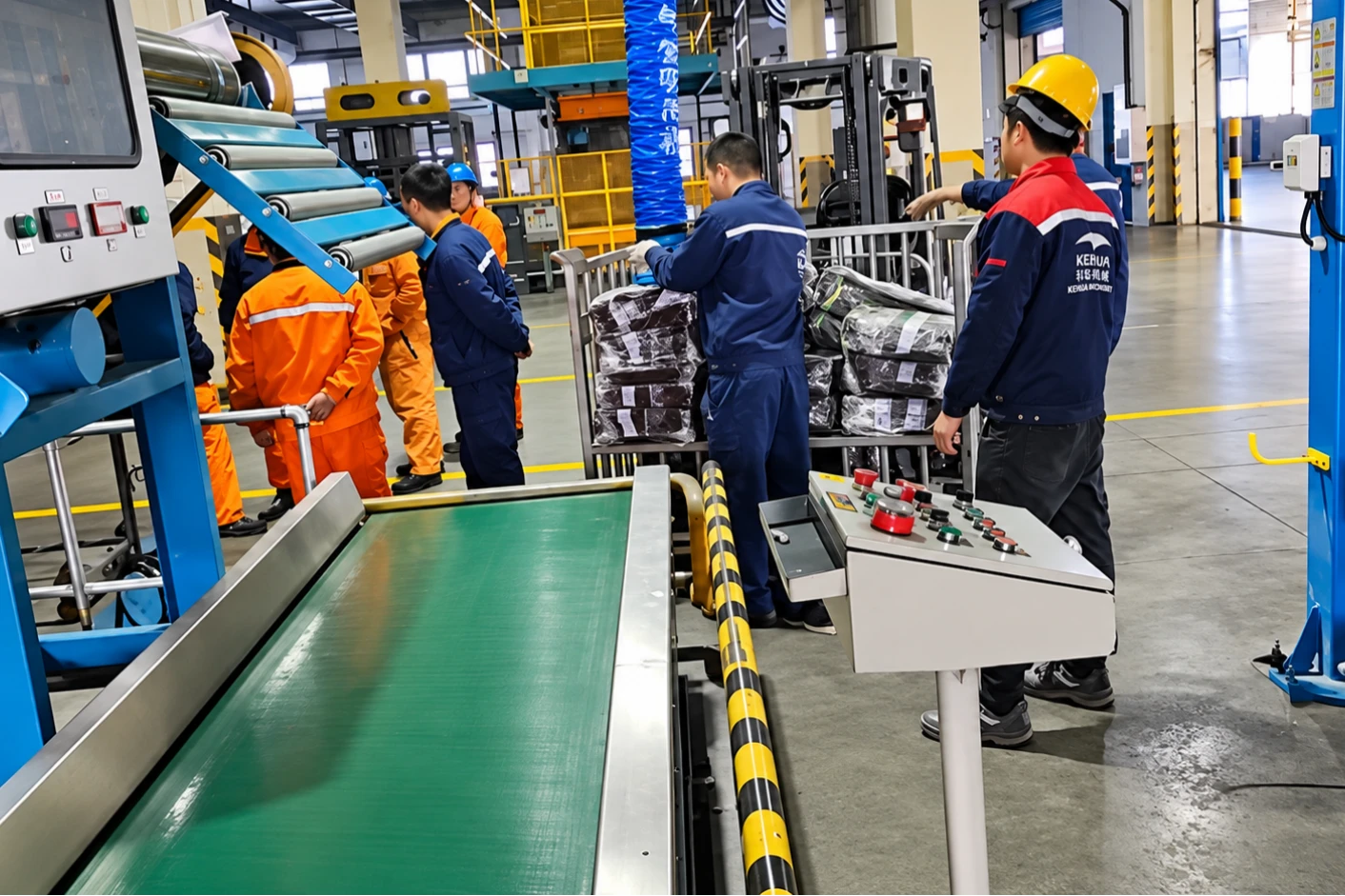
The conveyor is 900 mm above the floor. The reported maximum stacking height is approximately 900 mm, and the cage dimensions are 1,200 × 1,000 × 890 mm.
The suction cup's configured travel range is 150–1,850 mm above the floor. Subtracting these positions gives 1,700 mm of effective vertical travel. These are cup positions, not a statement that every point in a cage is accessible: the cage rim, block dimensions, tooling and jib route also affect clearance.
An unloaded hover setting establishes the resting height of the empty attachment. A loaded hover setting allows the operator to establish a practical height after a block is gripped. These adjustments support operator guidance while the lifting system carries the block's weight.
For another workstation, WOLIFT reviews the actual lowest placement position, cage access and clearance over the rim before confirming the travel range.
Project video
Caption: WOLIFT vacuum tube lifter transferring 35 kg rubber blocks from a conveyor to a material cage at a customer site in Thailand. Project year: 2024.
Operating cycle and practical outcome
WOLIFT reports approximately 15–20 seconds to complete a transfer and placement cycle under the project's operating conditions. Timing depends on the operator, available block position and destination inside the cage; it should not be treated as a guaranteed hourly output.
The supplied arrangement provides vacuum-assisted lifting and guided placement of the 35 kg block, with horizontal orientation adjustment at the suction head. The reported information does not include a measured percentage improvement, injury reduction or independently verified labour saving.
Historical project cost
| Item | Disclosed 2024 project charge |
|---|---|
| Equipment | USD 5,674 |
| DDP delivery charge to the customer | USD 400 |
| Total disclosed project charges | USD 6,074 |
These figures describe the reported equipment and DDP delivery charges for this project. They are historical amounts, not a current standard price. A new proposal should itemise the equipment scope, delivery destination, installation and other services so that complete offers can be compared on the same basis.
What to compare with Schmalz or TAWI solutions
Schmalz's JumboSprint/JumboErgo families offer configurable tube-lifter and gripper arrangements, and TAWI describes rubber-bale lifting applications. Buyers assessing these alternatives should compare the selected configuration for their actual workpiece, rather than relying on a product family's maximum load alone.
| Requirement | WOLIFT project detail | Comparable proposal should confirm |
|---|---|---|
| Temperature and contact | 35 kg block at a reported 40–50°C; uneven film-covered surface | Gripper material, contact conditions and representative suitability check |
| Gripping layout | Single silicone multi-lip cup, 120 × 315 mm | Cup number, sealing profile and suitability for the actual block |
| Placement | Neatly arranged blocks in a 1,200 × 1,000 × 890 mm cage | Cage access, clearance and orientation adjustment |
| Vertical working range | Cup positions 150–1,850 mm above floor | Tooling-inclusive minimum and maximum positions |
| Local coverage | 3 m column jib with aluminium rail | Coverage of both conveyor pickup and cage placement |
| Controls and price | Loaded/unloaded hover adjustment; disclosed historical charges above | Quoted controls and itemised equipment, delivery and service scope |
This is a purchasing checklist, not a comparison test or competing quotation. The project information provides no basis for claiming that WOLIFT is faster, cheaper or more temperature-resistant than an equivalent competitor configuration.
Frequently asked questions
Why use a 50 kg rated lifter for a 35 kg block?
The supplied project configuration is rated for 50 kg and handles the actual 35 kg workpiece. This identifies the selected configuration, not a universal rule for capacity margins. Gripper contact, frame coverage and the handling route must also be assessed.
Does a silicone cup mean the lifter can handle any hot rubber block?
No. This project concerns a reported 40–50°C block surface. A different temperature, contact duration, packaging or rubber surface requires its own configuration review.
Does the block need to be flipped before placement?
No flipping is required in this project. Free 360° rotation at the suction head helps the operator adjust the horizontal orientation for orderly placement.
Is 1,850 mm the effective lifting stroke?
It is the highest configured cup position above the floor. The lowest position is 150 mm, so the effective travel is 1,700 mm.
Will every cage position take 15–20 seconds?
No. The reported time is approximate. Block availability, operator movement and the selected placement position change the cycle.
Discuss your conveyor unloading requirement
For a similar application, provide the block weight, dimensions, contact temperature, protective-film condition, conveyor height, cage dimensions and placement sequence. Include photos of the contact surface and a layout of the required working area.
Explore the related WOLIFT bag vacuum tube lifter range, configured around the actual packaged material or rubber block. Review jib cranes and rail systems for station coverage, or read how vacuum tube lifters work.
Contact WOLIFT for a project-specific equipment review.
Discuss a similar handling requirement
Share the workpiece data and site conditions for an initial engineering review.