

30 kg Rubber Block Loading with One Vacuum Tube Lifter in Spain
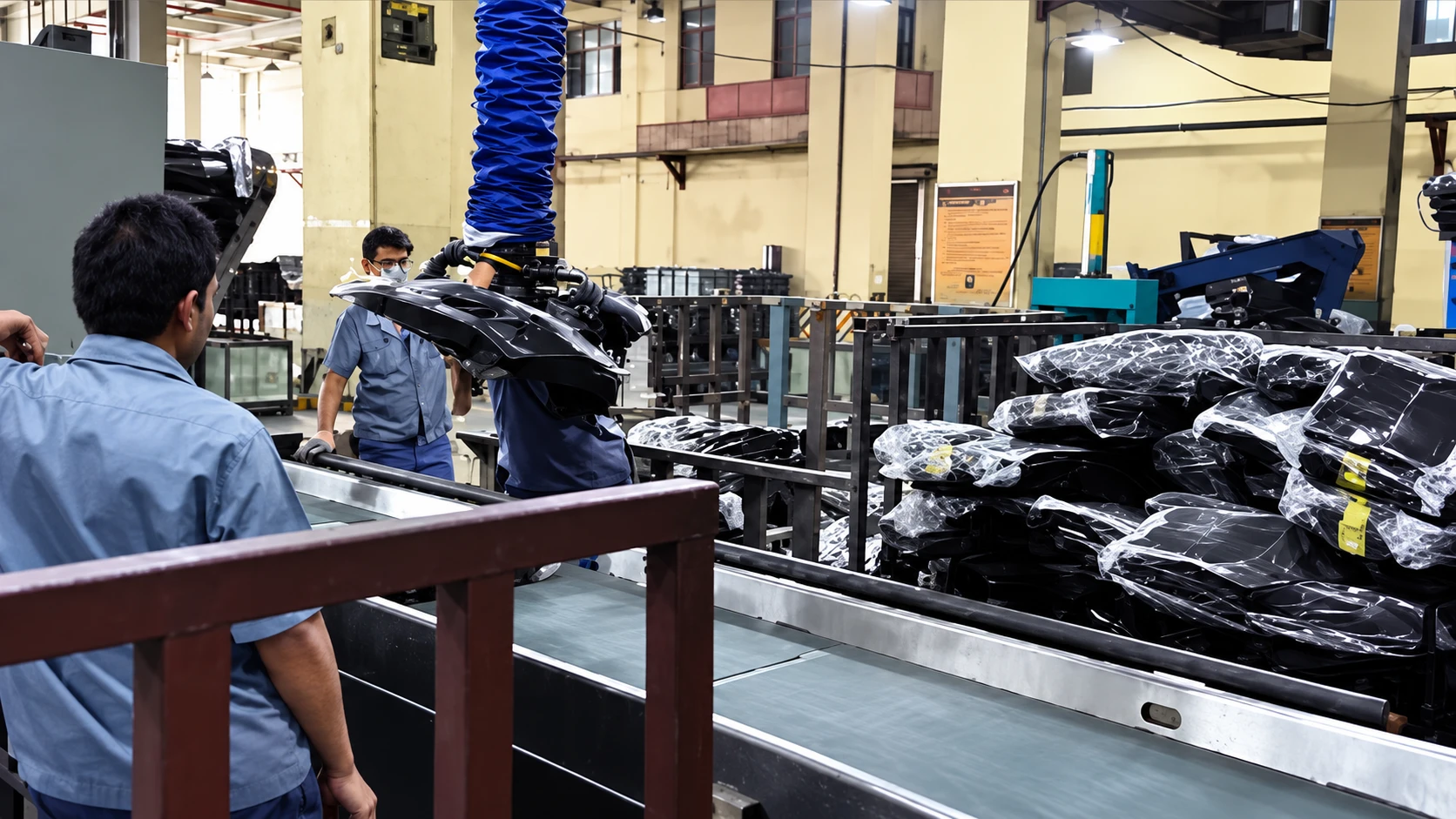
An industrial and sealing-products manufacturer in Spain needed to load two types of rubber raw material onto a conveyor feeding its dry-rubber mixing process. Workers previously moved the blocks by hand, a demanding task because each block weighed 30 kg.
In 2025, WOLIFT supplied a WO-QGDD100 vacuum tube lifter with a 5 m column-mounted jib crane. The arrangement serves material cages on both sides of the conveyor. Workers use the same lifter alternately, passing the unloaded control handle to the other side after completing their loading task.
The project combines three application-specific features: a multi-lip suction cup for uneven film-covered rubber, a jib covering both loading positions, and adjustable unloaded and loaded hover settings.
Project specifications
| Item | Supplied project configuration |
|---|---|
| Customer industry | Industrial and sealing products |
| Application | Conveyor loading for dry-rubber mixing |
| Country and project year | Spain, 2025 |
| Materials | Black and yellow rubber raw-material blocks |
| Actual block weight | 30 kg for either material |
| Block dimensions | 460 × 800 × 150 mm |
| Contact surface | Close-fitting protective film over an uneven rubber surface |
| Tube lifter | WO-QGDD100 |
| Rated load for this configuration | 30 kg |
| Suction cup | One 120 × 315 mm multi-lip nitrile rubber cup |
| Vacuum source | Vacuum blower |
| Supporting crane | Column-mounted jib with aluminium rail |
| Column height / arm length | 3,300 mm / 5,000 mm |
| Suction-cup height above floor | Minimum 150 mm; maximum 1,850 mm |
| Effective vertical travel | 1,700 mm |
| Conveyor height | 800 mm |
| Hover adjustment | Unloaded and loaded hover settings |
The challenge: repeated manual loading from both sides
The factory uses two colours of rubber raw material, stored in cages on opposite sides of the conveyor. The blocks retain protective film, but their upper surfaces are not completely flat.
Manual handling required workers to lift and position 30 kg blocks repeatedly. The customer identified high physical effort and low handling efficiency as the main problems. A useful replacement needed to grip the actual surface, reach both material positions and fit into the existing conveyor-loading process.
The blocks are placed onto the conveyor before entering the mixing process. The lifting system handles transfer and placement; it does not automate the material recipe or the mixing operation.
How one jib crane serves two loading positions
The 5 m jib arm and aluminium rail support the tube lifter across the required loading area. Material cages remain on opposite sides of the line, and workers share the equipment in turn.
The operating sequence is:
- A worker positions the suction cup on a suitable contact area of a film-covered rubber block.
- The lifter grips and raises the block, while the worker controls its movement.
- The worker transfers the block to the conveyor and places it on the supported surface.
- After release, the unloaded handle is passed to the worker on the opposite side.
- The next worker repeats the loading sequence for the other material.
This is one shared lifting device serving two positions alternately. It does not lift two blocks simultaneously. For another installation, the jib position, swing clearance and access to both cages must be checked against the real floor plan.
Why the suction cup matters on film-wrapped rubber
WOLIFT selected one rectangular 120 × 315 mm nitrile rubber suction cup with a multi-lip sealing profile. The flexible lips help accommodate local unevenness at the contact surface, allowing the selected cup to form a seal on these rubber blocks.
The close-fitting film is part of the contact condition. Loose wrapping, torn film or a different rubber profile may change the grip, so a similar project should be reviewed using its actual block and packaging. The success of this installation does not establish suitability for every film-covered material.
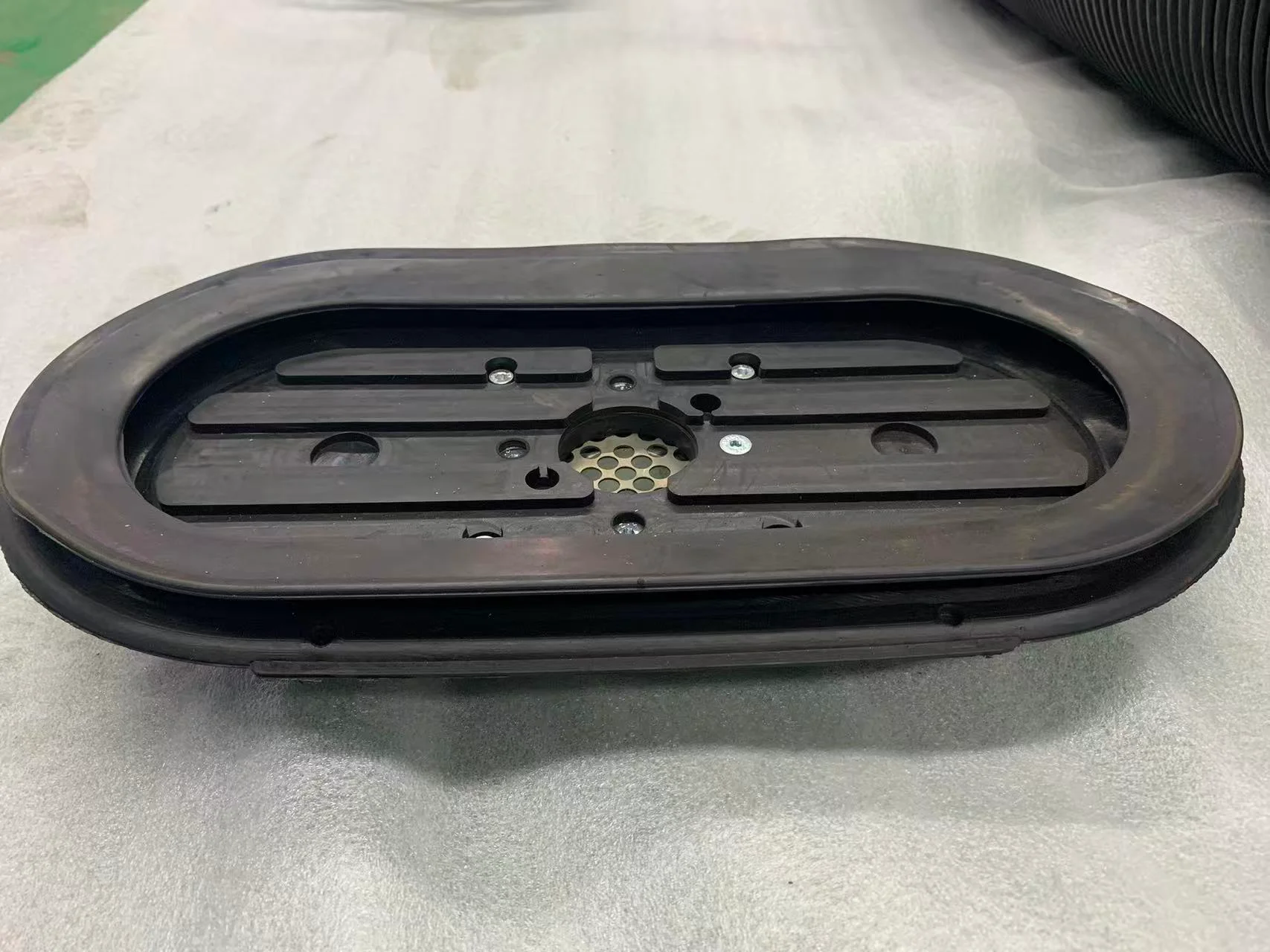
The vacuum blower supplies the tube-lifting system. Workpiece weight, tube capacity and the cup's contact conditions must be assessed together. The complete configuration in this project is rated for 30 kg.
Working height and hover settings
The suction cup can move from 150 mm to 1,850 mm above the floor, giving an effective vertical travel of 1,700 mm. These cup positions are distinct from the crane's 3,300 mm column height. The conveyor stands 800 mm above the floor.
The lifter allows an unloaded hover setting, which establishes the resting height of the empty lifting attachment, and a loaded hover setting for the attachment after it has gripped a block. The operator can adjust these settings to the task within the equipment's operating range.
These adjustments help workers guide the block at a practical height rather than carrying its full weight manually. The system remains operator-controlled: workers position the cup, guide the transfer and place the block.
Project video
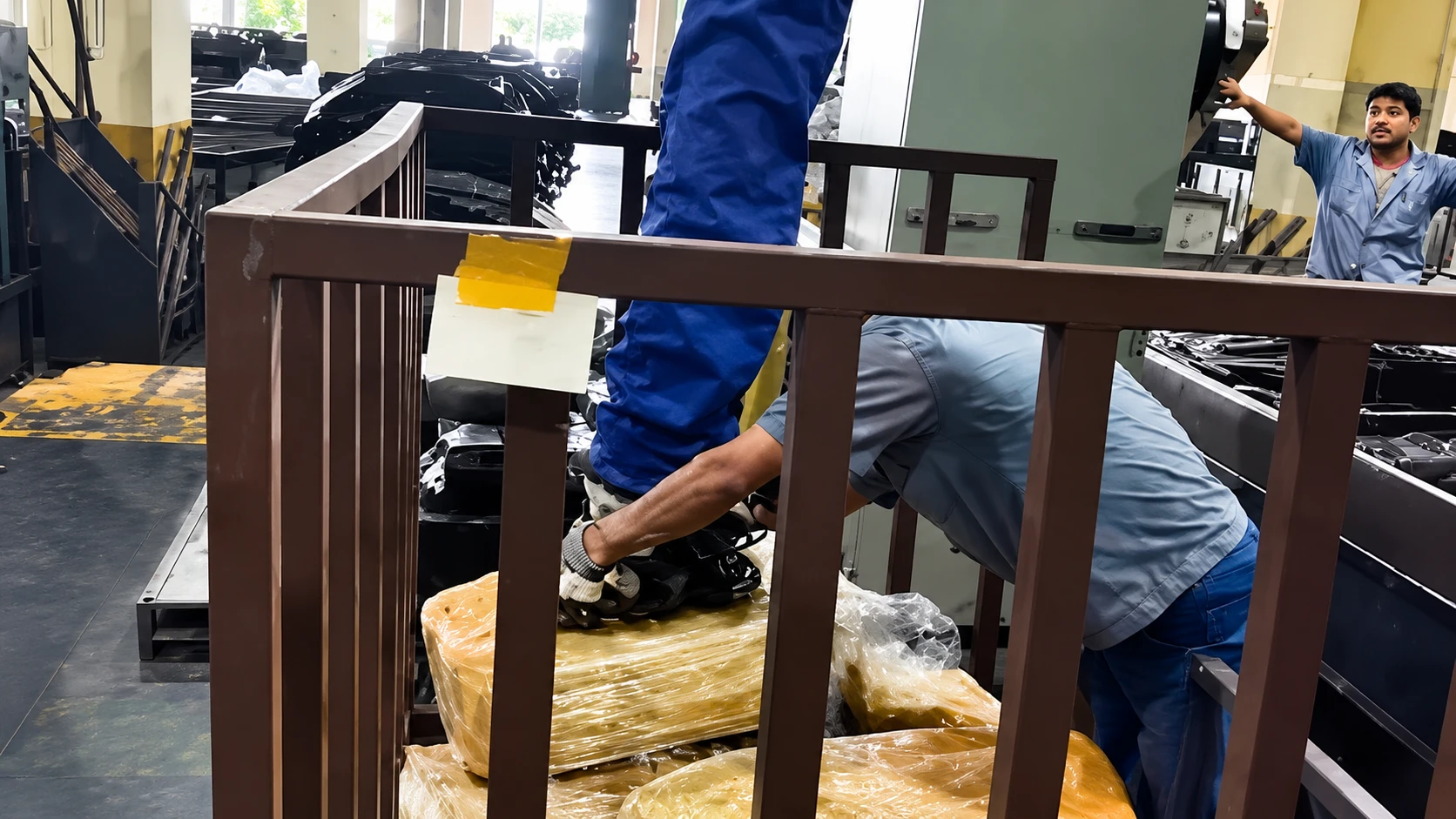
Video caption: WOLIFT vacuum tube lifter handling 30 kg rubber blocks for conveyor loading at a customer site in Spain. Project year: 2025.
Reported operating results
WOLIFT reports approximately 15 seconds for a loading cycle under this project's operating conditions. Actual cycle time depends on the worker, pickup position and handling sequence; it is not a guaranteed continuous production rate.
The customer reported reduced worker physical effort and lower staff turnover after the equipment was introduced. These are qualitative customer observations. No measured turnover percentage or controlled productivity comparison is presented.
Project cost: the supplied 2025 package
| Cost item | Historical project amount |
|---|---|
| Column jib crane and vacuum tube lifter package | USD 6,700 |
| Transport and insurance charge associated with the CIF shipment | USD 120 |
| Total of these disclosed charges | USD 6,820 |
These are the disclosed charges for this particular 2025 project. They are not a current standard quotation or a statement of the customer's complete landed or installed cost. New quotations depend on the configuration, destination and delivery scope.
Comparing this configuration with Schmalz and TAWI
Buyers considering European vacuum-handling suppliers can assess Schmalz JumboErgo/JumboSprint and TAWI lifting solutions alongside a WOLIFT project proposal. Schmalz publishes modular tube-lifter configurations whose specifications depend on the selected gripper. TAWI also describes rubber-bale handling applications. These are relevant product references, rather than systems known to have been quoted to this customer.
For this task, a useful comparison is based on the following requirements:
| Comparison point | Confirmed WOLIFT project | What to request from another supplier |
|---|---|---|
| Actual workpiece | Two types of 30 kg film-wrapped rubber block | Suitability assessment for both actual block surfaces |
| Gripper | One 120 × 315 mm multi-lip nitrile rubber cup | Selected gripper, seal material and representative contact test |
| Working envelope | Cup height 150–1,850 mm; 1,700 mm effective travel | Actual cup positions with the proposed suspension and tooling |
| Station coverage | 5 m jib serving both sides alternately | Floor-plan review and coverage of both pickup and placement positions |
| Operator adjustment | Loaded and unloaded hover settings | Controls and adjustment procedure for the quoted unit |
| Supply scope and cost | Jib and tube-lifter package; disclosed 2025 charges above | Itemised equipment, delivery, installation and service scope |
This comparison does not establish equivalent configurations, a lower competing price or a performance ranking. No competing project quotation was supplied. The practical purchasing question is whether the complete proposed system fits the block surface, operating heights and two-side workflow.
Frequently asked questions
Can one vacuum tube lifter handle both rubber materials?
In this installation, both black and yellow blocks weigh 30 kg and are handled with the same selected cup. Other compounds or packaging conditions require their own contact review.
Does the uneven block surface prevent vacuum lifting?
Not necessarily. The multi-lip cup was selected to accommodate the surface condition in this project. Actual seal quality still depends on the film, surface shape and contact position.
Can both workers use the lifter at the same time?
They use it alternately. After a block is placed and released, the unloaded control handle is passed to the worker on the opposite side.
Is 1,850 mm the lifting stroke?
No. It is the maximum suction-cup height above the floor. The minimum position is 150 mm, so the effective travel is 1,700 mm.
Is the 15-second loading cycle guaranteed?
No. It is an approximate project operating figure. Worker speed, cage access, block position and transfer distance affect the cycle.
Discuss a similar rubber or bag handling task
This project shows how a configured tube-lifting system can handle a film-covered rubber block. WOLIFT's bag vacuum tube lifter range is a related starting point for sack and packaged-material handling; the gripper and rated configuration must be selected for the actual workpiece.
For station coverage, explore WOLIFT jib crane and rail systems. For an explanation of the lifting principle, read what a vacuum tube lifter is and how it works.
Send photos of both block types, actual weights, film condition, cage dimensions, conveyor height and a floor plan of the loading area. Contact WOLIFT for a configuration review.
Discuss a similar handling requirement
Share the workpiece data and site conditions for an initial engineering review.