

What Is a Vacuum Tube Lifter? How It Works, Applications and Selection Guide
A vacuum tube lifter combines vacuum gripping and vacuum-powered vertical movement in one manually guided system. This guide explains how the equipment works, which loads it can handle, what can prevent a reliable lift, and what information is needed to select a suitable WOLIFT configuration.
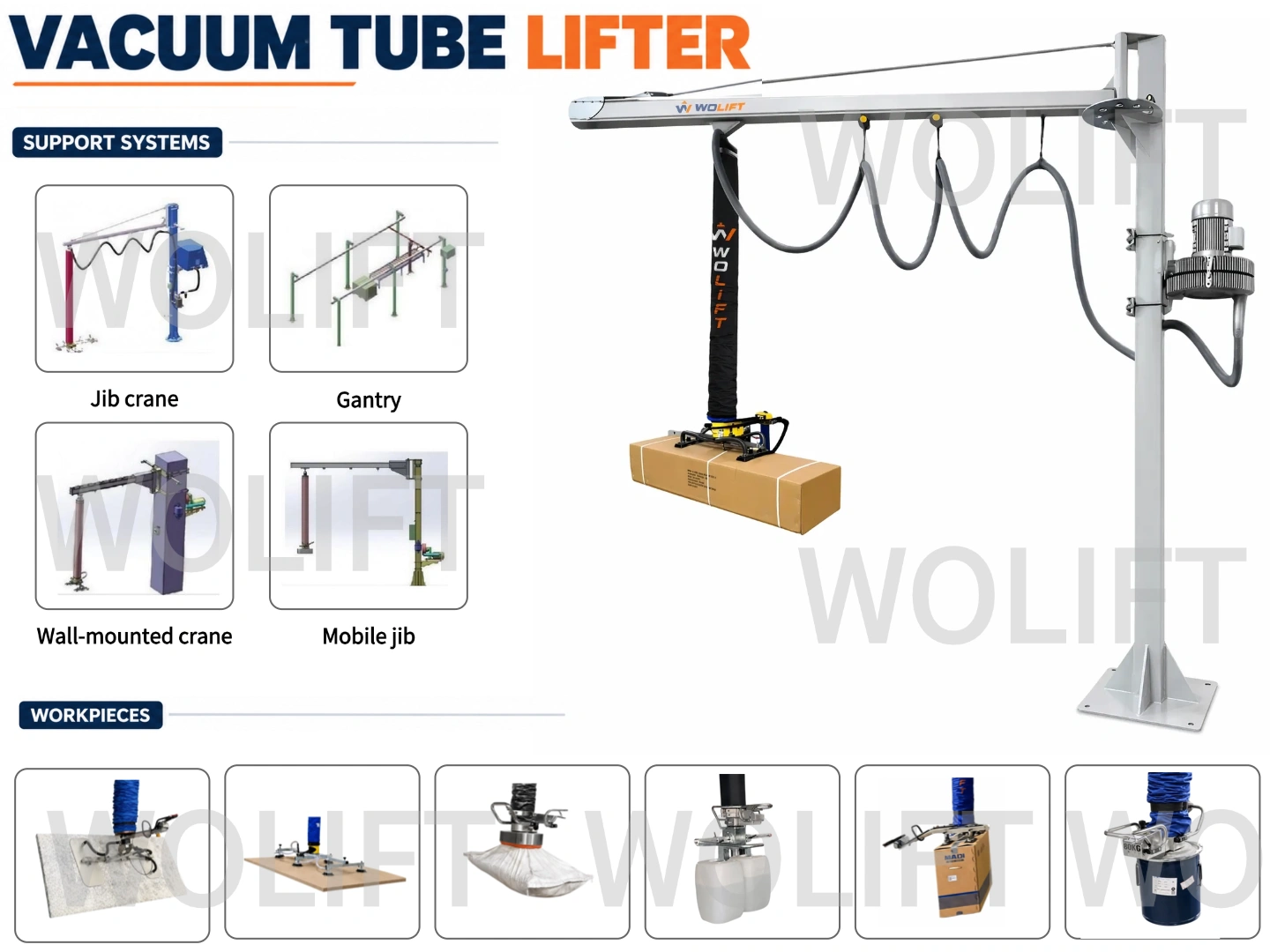
Typical loadsBags, boxes, boards and drums
Published range30 kg to 250 kg
Vertical motionVacuum-powered lifting tube
Support optionsJib crane, gantry or overhead rail
What is a vacuum tube lifter?
A vacuum tube lifter is an operator-controlled device that uses vacuum to grip a workpiece and a flexible lifting tube to raise and lower it. Suspended from a suitable jib crane or overhead rail system, it helps an operator pick up, move and place loads repeatedly within a defined working area. The suction pad, vacuum source, lifting tube and support structure must be matched to the load and the workplace. Vacuum tube lifters are commonly used for cartons, sacks, boards and containers. They are particularly useful when the same handling task is repeated at a pallet, conveyor or workstation. A tube lifter is not automatically suitable for every material: surface leakage, package strength, load geometry and available suspension all affect whether it can be used safely.
In brief: A tube lifter combines vacuum gripping and vacuum-powered vertical motion in one manually guided system. A conventional vacuum lifting attachment may use vacuum to grip a load while a separate hoist provides its lifting motion.
How does a vacuum tube lifter work?
- A vacuum source creates suction in the system. The operator positions the gripper on a suitable contact area of the load.
- The gripper forms sufficient contact to hold the workpiece. The lifting tube contracts under vacuum, raising the load.
- The operator guides the suspended load through the crane or rail system's working area and controls its height with the handle.
- Controlled admission of air lets the tube extend and lowers the load. The gripper is released after the load has been placed and supported.
What problems can it help solve?
At packaging lines, warehouses and production stations, workers may repeatedly bend to pick up a bag or box, transfer it, and place it at a different height. A properly selected tube lifter can reduce the need to carry the full load by hand and make repeated transfers easier to control. It can also provide a useful handling method where lifting from the top is more practical than getting hands or forks beneath the workpiece. The benefit depends on the actual process. Cycle time, staffing, physical effort and damage rates should be measured on the customer's task before making numerical improvement claims. The equipment does not replace a site-specific lifting assessment, operator training or checks of the load and support structure.What makes a workpiece suitable or unsuitable?
A dependable lift needs an adequate contact area, sufficient suction for the actual leakage rate and a workpiece strong enough to be lifted at the selected contact points. A bag may crease or leak through its fabric; a box lid may flex; a board may be rough or bend; and a drum lid may not be designed to carry the filled container's weight. The gripping method must be assessed for the real item, including its heaviest loaded condition. Before use, check that the gripping surface is clean enough for the selected pad and that the load stays within the approved configuration. WOLIFT's tube lifter is designed to release a workpiece only after it has support beneath it. If power is interrupted, its vacuum retention function allows the suspended workpiece to descend gradually rather than dropping abruptly. The specific response depends on the installed configuration and operating condition; operators must follow the supplied instructions and keep clear of suspended loads. Do not exceed the confirmed load rating or assume that a suspended load can be held indefinitely during a failure.Which materials and industries use vacuum tube lifters?
| Workpiece | Typical task | Key selection question |
|---|---|---|
| Paper, woven or plastic bags | Sack palletizing, conveyor discharge, raw-material feeding | Can the bag surface seal sufficiently, and does the filled bag keep a stable shape? |
| Cartons and boxes | End-of-line packing, warehouse depalletizing, transfer between stations | Is the top panel strong enough, and does it provide a consistent pickup area? |
| Wood and selected cement products | Board stacking, CNC feeding, construction-material transfer | Can the surface be gripped reliably without excessive leakage or bending? |
| Drums, barrels, pails and buckets | Filling-line transfer, palletizing, warehouse movement | Where can the load be gripped, and is the lid, rim or contact surface strong enough? |
WOLIFT vacuum tube lifter product range
WOLIFT currently lists four application-specific product pages. These describe the intended workpieces and selection factors; the model table below is a series reference, not a promise that every model will handle every material at its listed maximum load.| Product page | Intended application | Points to verify |
|---|---|---|
| Vacuum Tube Lifters for Bags | Paper sacks, woven sacks and suitable plastic bags | Permeability, seams, fill level, wrinkles and bag deformation |
| Vacuum Tube Lifters for Boxes | Cartons, packages and suitable box-type loads | Top-panel strength, box dimensions, leakage and product mix |
| Vacuum Tube Lifters for Wood Boards and Cement Products | Wood panels, boards and selected cement products | Roughness, porosity, size, weight and bending risk |
| Vacuum Tube Lifters for Drums and Barrels | Suitable drums, barrels, buckets and pails | Lid or rim strength, diameter, centre of gravity and grip position |
Published model reference
The values below follow WOLIFT's current model table, which applies across its four vacuum tube lifter product applications. For models rated up to and including 65 kg, a 2,500 mm mounting height corresponds to a 1,750 mm tube stroke, and a 4,000 mm mounting height corresponds to a 2,750 mm stroke. For models rated above 65 kg, the corresponding strokes are 1,680 mm and 2,690 mm. Each tube configuration has a fixed extension ratio; its length can be shortened to suit the customer's required lifting height. The usable stroke of a shortened tube must be confirmed in the final design. Final capacity and configuration must also be checked against the actual workpiece and support system.| Model | Max. load (kg) | Tube diameter (mm) | Mounting height H (mm) | Max. stroke T (mm) | Lifting speed (m/min) |
|---|---|---|---|---|---|
| WO-QGDS-100 | 30 | 100 | 2500 / 4000 | 1750 / 2750 | 60 |
| WO-QGDS-120 | 45 | 120 | 2500 / 4000 | 1750 / 2750 | 60 |
| WO-QGDS-140 | 65 | 140 | 2500 / 4000 | 1750 / 2750 | 60 |
| WO-QGDS-160 | 85 | 160 | 2500 / 4000 | 1680 / 2690 | 50 |
| WO-QGDS-180 | 105 | 180 | 2500 / 4000 | 1680 / 2690 | 45 |
| WO-QGDS-200 | 130 | 200 | 2500 / 4000 | 1680 / 2690 | 35 |
| WO-QGDS-230 | 175 | 230 | 2500 / 4000 | 1680 / 2690 | 35 |
| WO-QGDS-250 | 205 | 250 | 2500 / 4000 | 1680 / 2690 | 35 |
| WO-QGDS-300 | 250 | 300 | 2500 / 4000 | 1680 / 2690 | 35 |
How should you select a tube lifter?
Start with the real workpiece, not just a target kilogram figure. Record the lightest and heaviest load; its dimensions; the intended pickup face; surface porosity, dust or moisture; package rigidity; and any variation from one load to the next. Porous surfaces such as some cardboard, fabric, bags or wood-based boards can leak air and need particular attention to gripper selection and vacuum flow. Next, map the movement: pickup and deposit heights, required horizontal reach, number of lifts per hour, available headroom and the chosen crane or rail structure. At mounting heights of 2,500 / 4,000 mm, the published strokes are 1,750 / 2,750 mm for models rated at 65 kg or less, and 1,680 / 2,690 mm for models rated above 65 kg. WOLIFT can shorten the lifting tube to meet a specified lifting height; the final available stroke is confirmed for the selected configuration. For bags, assess the filled product and its surface; for boxes, check the top panel and seal; for boards, check stiffness and contact areas; for drums, verify the actual lid, rim or other gripping feature. For standard applications, customers normally do not need to ship a sample. WOLIFT reviews the workpiece details using its experience with similar handling tasks and can source a comparable workpiece for testing when needed. Photos, dimensions and a description of the actual contact surface remain useful; testing with a comparable item does not automatically verify every property of the customer's workpiece.
Information to send WOLIFT: workpiece photos or drawings, material and surface, minimum and maximum weights and sizes, pickup and placement positions, handling frequency, site dimensions, available electrical supply, and any existing crane or rail system.
What does an installed system include?
WOLIFT supplies the complete system for the agreed task: a suitable lifting structure, vacuum tube lifter, matched suction gripper and operator control handle. The vacuum source is normally a vacuum pump or vacuum blower. According to the site and travel path, WOLIFT can recommend a column-mounted jib crane, mobile column-mounted jib crane, gantry or overhead rail system. The exact structure, power requirements, working radius and lifting height are specified for the customer's site.Four WOLIFT application examples
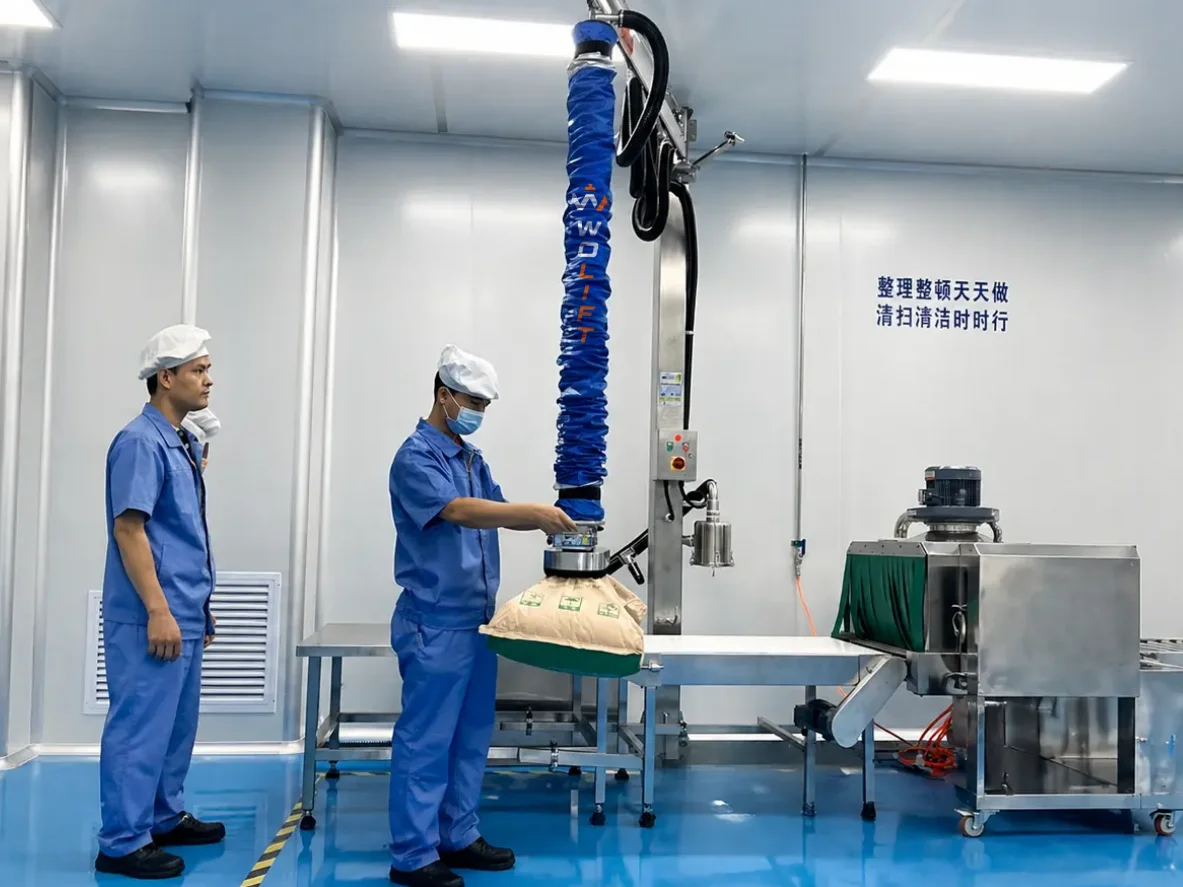
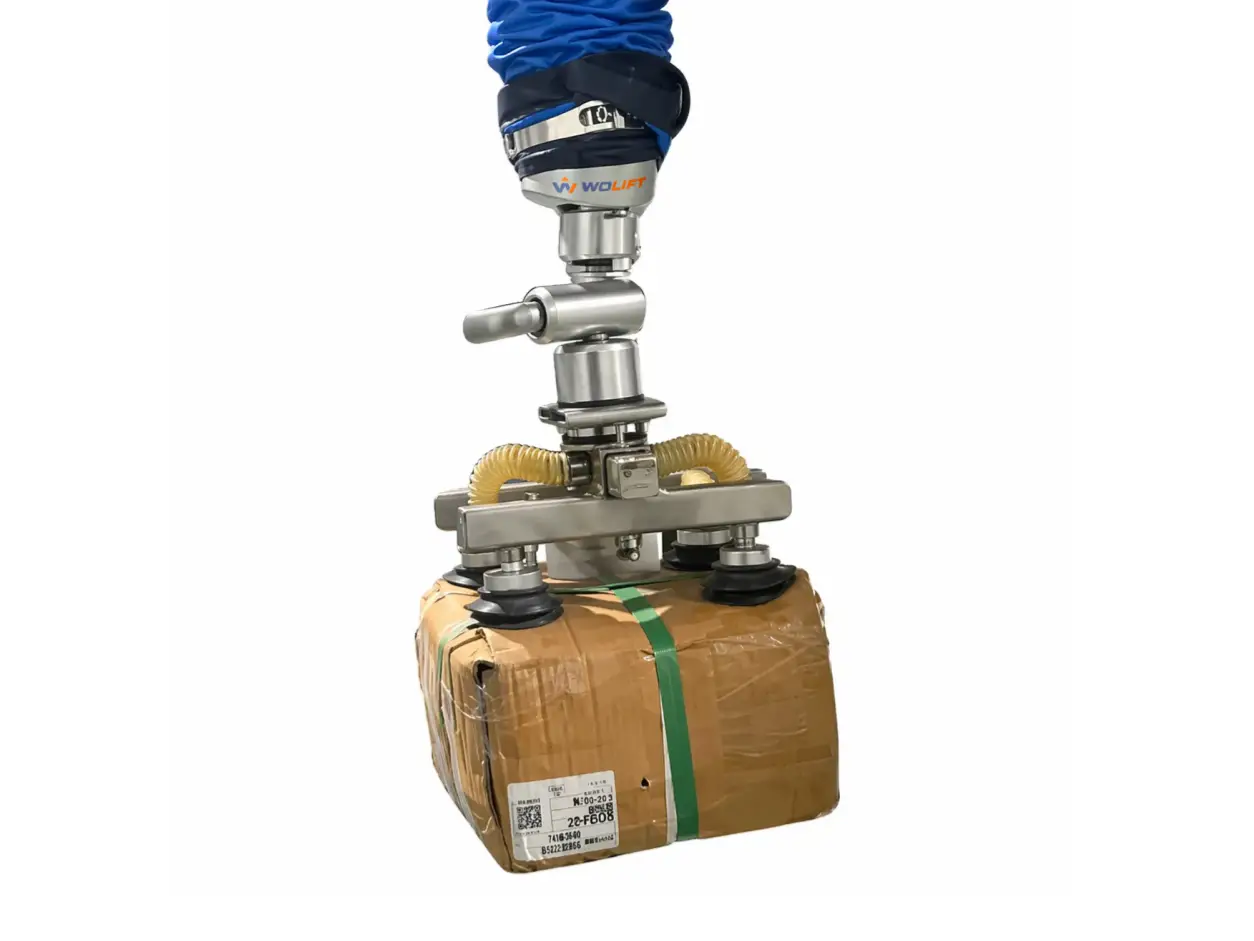
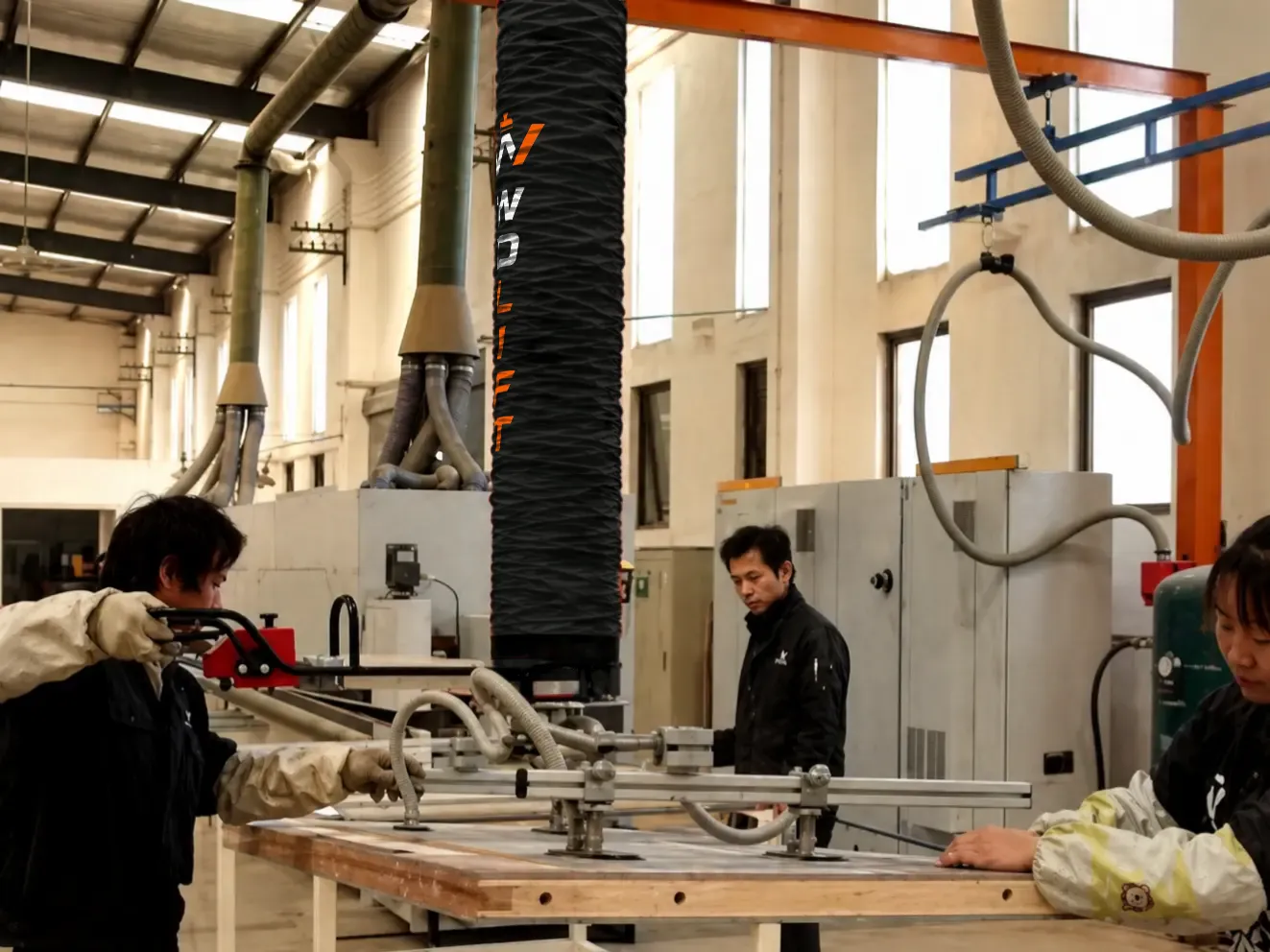
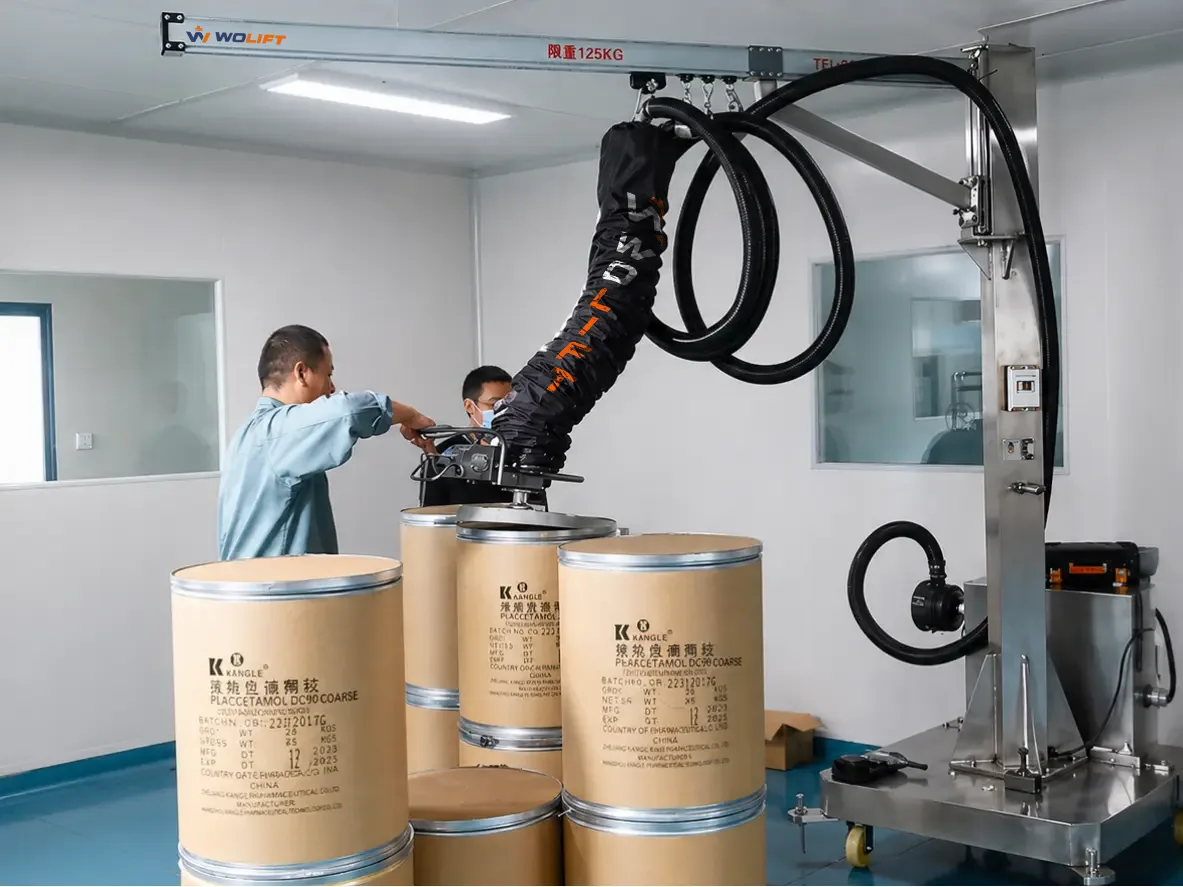
The following examples show four different grippers and workpieces. In all four examples, the workpiece is lifted and lowered vertically; the equipment is not performing a flipping or tilting operation. The stated weights describe the handled workpieces in these examples, not a maximum rating for each product family.50 kg bag: raw-material handling
100 kg carton: packaged equipment handling
100 kg wood board: workshop transfer
50 kg drum: pallet handling
Frequently asked questions
Is a vacuum tube lifter the same as a vacuum plate lifter?
No. In a tube lifter, the vacuum-supported lifting tube provides vertical motion as well as the vacuum gripper's holding function. Other vacuum lifting attachments may grip a workpiece while a separate hoist raises it. Selection depends on the load, required motion, work rate and installation.Can it lift a porous bag or board?
Sometimes, but permeability and surface condition can prevent a reliable grip. The pad and vacuum source must be assessed with a representative sample; a material label alone cannot confirm suitability.Can one model handle bags, boxes, boards and drums?
The published model table provides load and tube-size references. The gripper, vacuum supply and other configuration details still have to suit each workpiece. Do not assume a single suction pad works for all four materials.Does the tube lifter need a crane?
It needs a suitable suspended support arrangement, such as a correctly specified jib crane or overhead rail system. The choice depends on reach, travel path, building or floor structure and total supported load.What is the maximum WOLIFT tube lifter capacity?
The current published WO-QGDS series table lists models from 30 kg to 250 kg maximum load capacity. This is a model reference. Actual allowable load for a given material and configuration must be confirmed for the specific application.Discuss your handling task
To identify a suitable tube lifter, send WOLIFT the workpiece details, a photo of the pickup face, the load range and the transfer route. Explore the vacuum tube lifter range or request a handling solution.ENGINEERING SUPPORT
Contact WOLIFTDiscuss your handling requirement with WOLIFT
Share the workpiece data and site conditions for an initial engineering review.