

Telescopic Battery Vacuum Lifter for Laser Cutting Sheet Loading in Australia
2026 Australian customer project | Sheet metal fabrication | WO-BC2000(DC)
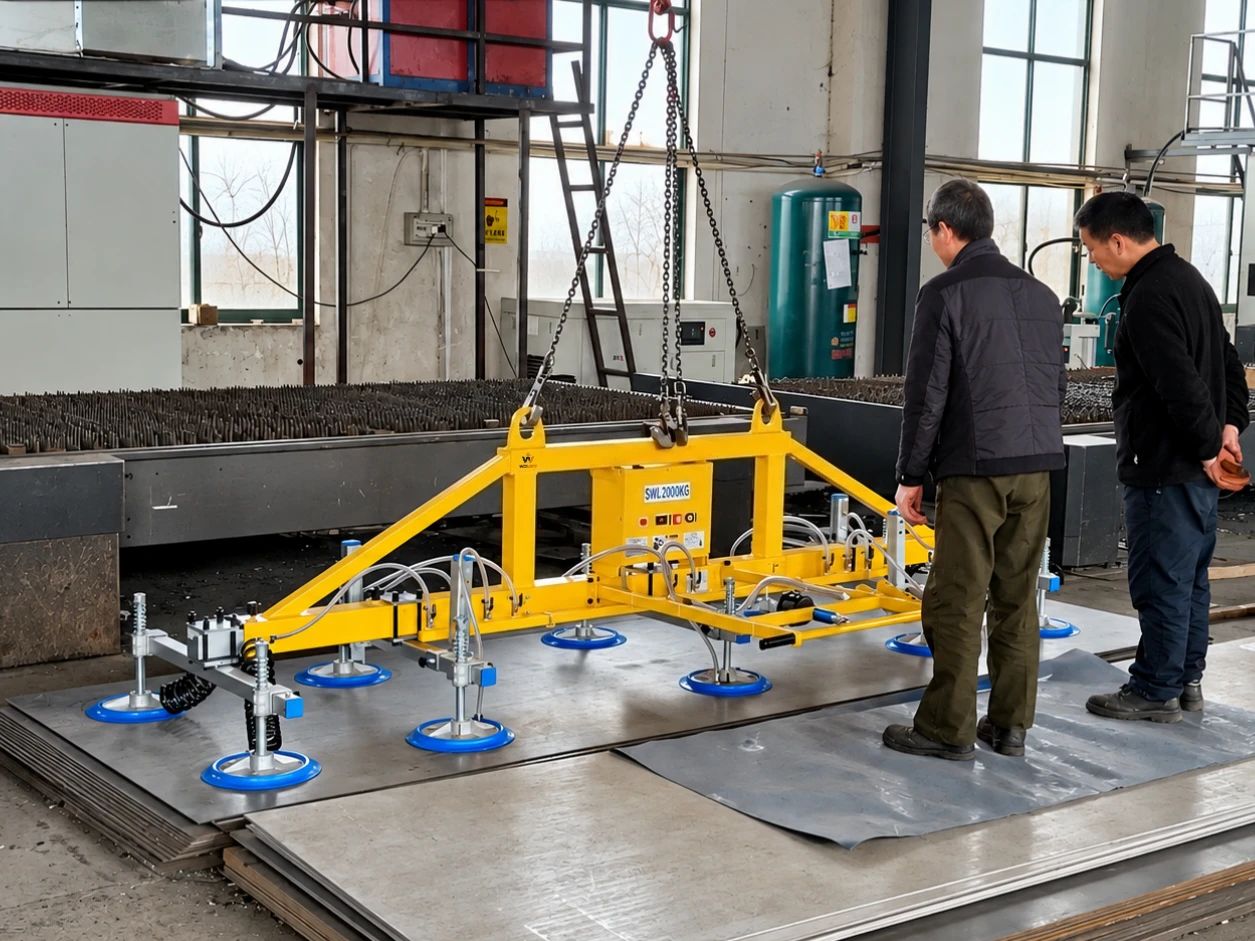
In 2026, we supplied a WO-BC2000(DC) battery-powered vacuum sheet lifter for a sheet metal fabricator in Australia. The customer needed to transfer carbon steel and stainless steel sheets from a stack onto a laser cutting table using an existing overhead crane. Their largest specified sheets measured up to 6,000 × 2,000 mm, with a maximum specified workpiece weight of 2,000 kg.
The key challenge was not the cutting speed. The customer wanted to replace the repeated work of attaching lifting hooks at four points, reduce the likelihood of marking stainless steel surfaces, and handle different sheet materials without depending on magnetic attraction. A high crane installation also made a moving power cable inconvenient.
We selected a battery-powered lifter with a telescopic beam, five crossbeams and ten individually controlled Ø300 mm suction cups. The battery system powers the vacuum pumps without an external electrical cable during normal lifting; the overhead crane still provides the lifting and travel movements.
Project at a glance
| Project detail | V01 configuration and application |
|---|---|
| Country / year | Australia / 2026 |
| Industry | Sheet metal fabrication |
| Application | Loading sheets onto a laser cutting machine |
| Workpiece materials | Carbon steel and stainless steel |
| Maximum specified sheet dimensions | 6,000 × 2,000 mm |
| Maximum specified workpiece weight | 2,000 kg |
| Vacuum lifter model | WO-BC2000(DC) |
| Nominal equipment capacity | 2,000 kg; operation is subject to the approved load configuration |
| Lifting and travel | Customer's existing overhead crane |
| Central beam section | 3,000 mm |
| Maximum extended beam length | 5,000 mm |
| Retracted length on supplied drawing | Approximately 3,300 mm |
| Frame width | Approximately 1,000 mm |
| Crossbeams | 5 (three on the centre section, one on each extension) |
| Vacuum cups | 10 × Ø300 mm, movable along crossbeams |
| Cup operation | Individual push-pull suction valves |
| Vacuum pumps | 2 diaphragm pumps, 2 m³/h each |
| Battery arrangement | Two 12 V, 15 Ah batteries; charger supplied |
| Vacuum monitoring | Digital vacuum display and audible/visual alarm |
| Reserve volume | Sealed lifting beam, with a non-return valve |
| Retention observation | 30-minute test while holding a carbon steel plate; pressure change depends on test conditions |
The customer's maximum workpiece weight and the model's nominal capacity are not proof that every sheet of that weight can be lifted under all conditions. The permitted load depends on the verified machine rating, effective cup contact, vacuum level, plate stiffness, load distribution and operating conditions.
The handling problem: four hooks and two different metals
The customer's previous method required workers to connect hooks at four lifting points before a plate could be transferred. Those extra steps made a routine loading operation unnecessarily cumbersome. They also introduced a surface-contact problem: hooks and their associated lifting hardware could scratch stainless steel sheets.
Magnetic lifting was not a straightforward replacement. Many grades of austenitic stainless steel are not suitable for conventional magnetic lifting, and magnetic lifting of stacked carbon steel can, in some arrangements, influence the sheet immediately below the intended load. Both issues matter in a workshop that regularly handles different metals.
Our objective was to provide a repeatable top-surface pickup process that the operator could use for the customer's range of sheets. We were not claiming to shorten the laser cutting cycle by a specific percentage; the more useful improvement was simplifying the sheet-loading sequence.
Why we chose battery power for an overhead-crane application
The workshop already had an overhead crane, but the crane was installed at a considerable height. Arranging a suitable moving electrical supply for an AC-powered vacuum attachment would have been inconvenient. A pneumatic attachment would likewise need a compressed-air connection.
With the battery system, the vacuum pumps are installed on the lifting unit itself. The operator can position the attachment using the overhead crane without routing a separate power cable down to the vacuum lifter. The crane carries the load; the batteries supply the vacuum-generation function.
For this project, we used two 2 m³/h diaphragm vacuum pumps and two 12 V, 15 Ah batteries with an external charger. In the equipment test reported for this project, both pumps were able to operate continuously for approximately eight hours. This is a reported continuous-pump test result, not a guaranteed eight-hour operating duration under every field condition. In normal pickup operations, establishing vacuum typically takes about 10–15 seconds; subsequent pump demand depends on the actual system state and leakage.
Telescopic beam: adjustable suction distribution for different sheet lengths
The customer's maximum sheet length was 6,000 mm. Rather than use a fixed beam for one sheet size, we supplied a telescopic frame built around a 3,000 mm central section. The two end sections can extend by up to 1,000 mm each, giving a 5,000 mm fully extended length. The supplied layout drawing marks approximately 3,300 mm in its retracted position.
The frame has five crossbeams: three along the central section, with one on each extension. This lets us spread the suction points over a greater length for larger sheets and bring them closer together for shorter sheets. Each cup can also be shifted along its crossbeam.
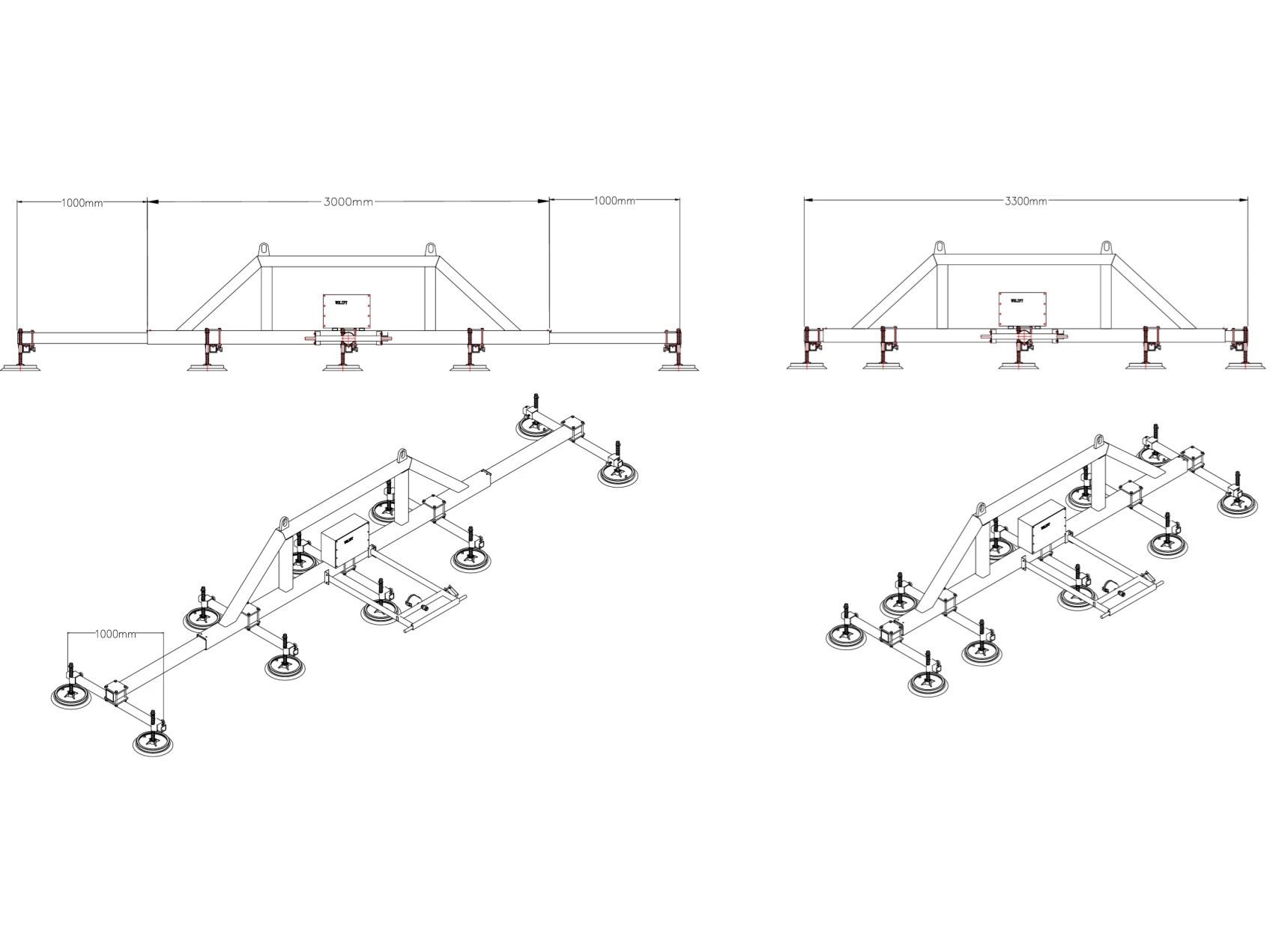
A 5,000 mm frame does not automatically make every 6,000 mm sheet safe to lift. For each plate, the critical questions are its thickness and bending stiffness, the distance between effective suction points, the overhang beyond the outer cups, the centre of gravity and the actual lifting load. These considerations determine the suitable extension and cup layout.
Ten Ø300 mm cups, independent valves and spring-mounted contact
The attachment has ten 300 mm diameter suction cups. Each cup can be repositioned along its crossbeam and controlled through its own manual push-pull valve. When the workpiece geometry changes, the operator can configure the contact points rather than necessarily engaging every cup in an unsuitable location.
At a nominal 60 kPa vacuum pressure difference, a 300 mm circular contact area develops approximately 4.24 kN of ideal theoretical holding force, equivalent to about 432 kgf. Applying a simple factor of two gives about 216 kgf per cup, which we round down to a 200 kg design reference per cup. This is not a stand-alone certification of the allowable load: effective sealing area, cup properties, oil, dust, plate stiffness, load share and dynamic forces must also be assessed. For the nominal 2,000 kg equipment capacity, the approved complete-machine configuration and test records govern.
The spring-mounted cup assemblies have two stages of compliance to help them settle against the plate and accommodate small height differences during contact. The springs do not correct an improperly positioned centre of gravity or compensate for substantial plate bending. We still advise placing the lifting frame as close as practicable to the load's centre of gravity and verifying suitable contact at all active cups.
Surface oil and dust: a selection and operating consideration
The customer handles carbon steel and stainless steel sheets that may carry oil or dust. These conditions directly influence the reliability of a vacuum seal. A plate can appear flat while contamination reduces effective contact, changes friction or causes leakage at the cup edge.
For this reason, our handling assessment considers the actual condition of the suction areas. Operators must inspect and, where necessary, clean the contact points before lifting. The required vacuum must be reached and confirmed before the crane raises the plate. A nominal lifting capacity should never be treated as proof that any heavily contaminated sheet is suitable for lifting without evaluation.
Monitoring, vacuum reserve and a loaded retention test
We included a digital vacuum indicator, an audible/visual alarm, a non-return valve and a sealed lifting beam that also serves as vacuum reserve volume. The indicator allows the operator to check the system state before and during a lift. The valve helps limit reverse flow when vacuum generation is interrupted, while the sealed beam provides a reserve that can delay loss of vacuum.
We also performed a 30-minute vacuum-retention observation with a carbon steel plate attached. The recorded vacuum indication changed by approximately ten scale units during that period. Because the available project notes do not identify the gauge unit, initial vacuum reading or test-plate mass, we do not present this number as a standardized leakage rate or guaranteed suspended-load holding time.
The operator must never regard vacuum retention as permission to stand beneath a suspended sheet or leave it hanging unattended. The load should be placed on stable support before suction is released, and the equipment should only be operated within its approved lifting conditions and procedures.
Site operation: transferring sheets onto the laser cutting bed
The project video was recorded during the customer's laser-loading operation in Australia. It shows the general workflow: the overhead crane brings the lifting frame over the sheet, the operator positions the cups and actuates the vacuum control, vacuum is checked, and the crane transports the sheet to the cutting table. Once the sheet is securely supported by the machine table, suction can be released.
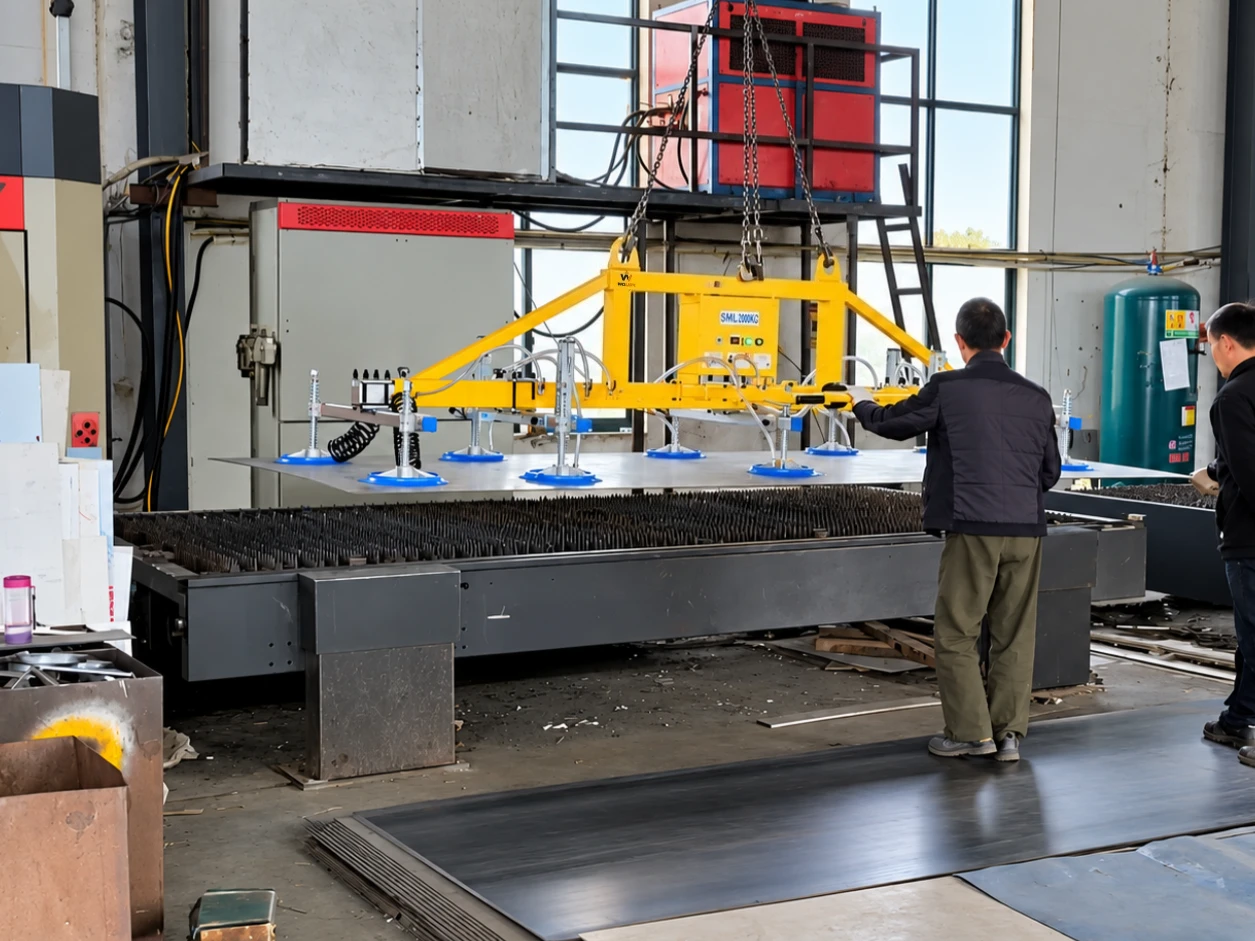
Compared with four-point hook attachment, this pickup method reduces the number of individual connections the operator has to make. The site footage demonstrates the handling method, but we have not claimed a measured production-speed improvement because no comparative cycle-time data was collected for this project.
Watch the equipment in operation
Engineering takeaways from the Australian project
This project illustrates why we select a sheet-handling attachment from the material mix and working route, not from rated capacity alone. The customer needed to lift both carbon steel and stainless steel, work with a high overhead crane, and handle multiple sheet sizes without repeated four-point hook connections.
The battery-powered system avoided the need for a moving electrical or compressed-air supply to the vacuum attachment. The telescopic beam and repositionable cups provided flexibility for different sheet formats, while the digital vacuum indication and reserve system supported operation within the specified lifting procedure.
This was a configuration of our existing WO-BC(DC) product family, rather than a newly developed special-purpose mechanism. The project-specific engineering work was selecting and arranging the system around the customer's materials, maximum sheet size, existing crane and loading workflow.
Questions buyers often ask
Can a battery vacuum lifter handle both carbon steel and stainless steel?
It can be suitable for both because vacuum gripping does not rely on the metal being magnetic. The actual sheet surface, weight, dimensions, stiffness and required suction arrangement still have to be reviewed.
Why not use magnetic lifting for this application?
The customer wanted to handle both carbon steel and stainless steel. Some stainless steel grades are not suited to conventional magnetic lifters, and stacked ferromagnetic sheets require careful assessment of possible attraction of the next sheet. Vacuum lifting was chosen for the mixed-material workflow.
Why extend the frame to 5,000 mm for a 6,000 mm sheet?
The beam length and the overall sheet length are not required to be identical. What matters is whether the effective suction layout adequately supports the particular sheet, including its thickness, bending stiffness, overhang, load and centre of gravity. The arrangement must be checked for the actual workpieces.
What happens if the vacuum pumps stop?
The non-return valve and sealed beam provide a vacuum retention function, and the monitoring/alarm arrangement informs the operator about the system state. These features do not eliminate the need for safe handling procedures or justify leaving a load suspended.
Does the lifting unit need an external power cable while it is working?
No. The vacuum pumps are battery-powered on the attachment. The existing overhead crane supplies lifting and travel movements.
Planning a similar laser-loading installation?
We manufacture battery, AC-electric and pneumatic vacuum lifting systems for sheet metal handling. If you are planning to load sheets onto a laser cutting machine, send us the material grades, maximum length and width, thickness range, maximum mass, surface condition, available overhead crane details and pickup-to-placement route. We can review the operating conditions and propose an appropriate suction configuration.
Product: Battery Vacuum Sheet Metal Lifter
More examples: Sheet Metal Handling Case Studies
Manufacturer: Shanghai Wolift Automation Equipment Co., Ltd. (WOLIFT)
Discuss a similar handling requirement
Share the workpiece data and site conditions for an initial engineering review.