


WOLIFT 1 Tonne Battery Vacuum Lifter for Laser Cutting Sheet Loading in Latvia
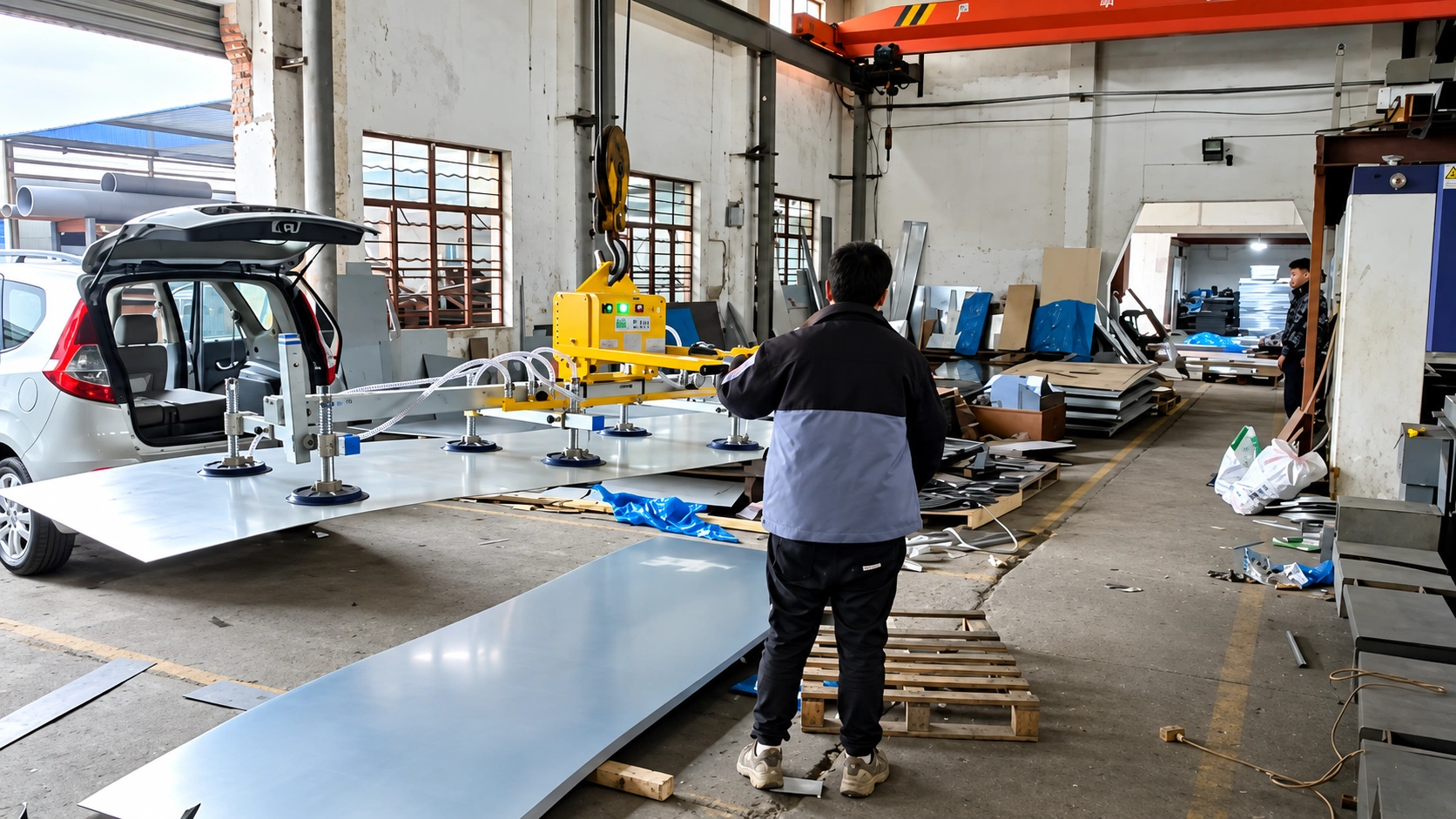
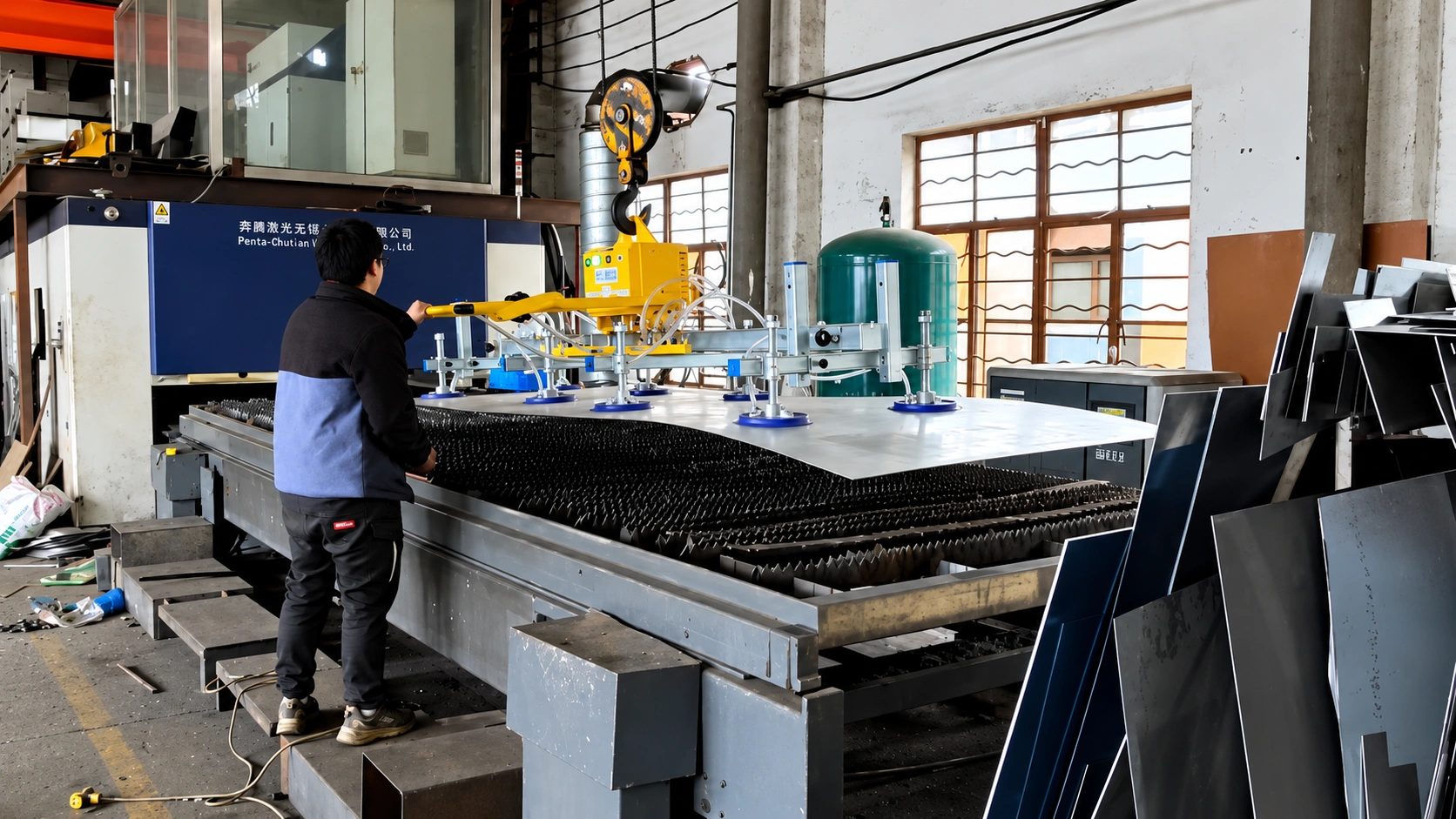
A machinery manufacturer in Latvia needed a practical way to transfer metal sheets from pallets to a 4020 laser cutting table. WOLIFT supplied a 1,000 kg rated battery vacuum lifter for use with the customer's overhead crane. The main described workpiece is a 3,000 × 1,500 mm stainless steel sheet weighing 1,000 kg, while the workshop also processes carbon steel and aluminium plates.
Project specifications
| Customer industry | Machinery manufacturing |
|---|---|
| Main workpiece | Stainless steel sheet, 3,000 × 1,500 mm, 1,000 kg |
| Other materials | Carbon steel and aluminium plates |
| Equipment model | WO-BC500DC |
| Rated load | 1,000 kg |
| Suction cups | 8 × Ø300 mm |
| Batteries | Two 12 V, 15 Ah batteries |
| Control | Manual suction and release |
| Release control | Self-locking slide valve |
| Supporting equipment | Customer's overhead crane |
| Laser cutting machine | 4020 |
| Safety features | Vacuum alarm, low-battery indication and vacuum retention |
| Reported work cycle | Approximately 60 sheets per eight-hour shift |
The challenge: moving sheets from pallets to the laser table
The customer previously used manual handling or hooks to load sheets. With stainless steel, carbon steel and aluminium plates moving through the workshop, the team needed a top-gripping method that could lift a sheet from the pallet, travel with the overhead crane and place it accurately on the laser cutting table.
The vacuum attachment also needed to operate without a trailing external power cable during normal loading. At the same time, suitability still had to be confirmed for each plate's weight, dimensions, stiffness, surface condition and available suction-cup contact areas.
The WOLIFT solution: a 1 tonne battery vacuum lifter
WOLIFT supplied a battery-powered sheet metal vacuum lifter equipped with eight Ø300 mm suction cups. The battery system powers the vacuum attachment, while the customer's overhead crane provides the lifting and travel movement.
The unit uses manual suction and release controls. A self-locking slide valve is used for release, helping prevent unintended operation. Cup positions and the contact surface must match the approved workpiece configuration, particularly when different materials and sheet sizes are handled.
Battery supply, vacuum monitoring and retention
The unit is equipped with two 12 V, 15 Ah batteries. It also includes a vacuum alarm and low-battery indication so operators can respond according to the operating instructions and site procedure.
In a project-specific test on a flat stainless steel surface, vacuum was retained for 24 hours after the power was switched off, without powered vacuum replenishment. This result applies to the tested conditions and is not a guarantee for every workpiece or permission to leave a load suspended unattended.
Battery power makes the vacuum attachment independent of a trailing power cable; the overhead crane still raises and transfers the sheet.
Reported battery use in the customer's work cycle
The customer reported a work pattern of approximately 60 sheets per eight-hour shift. Under that project duty cycle, the unit was used over five working days without recharging, after which the battery indication remained at approximately 30%.
This does not mean the vacuum pump ran continuously for forty hours. Battery consumption can change with leakage, pump duty, plate surface, battery condition, ambient temperature and the number of handling cycles.
Case video: loading a 4020 laser cutting table
The video shows the handling sequence from gripping a sheet on the pallet to lifting and moving it with the overhead crane, positioning it on the 4020 laser cutting table and releasing it after placement. The weight of the particular sheet shown in the video has not been confirmed.
The result: simpler sheet loading without a trailing power cable
The battery-powered vacuum attachment gave the workshop a direct pallet-to-laser-table handling process using its existing overhead crane. It provided top-surface gripping for the approved sheet configurations while removing the need for hooks and an external vacuum power cable during normal loading.
The customer reported an approximately 20–30% improvement in loading efficiency compared with the previous process. This is customer feedback from this installation, not a controlled time-study result or a performance guarantee for other laser cutting stations. Browse more sheet metal handling solutions or contact WOLIFT for a project-specific review.
Questions buyers ask about a similar laser loading system
These are the practical questions production teams commonly need answered before selecting a battery vacuum lifter.
Does the battery lift the sheet without a crane?
No. In this installation the batteries supply the vacuum attachment, while the overhead crane raises and transfers the sheet. Battery power removes the need for a trailing power cable for the vacuum source during normal loading.
Can the same unit handle stainless steel, carbon steel and aluminium?
Vacuum gripping does not depend on magnetism, but each material and sheet condition still needs a suitability check. Cup contact, surface condition, weight, dimensions and stiffness must match the approved configuration.
Does the reported five-day battery result apply to every shift pattern?
No. It refers to this reported project pattern of roughly sixty sheets per eight-hour shift without recharging. A different sheet surface, leakage rate or pump duty can change battery consumption.
Does the 24-hour vacuum-retention result mean a sheet may be left hanging overnight?
No. The reported 24-hour power-off retention result applies only to the tested conditions. It does not authorize unattended or extended suspended-load storage. The equipment must be operated according to its instructions and site procedures.
Discuss a similar handling requirement
Share the workpiece data and site conditions for an initial engineering review.