

WOLIFT Glass Vacuum Suction Lifter for Waterjet Cutting Loading and Unloading
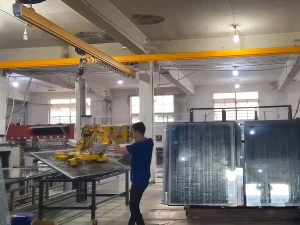
In glass processing workshops, loading and unloading after waterjet cutting can be slow, wet and physically demanding. WOLIFT provided a pneumatic glass vacuum suction lifter mounted on an overhead bridge crane to help one operator handle wet glass panels more safely and efficiently around the waterjet cutting station.
Application
Waterjet glass cutting
Material
Wet glass panels
Power source
Compressed air
Functions
90° tilting and 90° rotation
The challenge: wet glass handling after waterjet cutting
The customer mainly processes custom-shaped glass, with waterjet cutting as one of the core production steps. Before using WOLIFT equipment, moving glass panels on and off the cutting table required two to three workers, and large-format panels were especially difficult to control. After cutting, the glass surface often retains water. This makes manual handling slippery and increases the risk of edge chipping, operator injury and slow production cycles. The customer needed a solution that could work safely in wet conditions, keep the floor clear and follow the cutting pace.The solution: pneumatic suction lifter with overhead bridge crane
The final configuration combined an overhead bridge crane with the WOLIFT pneumatic glass vacuum suction lifter and a telescopic operating handle. The overhead bridge crane is ceiling mounted, with rails fixed to the roof structure. This keeps the floor free from columns or bases, allowing forklifts and operators to move through the workshop without obstruction. Workers can manually push the crane along the rails and position the lifter above the cutting table with light movement. The vacuum lifter is powered by compressed air. For a wet waterjet cutting environment, this is an important advantage because the suction lifter does not rely on exposed electrical circuits near wet glass surfaces. The air inlet is also equipped with a water-oil separator, helping discharge small amounts of moisture without affecting vacuum performance.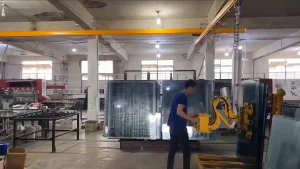
Telescopic handle for two operating modes
The lifter handle uses a telescopic design. When the glass is lying flat on the cutting table, the handle can be extended so the operator can control the lifter from a safer distance without bending over the cutting area. After the glass is lifted and needs to be tilted or positioned, the handle can be retracted into short-handle mode. This allows the operator to stand closer to the panel, apply force more naturally and control the tilting angle with better precision.The telescopic handle separates flat-table pickup and vertical positioning, making daily operation more natural for the worker.
90° tilting and rotation to match waterjet workflow
Waterjet cutting often requires glass panels to be turned, reoriented or transferred to the next process. The WOLIFT glass vacuum suction lifter supports 90° tilting and 90° rotation, allowing one operator to pick up a panel from horizontal position and tilt it to vertical position for transfer or storage on A-frames. The rotation function also helps adjust the glass orientation for following processes such as cutting, edging or temporary storage. Tilting and rotation are completed by the equipment, so the operator mainly guides and positions the load instead of manually lifting it.The result: faster loading cycle and safer wet glass handling
According to on-site feedback, the biggest improvement was the faster loading and unloading cycle. Previously, heavy glass panels required multiple workers to lift together. With the WOLIFT system, one operator can move the crane into position, pick up the glass, lift, tilt and transfer the panel. Once the cutting table is clear, the waterjet machine can start the next piece more quickly, reducing idle time. Safety also improved because wet glass no longer needs to be held directly by hand during the main lifting and tilting process.Case video
The video can show how the pneumatic glass vacuum suction lifter picks up wet glass from the waterjet cutting table, tilts the panel and transfers it with the overhead bridge crane. Use this module when your real on-site video is ready.RFQ questions for a similar glass handling solution
Before selecting a pneumatic glass vacuum suction lifter for waterjet cutting loading and unloading, customers usually need to confirm these points.Can the lifter work safely with wet glass surfaces?
Yes. Pneumatic suction is suitable for wet processing environments because the lifter is driven by compressed air and does not require exposed electrical circuits near the glass surface.Can the crane system avoid occupying workshop floor space?
Yes. A ceiling-mounted overhead bridge crane keeps the floor clear and can cover the loading path around the waterjet cutting table.Is one operator enough for loading and unloading?
For suitable glass size and weight, one operator can control pickup, lifting, tilting and transfer. Final selection depends on panel dimensions, weight and workshop layout.What information is needed for quotation?
Please provide maximum glass size, weight, surface condition, cutting table size, available compressed air supply, required tilting/rotation functions and crane installation conditions.ENGINEERING SUPPORT
Contact WOLIFTDiscuss a similar handling requirement
Share the workpiece data and site conditions for an initial engineering review.