

WOLIFT Vacuum Tube Lifter for Carton Palletising in Wood Product Packaging
In wood product packaging workshops, finished goods are often packed into cartons and stacked on pallets by hand. The cartons can be heavy, smooth and difficult to grip, while the outer box must remain clean and undamaged. WOLIFT provided a carton-dedicated vacuum tube lifter with an overhead bridge crane system to help one operator palletise packed wood products with less strain and more consistent handling.
The challenge: repeated carton lifting in the packing area
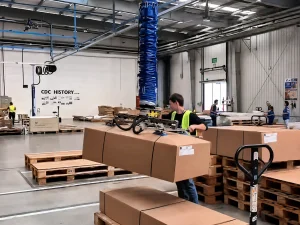
The customer manufactures wooden crafts and home accessories. After packaging, workers needed to move cartons from the packing table and case sealer to nearby palletising positions, then stack them layer by layer according to size. Carton weights ranged from a dozen kilograms to several tens of kilograms. Manual lifting caused sore backs and arms by the end of the shift, and the smooth carton surface gave workers few reliable handholds. Dropped cartons could damage the box, harm the products inside or create safety risks around the packing area.The solution: box vacuum lifter with overhead bridge crane
The final configuration combined an overhead bridge crane with a 100 kg WOLIFT vacuum tube lifter for boxes. The bridge rails were suspended from the factory ceiling and covered a working area of 9000 mm x 4000 mm. This ceiling-mounted layout kept the floor clear. There were no columns, bases or rail supports blocking forklifts, packing workers or material flow. The operator could pull the lifter above the packing table, case sealer or palletising position and complete the full carton handling route within one covered area. The travelling rails were made from aluminum alloy. For a large working span, this made daily movement lighter and smoother than a heavy steel rail system, so one worker could position the lifter without excessive pushing force.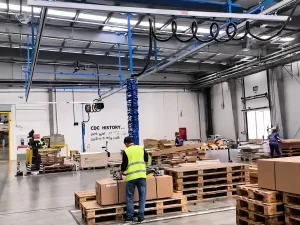
Frame suction cup layout for carton protection
Cartons are different from glass, steel plates or other rigid materials. Their surfaces have limited pressure resistance, and uneven suction can leave dents or deform the box. For this project, WOLIFT used a frame-type suction cup layout with four suction cups positioned near the carton corners. When a carton is lifted, the load is distributed across four contact points instead of concentrated in one area. This helps protect both the carton appearance and the wooden products inside. During trials, the customer tested cartons of different sizes, from smaller boxes to larger storage cartons, and the suction cups could be adjusted to match the carton dimensions.The four-cup frame layout helped the lifter hold cartons securely without crushing the box surface or damaging the products inside.
Hovering and pressure holding for safer palletising
The control logic is simple: lift, lower and release. Operators do not need long training, which is useful for packing areas where workers may change between shifts. The no-load and load-holding hovering functions are especially helpful during palletising. As the pallet stack grows from the first layer to higher layers, the operator can raise the carton to the right height, let the lifter hold position, then fine-tune placement before release. Safety was also important because the cartons contained wooden products, including fragile decorative pieces. The WOLIFT lifter includes a pressure-holding function. If air supply is interrupted or an abnormal condition occurs, the vacuum does not disappear instantly. The carton descends slowly instead of dropping suddenly, giving the operator time to guide it safely.The result: easier carton palletising with one operator
After installation, carton palletising in the packing area became easier and more continuous. Previously, two workers were often needed to carry and stack boxes. With the WOLIFT system, one operator can align the suction cups, lift the carton, move it to the palletising position, adjust height and release. The customer also reported fewer carton surface marks and less product damage caused by manual bumps or dropped boxes. For wood product packaging, this helps protect both the product and the final presentation of the carton before delivery.Case video
The video shows how the WOLIFT vacuum tube lifter for boxes supports carton pickup, transfer, hovering and palletising in a packaging area.RFQ questions for a similar carton handling solution
After seeing this carton palletising case, packaging teams usually ask these practical questions first.
Will the suction cups crush or mark our cartons?
The lifter can use a frame-type suction cup layout to spread the lifting force across the carton surface. For cartons with fragile products inside, WOLIFT checks carton size, surface strength and packed weight before selecting the suction head.
Can one operator really palletise cartons with this system?
For suitable carton weights and a covered working area, one operator can pick, move, hover and release cartons with the vacuum tube lifter. Final configuration depends on the heaviest carton and palletising height.
Can the crane cover our packing table, case sealer and pallet positions?
Yes, if the bridge crane is sized for the actual layout. WOLIFT confirms the distance between each workstation and designs the rail coverage so the lifter can move through the full packing route.
What happens if air pressure drops while a carton is lifted?
The system can be configured with pressure-holding safety so the carton does not drop suddenly. This is especially important when the cartons contain fragile or high-value products.
Discuss a similar handling requirement
Share the workpiece data and site conditions for an initial engineering review.