

35 kg Powder Bag Positioning for Mixer Loading in Greece
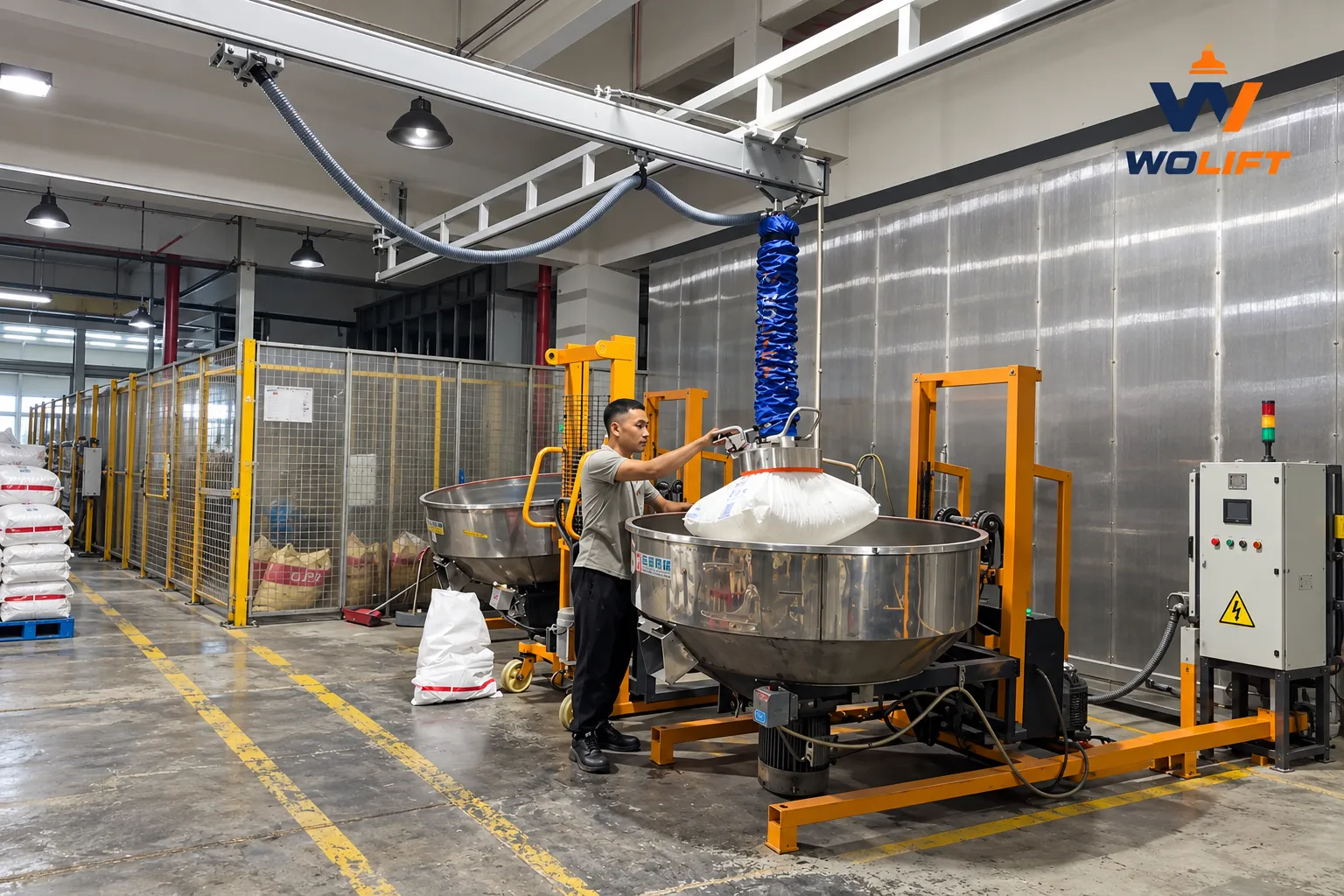
We supplied a WO-QGDD120 vacuum tube lifter to a rotational molding manufacturer in Greece to move 35 kg raw material bags from pallets to mixer loading positions. The factory produces plastic products and handles bagged materials including polyethylene powder, color pigments and additives such as antioxidants.
Our 2024 project uses an overhead bridge rail system serving four loading openings. A single oval suction head grips the bag while the operator guides it towards the selected mixer. The arrangement combines bag lifting and positioning with the customer's material preparation workflow.
The supplied project video demonstrates transfer and positioning over a loading opening. It does not show bag cutting or powder discharge. We report approximately 30–40 seconds for the complete bag loading operation, including opening and discharge.
Project specifications
| Item | Our project information |
|---|---|
| Customer industry | Rotational molding; plastic product manufacturing |
| Location / project year | Greece / 2024 |
| Materials handled | PE powder, color pigments and additives including antioxidants |
| Bag weight | 35 kg |
| Typical bag dimensions | 450 × 750 × 120–150 mm or 450 × 800 × 120–150 mm |
| Packaging | Lined woven bags, with folds; some materials involve dust |
| Handling task | Pallet-to-mixer bag transfer and positioning |
| Tube lifter | WO-QGDD120 |
| Rated lifting capacity | 50 kg |
| Suction head | One oval stainless steel head, 205 × 370 mm |
| Seal | Nitrile rubber |
| Vacuum source | Floor-mounted vacuum blower; nominal airflow 125 m³/h |
| Electrical supply | 400 V, 50 Hz |
| Support | Overhead bridge rail system |
| Fixed rails | European-profile rails; reported length 10,000 mm |
| Moving bridge rail | Aluminium; reported length 5,000 mm |
| Reported work area | Approximately 10,000 × 5,000 mm |
| Loading positions served | Four |
| Reported attachment | Chemical anchors to the overhead building structure |
| Mixer inlet height | Approximately 1,100 mm above floor |
| Pallet stack height | Approximately 1,400 mm including pallet |
| Suction head height range | Approximately 150–1,600 mm above floor |
| Effective vertical travel | Approximately 1,450 mm |
| Reported bag-bottom clearance at discharge position | Approximately 100–150 mm above the inlet |
| Bag alignment | 360° head rotation; no bag flipping required |
| Hover settings | Adjustable unloaded and loaded hover |
| Reported complete loading time | Approximately 30–40 seconds, including bag opening and discharge |
| Video demonstration | Transfer and positioning; no cutting or discharge shown |
Replacing manual carrying with assisted positioning
Workers previously carried the bags manually. The customer identified high physical effort and inconvenient handling as the main problems.
The vacuum tube lifter supports the filled bag while the operator guides pickup, movement and alignment. The overhead bridge arrangement allows the handling equipment to travel between the pallet area and the mixer loading positions.
This installation assists material transfer and positioning. It does not automatically weigh the ingredients, control the mixture recipe or operate the mixers.
Bag construction and suction contact
Typical bags measure approximately 450 × 750 mm or 450 × 800 mm, with reported thickness of 120–150 mm. They have liners and surface folds, and some materials involve dust.
We configured the equipment with an oval stainless steel suction head measuring 205 × 370 mm, fitted with a nitrile rubber seal. Selection should account for the actual contact surface, seams, folds, packaging condition and filled weight. A liner alone does not establish lifting suitability for every bag.
For another powder-handling application, assess the actual bags and the condition of the intended pickup area. See WOLIFT's vacuum tube lifters for bags for available handling configurations.
Overhead bridge rails serving four loading positions
Our supplied arrangement has European-profile fixed rails approximately 10,000 mm long and an aluminium moving bridge rail approximately 5,000 mm long. We configured the bridge rail system to serve four loading openings within a 10,000 × 5,000 mm working area.
The structure is reported to be attached overhead using chemical anchors. Rail travel, end stops, obstructions, building connections and suspended equipment geometry should be assessed together for another layout. The dimensions describe this project's reported arrangement rather than guarantee identical usable coverage in every building.
Serving four loading positions means the operator can move the lifting equipment to the selected position. It does not imply simultaneous handling at all four openings.
For supporting arrangements, see our crane systems.
Mixer height, bag sag and discharge clearance
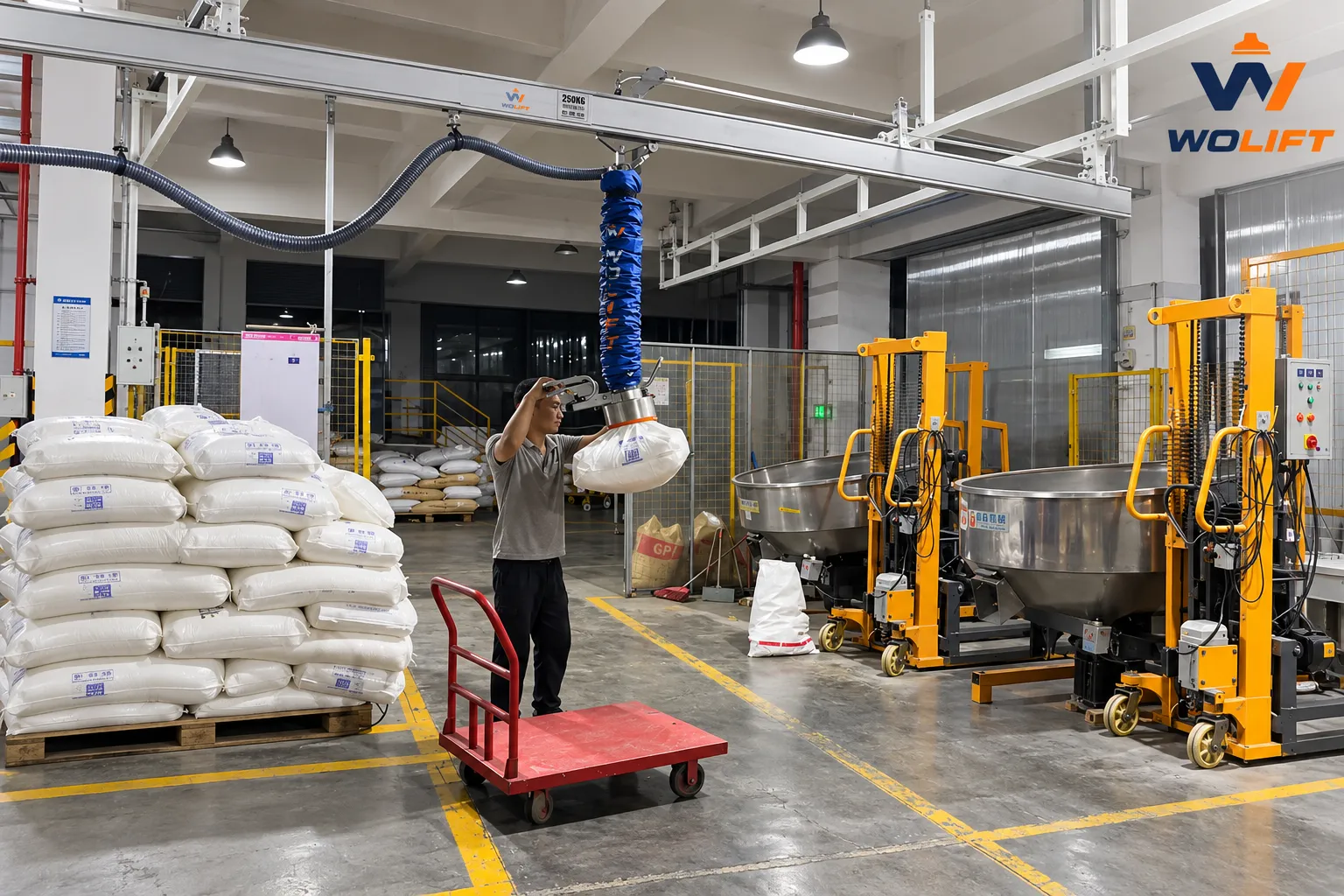
The reported pallet stack height is approximately 1,400 mm including the pallet, while the loading opening is approximately 1,100 mm above the floor. The suction head reaches approximately 1,600 mm above the floor.
We designed the arrangement for positioning the lifted bag over the mixer with its bottom approximately 100–150 mm above the inlet. We confirmed this 100–150 mm clearance with the bag suspended. The suction contact region stretches and the bag deforms during lifting and lowering, so its suspended depth differs from its thickness when resting on a pallet.
The short gap is intended to limit the distance powder falls into the mixer. This design intention should not be interpreted as evidence that dust is eliminated or as a measured reduction in airborne dust.
The project-specific bag opening workflow
We configured this project to allow suspended bag discharge. The bag remains attached to the suction head while it is opened over the mixer and its contents are discharged. The supplied video demonstrates positioning only; opening and discharge are described in our project information.
We set the discharge position at the configured upper lifting position. After the contents are discharged, the lifting arrangement is already at this upper position rather than having further upward travel available. This describes the project height setting; it does not imply an independently verified mechanical lock against upward movement. After discharge, the operator removes the empty bag from the suction head and collects it.
For another application, we assess the actual packaging, retained suction contact, changing load during discharge, operator access and the mixer interface before specifying a suspended bag opening arrangement.
The close discharge position is a geometric arrangement. Dust containment and extraction, where required by the material and site, need their own assessment.
Vertical travel and hover settings
The suction head range is approximately 150–1,600 mm above the floor. Subtracting the lower position from the upper position gives approximately 1,450 mm of vertical travel.
The head can rotate through 360° to align the bag. No bag flipping is required in the reported application.
Unloaded hover sets the resting position of the head and handle between operations. Loaded hover allows the operator to hold an attached bag at a selected working position while guiding it. Final operating settings need to account for bag geometry and the intended loading task.
Vacuum source and reported loading time
Our floor-mounted vacuum blower has a reported nominal airflow of 125 m³/h and uses a 400 V, 50 Hz supply. Nominal airflow describes the selected component rather than measured airflow at the bag surface.
We report approximately 30–40 seconds for a complete bag loading operation, including opening and material discharge. This figure is separate from the 58-second duration of the supplied video. The clip does not document that complete timed operation.
Actual output depends on bag opening, discharge behavior, material requirements, travel distance and operating pauses. The reported cycle should not be converted into a guaranteed sustained hourly rate.
Selecting a configuration for powder bag mixer loading
Select the suction head and lifting capacity for the actual filled bags, considering their weight, liners, folds, surface condition and available contact area.
Assess pallet height, mixer inlet height, suspended bag depth and rail coverage together. Confirm the intended bag opening method, operator position and behavior during discharge, as well as electrical compatibility and any required dust-control measures.
For a supported placement workflow, see our plastic pellet bag loading case in Vietnam, where the bag is placed on a platform before opening. The appropriate arrangement depends on the specific application.
Disclosed project cost
| Item | Historical project amount |
|---|---|
| Equipment, including bridge rail system | USD 6,900 |
| Disclosed CIF freight charge | USD 419 |
| Total of disclosed charges | USD 7,319 |
These amounts describe this 2024 project's quoted scope and shipping arrangement. They are not a current price list or a guaranteed final delivered cost for another destination. The applicable quotation should identify supplied equipment, installation scope and any additional destination services or charges.
Project demonstration video
The 58-second vertical project clip shows bag transfer and positioning above a loading opening. It does not show bag cutting or material discharge. The bag-opening workflow and complete loading time are based on our project information.
Frequently asked questions
What materials does the project handle?
The rotational molding factory handles 35 kg raw material bags. Reported materials include PE powder, color pigments and additives such as antioxidants.
How many mixer loading positions can the equipment reach?
We report four loading openings within the project's approximately 10,000 × 5,000 mm working area. The operator moves the equipment to the selected opening.
What is the effective vertical travel?
The suction head operates approximately 150–1,600 mm above floor, providing approximately 1,450 mm of travel. This is different from the maximum head height of 1,600 mm.
Does the video show complete powder feeding?
No. It shows transfer and positioning over the loading opening. Cutting and discharge are not shown.
Does a 100–150 mm discharge gap eliminate dust?
The short gap is intended to reduce powder drop distance. It does not establish dust-free operation or replace assessment of required containment and extraction.
What happens to the empty bag after discharge?
After the contents have been discharged, the operator removes the empty bag from the suction head and collects it.
Can any suction bag lifter be used for suspended bag opening?
No. The actual equipment, packaging and opening procedure must be assessed for retained contact, changing load, operator access and the mixer interface. This case describes a project-specific workflow.
Plan a similar mixer loading application
Explore our bag vacuum tube lifters and supporting crane systems. To assess a mixer loading workstation, contact WOLIFT with material and bag details, pallet and inlet heights, the opening method and the required loading positions.
Technical review: WOLIFT Engineering Team. Project year: 2024.
Discuss a similar handling requirement
Share the workpiece data and site conditions for an initial engineering review.