

25–30 kg Plastic Pellet Bag Loading with a Vacuum Tube Lifter in Vietnam
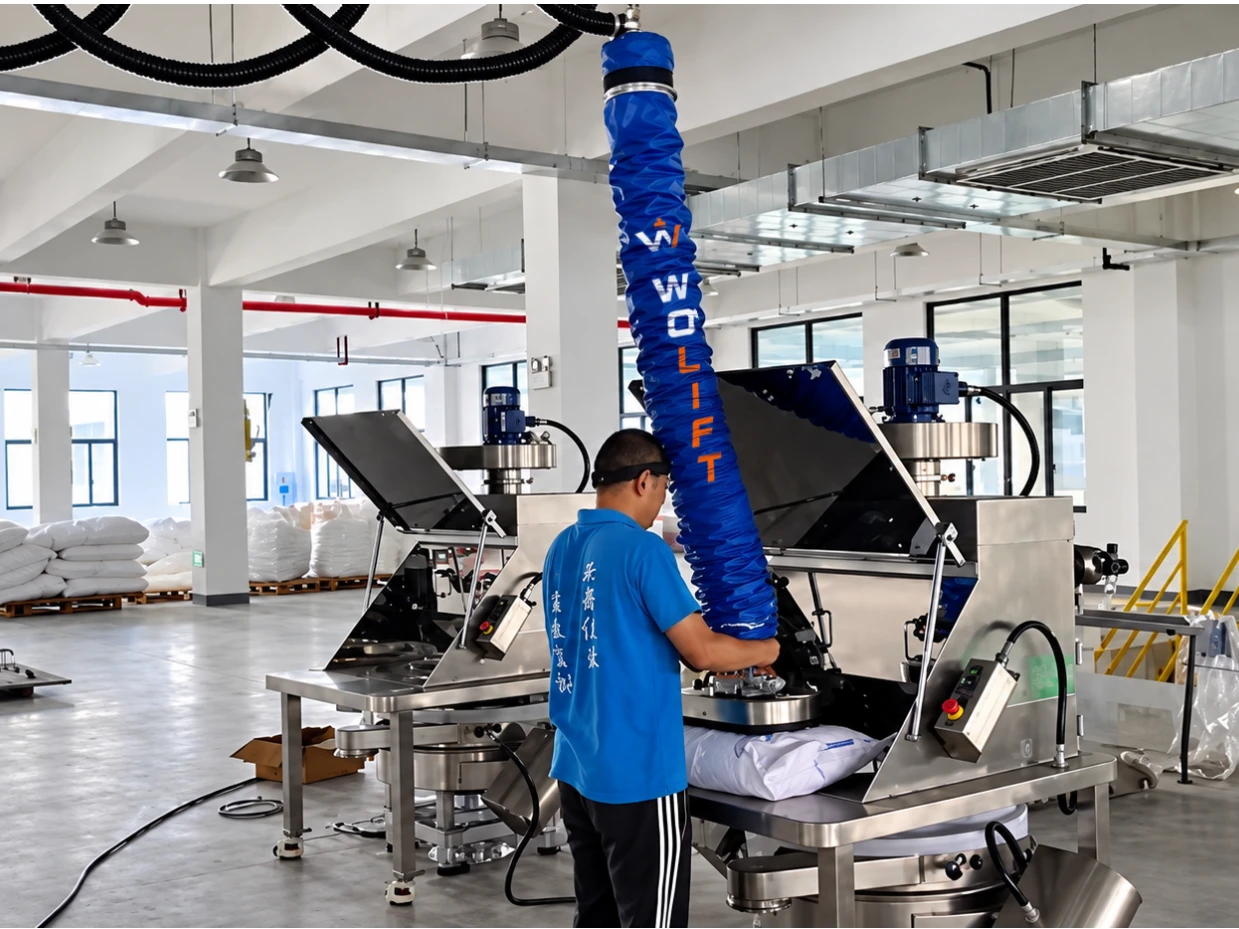
An injection molding factory in Vietnam selected a WOLIFT WO-QGDD120 vacuum tube lifter to transfer bags of plastic pellets from a pallet to a material loading platform. The 2025 installation handles bags weighing approximately 25–30 kg and uses a 50 kg rated lifting configuration with a single oval suction head.
The handling route is approximately 4,000 mm. Instead of carrying the bags manually, the operator guides them with the lifter and places them on a supported platform before opening them. WOLIFT reports approximately 25–30 seconds for an individual bag transfer. The factory's reported material supply requirement is approximately 50–60 bags per hour to support six injection molding machines.
Project specifications
| Item | Project information supplied by WOLIFT |
|---|---|
| Customer industry | Injection molding |
| Location / year | Vietnam / 2025 |
| Material | Plastic pellets in bags |
| Bag weight | Approximately 25–30 kg |
| Filled bag dimensions | Length 800–1,000 mm; width 450–550 mm; thickness 100–150 mm |
| Packaging | Lined bags; reported slight air permeability and surface folds |
| Handling task | Pallet-to-platform transfer before bag opening |
| Tube lifter model | WO-QGDD120 |
| Rated lifting capacity | 50 kg |
| Suction head | One oval stainless steel head, 175 × 275 mm |
| Seal | Nitrile rubber |
| Vacuum source | Vacuum blower; nominal airflow 135 m³/h |
| Electrical supply | 380 V, 50 Hz, three-phase |
| Reported supporting crane | Column jib crane with aluminium rail |
| Column height / arm length | 3,300 mm / 4,000 mm |
| Reported transfer distance | Approximately 4,000 mm |
| Loading opening height | Approximately 900 mm above floor |
| Reported pallet stack height | Approximately 1,600 mm, including pallet |
| Suction head height range | Approximately 200–1,900 mm above floor |
| Effective vertical travel | Approximately 1,700 mm |
| Orientation | Bag rotation required for placement |
| Hover settings | Adjustable unloaded and loaded hover |
| Reported individual transfer time | Approximately 25–30 seconds per bag |
| Reported operating requirement | Approximately 50–60 bags per hour supporting six machines |
The problem: carrying heavy material bags over a longer route
Workers previously carried the material bags manually over the transfer distance. The combination of bag weight and repeated carrying created high physical demands during material replenishment.
The selected lifting station assists the pallet-to-platform part of this process. The operator controls pickup, guided movement, alignment and placement. The case describes assisted bag handling rather than automatic conveying of loose plastic pellets into the injection molding machines.
Lined bags still require assessment of the actual contact surface
The customer's filled bags have liners, slight air permeability and visible folds. Their dimensions vary within the reported range, so the suction contact conditions can differ between bags.
The supplied oval head measures 175 × 275 mm and uses a nitrile rubber seal. Selection should consider the actual pickup area, folds, seams, outer packaging and the filled bag's shape. A liner alone does not establish that the complete bag assembly is airtight or suitable for a particular suction head.
The vacuum blower has a reported nominal airflow of 135 m³/h and uses 380 V, 50 Hz, three-phase power. Nominal airflow is a component specification, rather than a measurement at the bag surface or an independent lifting-capacity rating.
For other bag constructions or filled weights, see WOLIFT's vacuum tube lifters for bags.
Transfer first, open the bag on the platform
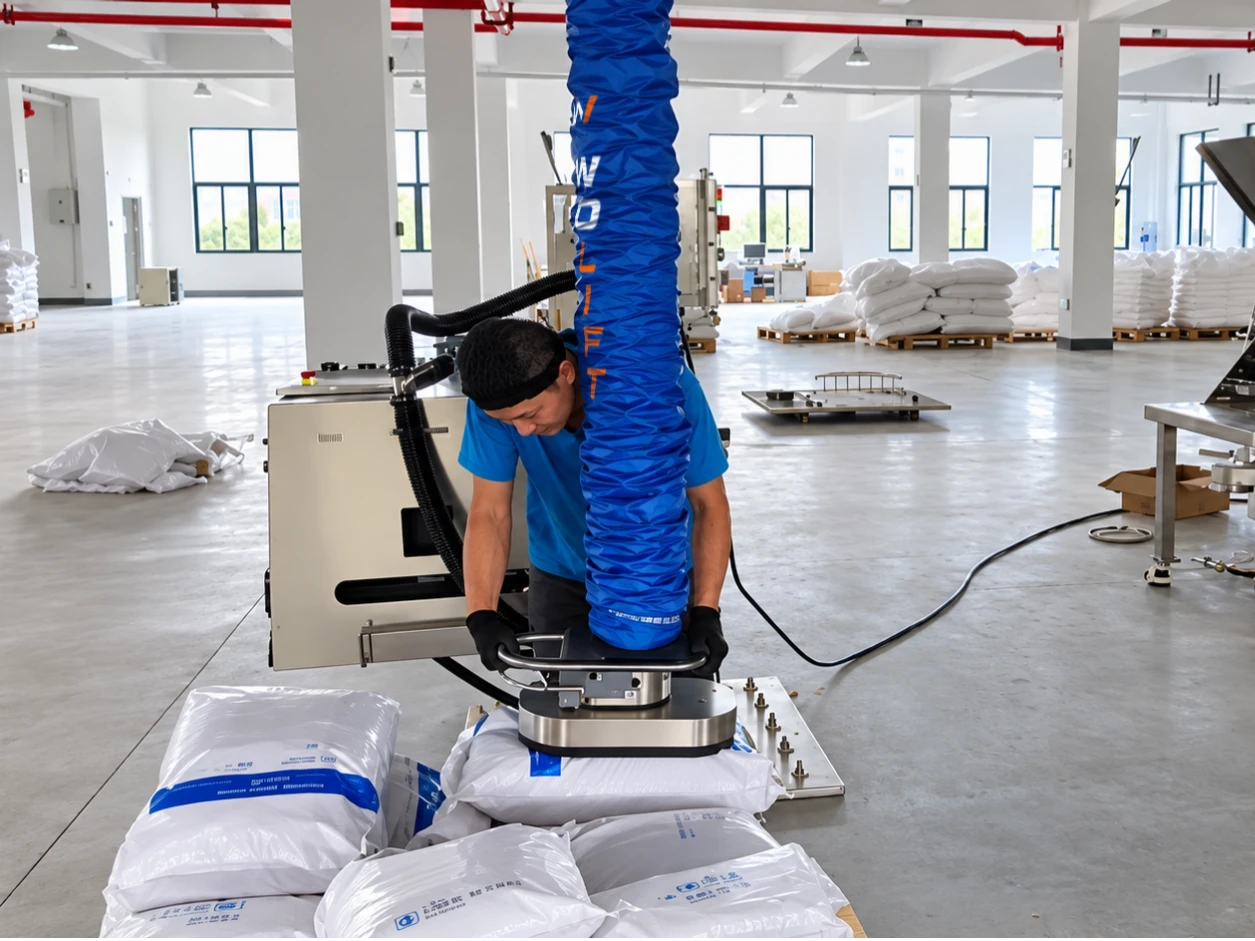
The customer describes the operating sequence as follows:
- Position the suction head on a suitable area of the filled bag.
- Establish suction and lift the bag clear of the pallet.
- Guide the bag towards the material loading platform, rotating it as needed for alignment.
- Lower the bag onto the platform and release the suction head once the bag is supported.
- Open the supported bag for the subsequent material feeding operation.
The loading opening is approximately 900 mm above the floor. The customer reports that the project video shows the complete bag placement sequence. This should not be presented as video evidence of a complete cutting, emptying or downstream material distribution cycle.
The platform provides a defined placement point before bag opening. The vacuum lifter's role in this case is transferring and positioning the intact bag; no suspended bag-cutting or powered bag-flipping operation has been specified.
Crane coverage and lifting clearance
The reported support arrangement is a column jib crane with a 3,300 mm column, a 4,000 mm arm and aluminium rail. The customer reports a transfer distance of approximately 4,000 mm.
Arm length and transfer distance are related layout information, but do not by themselves establish an unobstructed usable route. Crane position, suspended equipment geometry, pallet placement, machine access and operator movement all need to be considered when configuring a similar workstation.
The suction head operates from approximately 200 mm to 1,900 mm above the floor, providing approximately 1,700 mm of vertical travel. The reported pallet stack height is approximately 1,600 mm, including the pallet. Bag depth and sag below the suction head also affect the clearance available when moving a bag away from the stack.
For supporting equipment options, see WOLIFT's crane systems.
Hover settings for pickup and placement
The configuration provides adjustable unloaded and loaded hover positions. Unloaded hover sets the resting position of the head and handle between lifts. Loaded hover allows an attached bag to be held at a selected working position while the operator guides it.
These functions help adapt the handling position to the pallet and loading platform. Bag orientation is controlled by the operator as required for placement.
Transfer time and supply demand are different figures
WOLIFT reports approximately 25–30 seconds for an individual bag transfer. The factory's typical requirement is approximately 50–60 bag loading operations per hour to support six injection molding machines. The required supply frequency varies with the molded parts and material consumption.
The hourly figure describes operating demand, rather than the maximum throughput of the vacuum lifter. Likewise, dividing an hour by the individual transfer time would not establish a verified sustained handling capacity: opening bags, material feeding, pallet changes and other work can affect the overall process.
According to the supplied project information, the arrangement met the material loading needs of the six machines. No measured percentage improvement in productivity, reduction in staffing or reduction in injuries has been provided.
Disclosed project cost
| Item | Historical project amount |
|---|---|
| Equipment | USD 5,827 |
| Disclosed DDP transport charge | USD 560 |
| Total of disclosed charges | USD 6,387 |
These amounts describe this project's quoted supply and transport arrangement. They are not a current price list. A quotation for another destination should confirm the applicable scope, delivery location and included services.
Selecting a configuration for plastic pellet bag loading
Select the suction head and lifting capacity for the actual filled bags, considering their weight, packaging, folds and available contact area.
Assess the pallet height, loading platform height, transfer distance and crane coverage together. Provide a supported placement point for bag opening, and match the handling arrangement to the material supply frequency and electrical supply at the site.
Project video
The supplied 23-second project clip accompanies this case. The customer identifies the demonstrated action as bag transfer and placement at the loading platform. The project specifications and reported operating demand are WOLIFT-supplied information rather than measurements established by the clip alone.
Frequently asked questions
What material was handled in this project?
The factory handles plastic pellets in lined bags weighing approximately 25–30 kg. This is material loading for an injection molding application, rather than a powder packing-line case.
Does the operator cut the bag while it is suspended?
The reported sequence places the bag on a supported platform before opening it. The lifter transfers the intact bag to that placement point.
Can the system handle bags with folds and slight air permeability?
The supplied project uses an oval 175 × 275 mm head with a nitrile seal for the customer's lined bags. Suitability for another bag requires assessment of its actual contact surface, packaging, filled weight and vacuum configuration.
How long does a bag transfer take?
WOLIFT reports approximately 25–30 seconds per transfer. The site's separate operating requirement is approximately 50–60 bags per hour to support six machines; this is not a maximum throughput claim.
What heights were specified?
The loading opening is approximately 900 mm above floor. The suction head range is approximately 200–1,900 mm, and the pallet stack is approximately 1,600 mm high including the pallet. Clearance depends on the suspended bag geometry.
Plan a similar material loading station
Explore WOLIFT's bag vacuum tube lifters and supporting crane systems. For another production feeding layout, see the 30 kg rubber block loading case in Spain.
To assess a similar plastic pellet bag application, contact WOLIFT with bag details, pallet and loading heights, the transfer route and required supply frequency.
Project information supplied by WOLIFT. Technical review: WOLIFT Engineering Team. Project year: 2025.
Discuss a similar handling requirement
Share the workpiece data and site conditions for an initial engineering review.