

25 kg Pharmaceutical Raw Material Bag Loading in South Korea
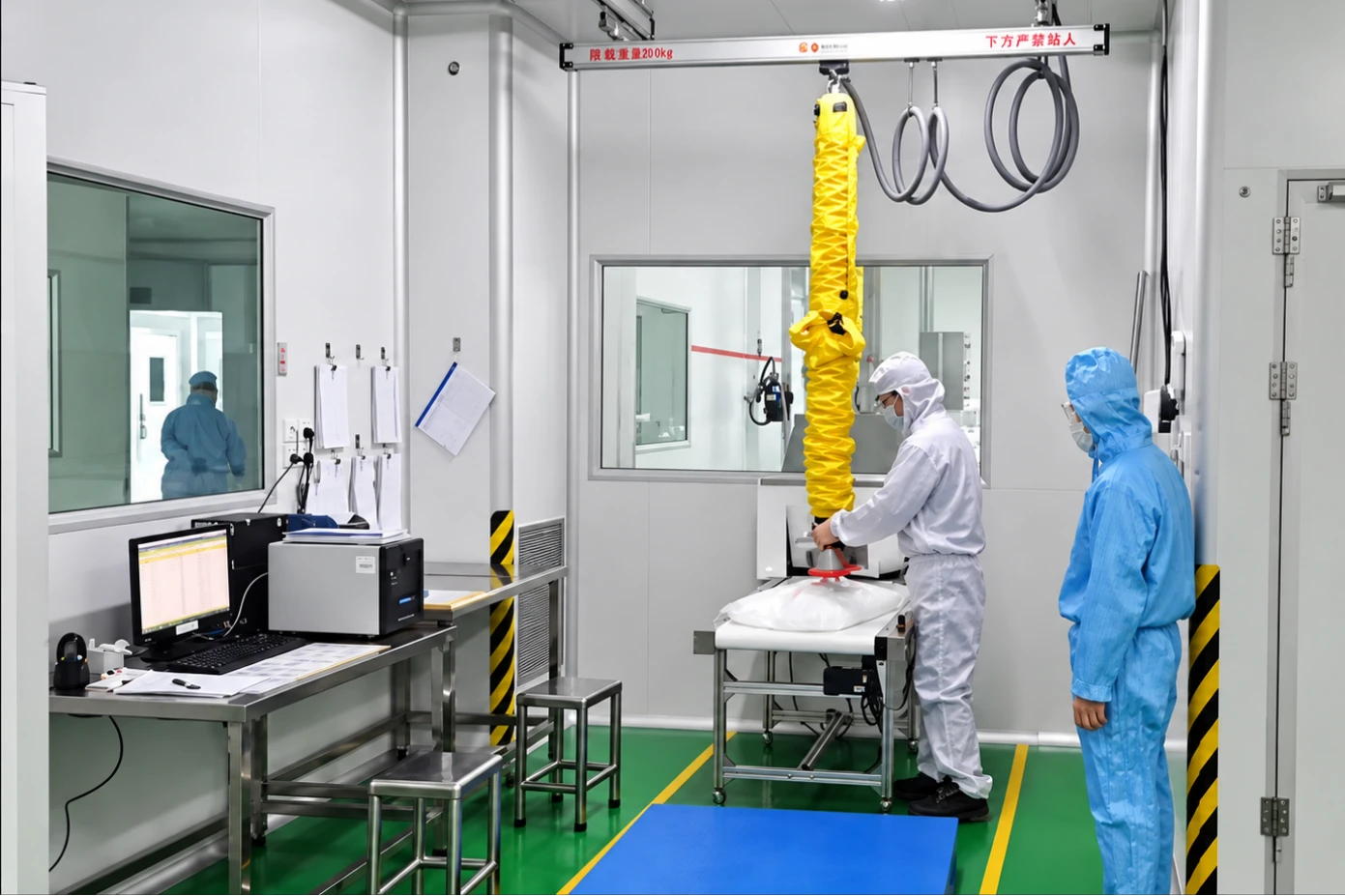
A pharmaceutical manufacturer in South Korea installed a WOLIFT WO-QGDD100 vacuum tube lifter to transfer 25 kg bags of pharmaceutical raw materials from pallets to a conveyor leading into a cleanroom. The 2024 project places the handling equipment outside the cleanroom entrance, in the material loading room.
The configuration uses a ceiling-mounted bridge rail system, a silicone suction cup and a floor-mounted vacuum blower. The operator guides each intact bag onto the conveyor and releases it after the bag is fully supported. WOLIFT reports approximately 30 seconds for a bag loading operation, while the customer reports that workers can complete the task with very little physical effort.
Project specifications
| Item | Project information supplied by WOLIFT |
|---|---|
| Industry | Pharmaceutical manufacturing |
| Location / year | South Korea / 2024 |
| Material | Bagged pharmaceutical raw materials |
| Installation location | Loading room outside the cleanroom entrance |
| Bag weight | 25 kg |
| Reported bag length × width | 650 × 850 mm |
| Packaging | Airtight plastic bag; no separate inner liner |
| Tube lifter model | WO-QGDD100 |
| Rated lifting capacity | 30 kg |
| Suction cup | One silicone cup, 90 × 200 mm |
| Cup material | Food-grade silicone, as specified by WOLIFT |
| Vacuum source | Floor-mounted vacuum blower; nominal airflow 125 m³/h |
| Electrical supply | 380 V, 60 Hz, three-phase |
| Support arrangement | Ceiling-mounted bridge rail system |
| Support materials | Stainless steel supporting structure; aluminium moving rail |
| Fixed rail length | 5,000 mm |
| Moving bridge rail length | 3,000 mm |
| Reported attachment | Chemical-anchor fastening to the overhead building structure |
| Conveyor height | 850 mm above floor |
| Pallet stack height | 1,200 mm including pallet |
| Suction cup height range | Approximately 100–1,600 mm above floor |
| Effective vertical travel | Approximately 1,500 mm |
| Suction cup rotation | 360° |
| Hover settings | Adjustable unloaded and loaded hover |
| Reported loading time | Approximately 30 seconds per bag |
| Video context | Customer-site commissioning |
Why the customer wanted lifting assistance
Workers wear protective clothing for the production environment. The customer reported that physical material handling made workers feel hot during the task. The project therefore focused on reducing the physical effort required to move filled bags to the entry conveyor.
The tube lifter supports the bag's weight while the operator guides pickup, movement and placement through the handle. This provides assistance for the transfer task; it does not automate the conveyor or the customer's subsequent raw material processing.
The equipment is outside the cleanroom entrance
The lifting station is located in the loading room outside the cleanroom entrance. The bags are transferred to the conveyor and enter intact. For this specific workflow, the customer reports that separate bag cleaning or outer-packaging removal is not required before entry.
This describes the customer's process rather than a general recommendation for pharmaceutical facilities. Packaging entry and cleaning procedures for another site need to follow that site's requirements.
The reported supporting structure is stainless steel, with aluminium moving rail. These material choices describe the supplied construction; they do not establish a cleanroom classification for the equipment or the room.
Silicone suction cup and bag contact
The project uses one 90 × 200 mm silicone suction cup. WOLIFT specifies the silicone as food-grade. The cup contacts the exterior of the sealed plastic bag during transfer rather than directly handling the raw material inside it.
The bag is reported to be airtight and has no separate inner liner. Selection should still consider the actual filled bag shape, folds, seams and contact area. Lifting clearance depends on the filled bag’s shape, depth and sag at the workstation.
Food-grade silicone is a material description for this supplied cup. It is not, by itself, evidence of pharmaceutical validation, a particular cleanroom class or certification of the complete lifting system.
For other packaging types and weights, see WOLIFT's vacuum tube lifters for bags.
Bridge rail coverage across the loading room
The supplied bridge arrangement has fixed rails approximately 5,000 mm long and a moving bridge rail approximately 3,000 mm long. WOLIFT reports that the installation covers the loading room, allowing the operator to move the lifter between the pallet pickup positions and the conveyor.
The stainless steel supporting structure is attached to the overhead building structure using chemical anchors, according to the project information. This is a description of the installation, rather than a universal anchoring specification. Another building requires its own assessment of the supporting structure and connections.
Rail lengths alone do not establish the exact usable floor coverage. End stops, trolley travel, obstructions, equipment geometry and the intended operator positions also affect reach.
For supporting arrangements, see WOLIFT's crane systems.
Pallet-to-conveyor transfer sequence
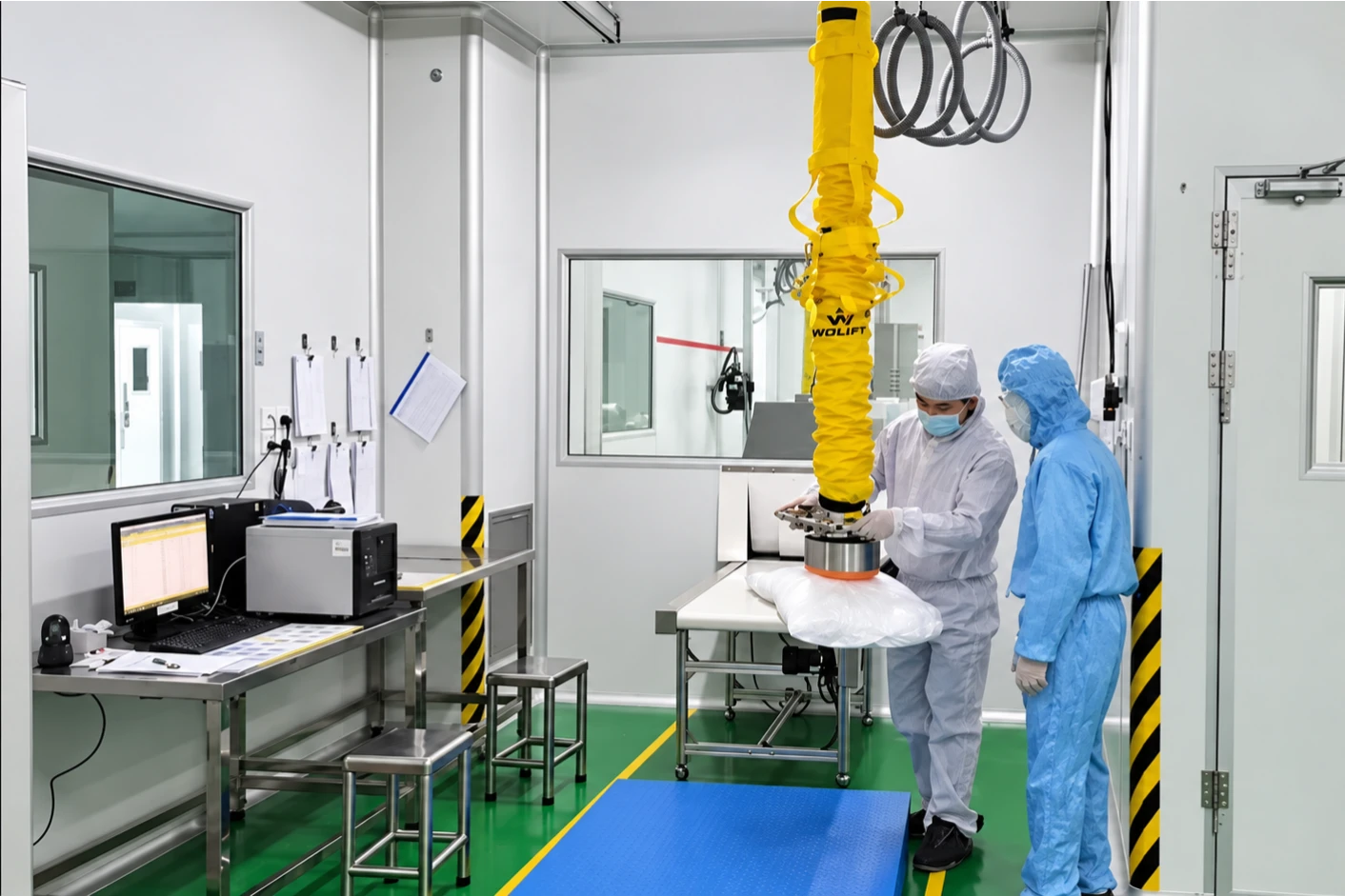
The operator positions the cup on the bag, establishes suction, lifts the bag clear of the pallet and guides it towards the entry conveyor. The cup can rotate through 360° to align the bag for placement.
The bag is lowered onto the conveyor, which is approximately 850 mm above the floor. The operator releases the cup after the complete bag is supported. The intact bag then continues through the customer's entry process.
Lifting height and hover adjustment
The reported suction cup range is approximately 100–1,600 mm above the floor, giving approximately 1,500 mm of effective vertical travel. The pallet stack height is approximately 1,200 mm including the pallet.
These are different measurements: suction cup height refers to the lifting contact point, whereas stack height refers to the top of the palletized bags. Bag sag and the clearance needed to move away from the stack affect the usable transfer conditions.
Unloaded hover allows the resting height of the cup and handle to be adjusted between lifts. Loaded hover allows an attached bag to be held at a selected working position while the operator guides the movement.
Vacuum source and electrical configuration
The vacuum blower is installed at floor level and has a nominal airflow of 125 m³/h. The reported electrical supply is 380 V, 60 Hz, three-phase.
Nominal airflow describes the blower configuration, rather than measured airflow at the bag contact point. Electrical compatibility, vacuum routing and the location of the vacuum source should be reviewed for each proposed installation.
Reported operation and customer feedback
WOLIFT reports approximately 30 seconds for one bag loading operation. No sustained hourly throughput or complete shift record has been supplied, so this time should not be converted into a guaranteed hourly capacity.
The customer reports that workers need very little physical effort to complete the loading task. This is qualitative customer feedback; the case does not claim a measured reduction in heat exposure, injury rate or staffing.
Disclosed project cost
| Item | Historical project amount |
|---|---|
| Equipment | USD 7,186 |
| Disclosed CIF freight charge | USD 230 |
| Total of disclosed charges | USD 7,416 |
These figures relate to the quoted scope of this 2024 project. They are not a current price list or a guaranteed final delivered cost for another location. The applicable quotation should identify the supplied equipment, destination and additional services or charges.
Selecting a configuration for pharmaceutical bag transfer
WFor a similar application, assess the filled bag’s weight, packaging and suction contact area together with the pickup height, conveyor height and required rail coverage.
Confirm the suction cup material documentation, cleaning requirements and vacuum-source location against the facility’s procedures. The configuration should also account for whether handling takes place inside the cleanroom or in an external loading room.
Customer-site commissioning video
The supplied 41-second project clip was recorded during customer-site commissioning. It accompanies the transfer application described in this case. Specifications and customer feedback are supplied by WOLIFT; the clip alone does not establish sustained output or a cleanroom classification.
Frequently asked questions
Is the vacuum tube lifter installed inside the cleanroom?
The customer reports that it is installed in the loading room outside the cleanroom entrance. It transfers intact bags onto a conveyor leading into the cleanroom.
What material and bag weight does the project handle?
The project handles pharmaceutical raw materials in 25 kg airtight plastic bags, with reported length and width of 650 × 850 mm and no separate inner liner.
Does food-grade silicone mean the whole system is cleanroom-certified?
No. Food-grade silicone describes the specified cup material. A cleanroom classification or complete-system certification cannot be inferred from that material description.
How much vertical travel is available?
The cup operates approximately 100–1,600 mm above floor, giving approximately 1,500 mm of travel. Actual transfer clearance also depends on bag geometry and the workstation.
When is the bag released?
The operator releases it after it has been fully placed and supported on the conveyor.
What was the reported handling time?
WOLIFT reports approximately 30 seconds per loading operation. This is not a documented sustained hourly throughput figure.
Plan a similar bag transfer workstation
Explore WOLIFT's bag vacuum tube lifters and crane systems. For another pallet-to-loading-position workflow, see the plastic pellet bag loading case in Vietnam.
To assess a similar facility, contact WOLIFT with filled bag information, entry procedures, cleaning and material requirements, workstation layout and available overhead structure.
Project information supplied by WOLIFT. Technical review: WOLIFT Engineering Team. Project year: 2024.
Discuss a similar handling requirement
Share the workpiece data and site conditions for an initial engineering review.