


Mechanical Clamp Tube Lifter for 50 kg Bags: Factory Test for a France Order
WOLIFT tested a WO-QGDD120 tube lifter with a stainless steel mechanical bag clamp at its own factory in 2026 for an order destined for France. The customer's application is palletizing bags containing stamped metal parts, springs and related components.
The factory demonstration used a 50 kg bag and included gripping, guided movement with the articulated jib crane, and lowering the bag for release. WOLIFT reports approximately 20 seconds for a demonstrated handling cycle. The supplied video documents factory testing rather than operation at the French customer's premises.
In this configuration, the mechanical clamp grips the bag, while vacuum contracts the lifting tube to provide lifting assistance. The bag itself is not held by a suction seal.
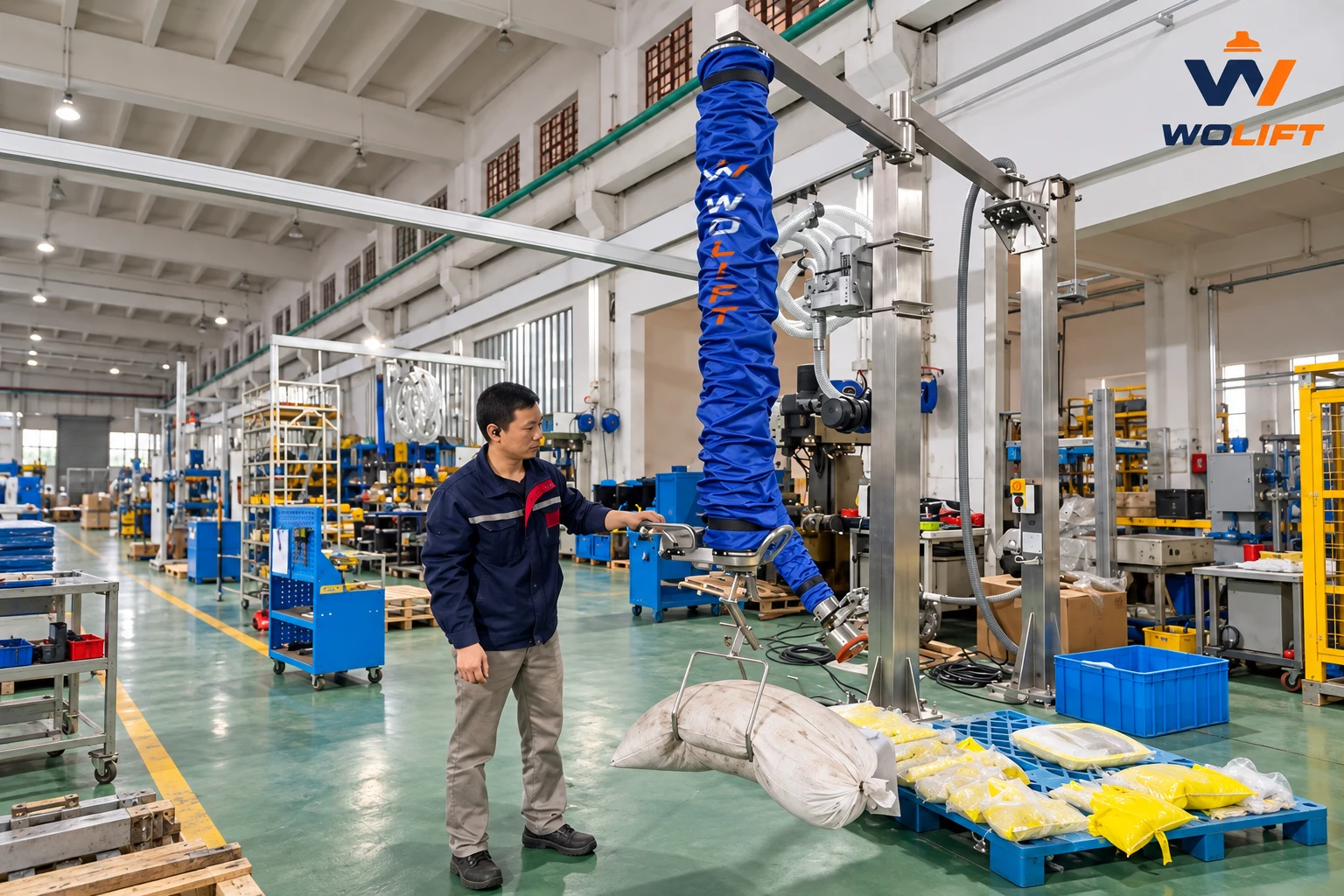
Test configuration
| Item | Information supplied by WOLIFT |
|---|---|
| Customer industry | Metal stamping and component manufacturing |
| Intended use | Bag palletizing |
| Bagged products | Stamped metal parts, springs and related components |
| Packaging | Mainly burlap sacks; plastic bags are also used |
| Order destination / project year | France / 2026 |
| Demonstration location | WOLIFT factory |
| Test bag weight | 50 kg |
| Tube lifter | WO-QGDD120 |
| Rated load | 50 kg for the configured equipment |
| Gripping tool | Stainless steel mechanical clamp around the bag body |
| Clamp mechanism | Rhombus linkage; load weight produces gripping force |
| Reported release condition | Bag must be supported so the load is removed from the gripping mechanism |
| Vacuum source | BECKER vacuum source; reported nominal airflow 195 m³/h |
| Vacuum function | Contracts the lifting tube to assist lifting |
| Supporting crane | Fixed column-mounted articulated jib crane |
| Arm configuration | Two 2,000 mm sections |
| Reported joint movement | Each section can swing through 270° |
| Nominal combined arm length | 4,000 mm |
| Reported lower / upper gripping position | Ground level / approximately 1,800 mm above floor |
| Bag orientation | 360° rotation available |
| Hover settings | Adjustable unloaded and loaded hover |
| Demonstrated sequence | Grip, lift, swing crane arms, lower and release |
| Reported test cycle | Approximately 20 seconds |
| Video | 43-second vertical factory demonstration |
Why the application uses a mechanical clamp
The customer primarily handles burlap sacks and also uses plastic bags. The application includes air-permeable packaging and irregular filled shapes. The bag openings are tied with cord. These characteristics can make suction contact and sealing more difficult, particularly when folds and varying filled shapes affect the pickup surface.
WOLIFT selected a mechanical clamp for this application. The clamp engages the bag body rather than relying on vacuum sealing against the exterior packaging. Selection still depends on the actual bag construction, load, geometry and the intended gripping position.
This case does not establish that suction lifting is unsuitable for every porous bag. For an application using a suction head and blower, see the warehouse bag handling case in Spain. The appropriate method should be assessed using the actual filled bags.
How the clamp and vacuum lifting tube work together
The stainless steel clamp uses a rhombus linkage. According to WOLIFT's design description, the suspended bag's weight produces the gripping force through the linkage. The clamp surrounds and grips the bag body; it is not a suction cup or a bag-mouth hook.
When the bag is lowered onto a supporting surface, the load acting on the mechanism is removed and the gripping force reduces, allowing release. WOLIFT reports that the mechanism is designed to release only when the bag is supported on the floor or another receiving surface.
The supplied BECKER vacuum source has a reported nominal airflow of 195 m³/h. Vacuum serves a separate function: it contracts the lifting tube and provides lifting assistance. This explains why a vacuum tube lifter can be paired with a mechanical gripping tool even though the bag surface does not provide the lifting seal.
WOLIFT reports no material packaging damage from the described test. This result concerns the tested bag and gripping arrangement; suitability for different packaging and contents requires assessment of their actual condition.
For the wider equipment range, see WOLIFT's vacuum tube lifters for bags.
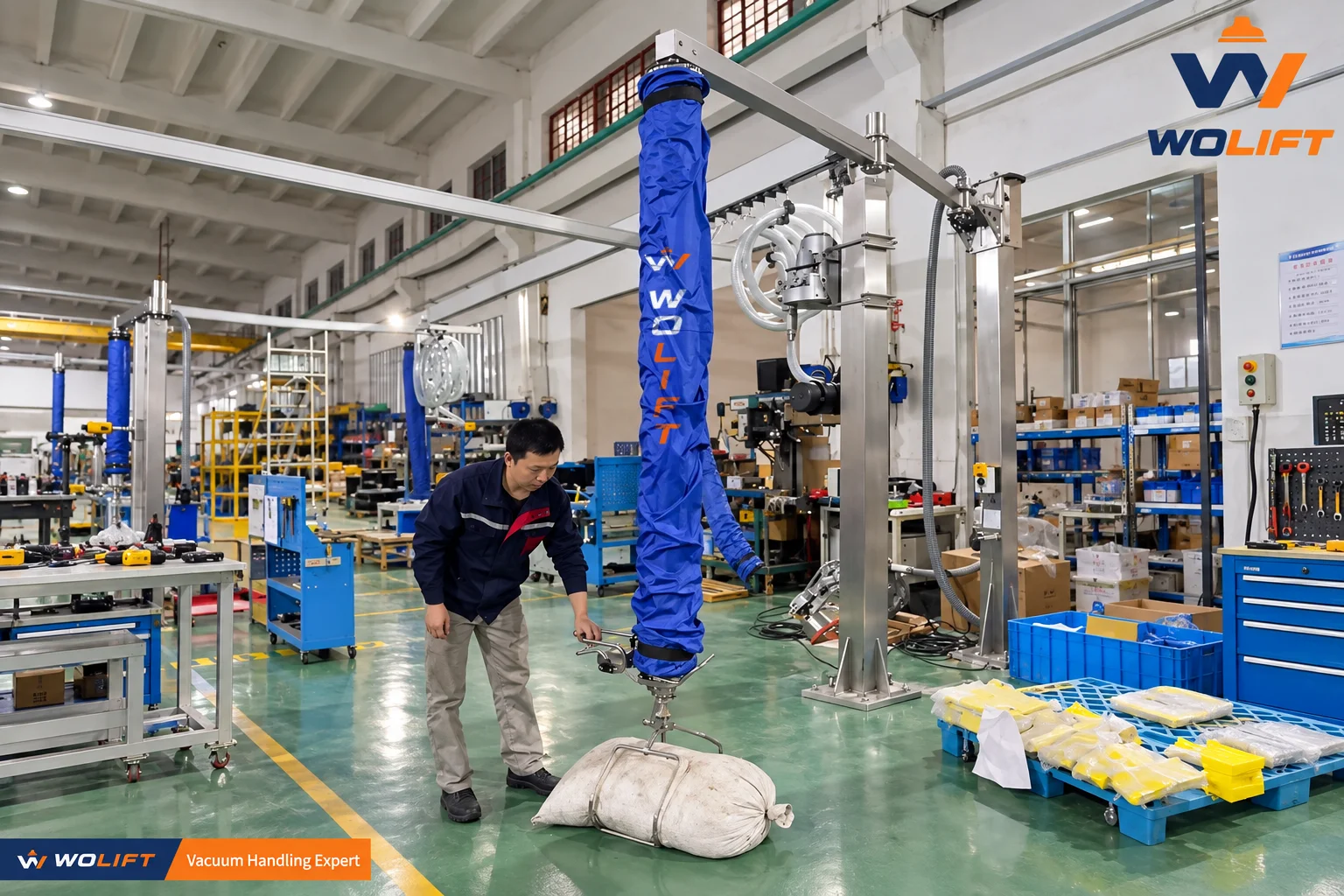
Articulated jib crane for guided transfer
The configuration uses a fixed column-mounted articulated jib crane with two 2,000 mm arm sections, each offering a reported swing range of 270°. It has two arm sections, each approximately 2,000 mm long, with reported swing movement of 270° for each section.
The combined arm length is approximately 4,000 mm. Actual usable reach depends on joint positions, swing limits, obstructions and the suspended lifting equipment. The sum of the arm lengths should not be treated as an unobstructed circular coverage guarantee.
The operator guides the bag by moving the articulated arms and the control handle. The bag can rotate through 360° for alignment. No powered flipping operation is specified for this test.
For supporting configurations, see WOLIFT's crane systems.
Floor pickup and hover adjustment
WOLIFT reports that the gripping arrangement can reach bags at ground level, with an upper gripping position of approximately 1,800 mm above the floor. This describes the supplied gripping arrangement, rather than a confirmed maximum pallet stack height.
A suspended bag extends below the gripping point. Bag geometry, clamp clearance and the placement route therefore need to be considered when selecting a palletizing height.
Unloaded hover sets the resting position of the tool and handle between lifts. Loaded hover allows the operator to hold an attached bag at a selected working position while guiding it to the receiving surface.
What the factory test demonstrates
The test used a bag weighing 50 kg, according to WOLIFT. The demonstrated sequence included gripping the bag, lifting, moving the articulated crane arms, lowering the bag and releasing it after support was restored.
WOLIFT reports approximately 20 seconds for one handling cycle. This is a factory test result, rather than a documented sustained hourly production rate. The information supplied does not establish customer-site output, long-term packaging performance or a measured productivity improvement.
Disclosed order cost
| Item | Disclosed amount |
|---|---|
| Equipment | USD 6,100 |
| CIF freight charge | USD 230 |
| Total of disclosed charges | USD 6,330 |
The figures describe the disclosed order scope and transport arrangement. They are not a current price list or a guaranteed final delivered cost at another destination. A quotation should identify the supplied equipment, destination and any additional services or charges.
Comparing mechanical gripping and suction lifting
| Selection point | Mechanical clamp in this test | Suction-head bag handling |
|---|---|---|
| Bag connection | Mechanical grip around the bag body | Suction contact with a suitable external surface |
| Packaging assessment | Grip geometry, packaging strength, contents and filled shape | Contact area, folds, packaging permeability and operating vacuum |
| Vacuum role | Lifting tube contraction | Typically both gripping and lifting in a tube-lifter configuration |
| Receiving position | Supporting surface unloads the clamp for release | Supporting surface receives the bag before release |
| Evidence needed | Test with the actual filled bag and configured clamp | Test with the actual filled bag, head and vacuum source |
For similar applications, select the gripping method based on the filled bag’s weight, packaging, shape and closure. Assess the gripping tool and supporting crane together against the required pickup and placement positions.
Factory demonstration video
The 43-second vertical clip shows the WOLIFT factory handling demonstration for this order. France is the intended project destination. The clip is not customer-site footage from France.
Frequently asked questions
Why use a mechanical clamp for a bag?
The customer uses mainly burlap sacks and some plastic bags. The application includes air-permeable packaging, cord-tied openings and irregular filled shapes. WOLIFT selected mechanical gripping so bag retention does not rely on a suction seal at the bag surface.
Does the system still use vacuum?
Yes. Vacuum contracts the lifting tube to assist lifting, while the mechanical clamp grips the bag body.
How does the clamp release the bag?
WOLIFT describes a load-actuated rhombus linkage. Once the bag is supported, the load on the mechanism is removed and the gripping force reduces. The supplied mechanism is designed to release with the bag supported.
Was the 50 kg bag tested at the customer's site?
The described test was conducted at the WOLIFT factory. The order destination is France, but no customer-site handling footage has been supplied for this case.
Can a 20-second test cycle be treated as an hourly capacity?
No. It describes the reported factory handling cycle. Sustained palletizing output depends on the actual layout, placement pattern, pallet changes and operating conditions.
Assess a similar bag handling application
Explore WOLIFT's bag tube lifters and supporting crane systems. To assess a mechanical gripping option, contact WOLIFT with bag construction, closure method, filled weight, contents, dimensions and the required pickup and placement positions.
Project and test information supplied by WOLIFT. Technical review: WOLIFT Engineering Team. Factory test year: 2026.
Discuss a similar handling requirement
Share the workpiece data and site conditions for an initial engineering review.