

50 kg Bag Vacuum Tube Lifter for Warehouse Depalletizing in Spain
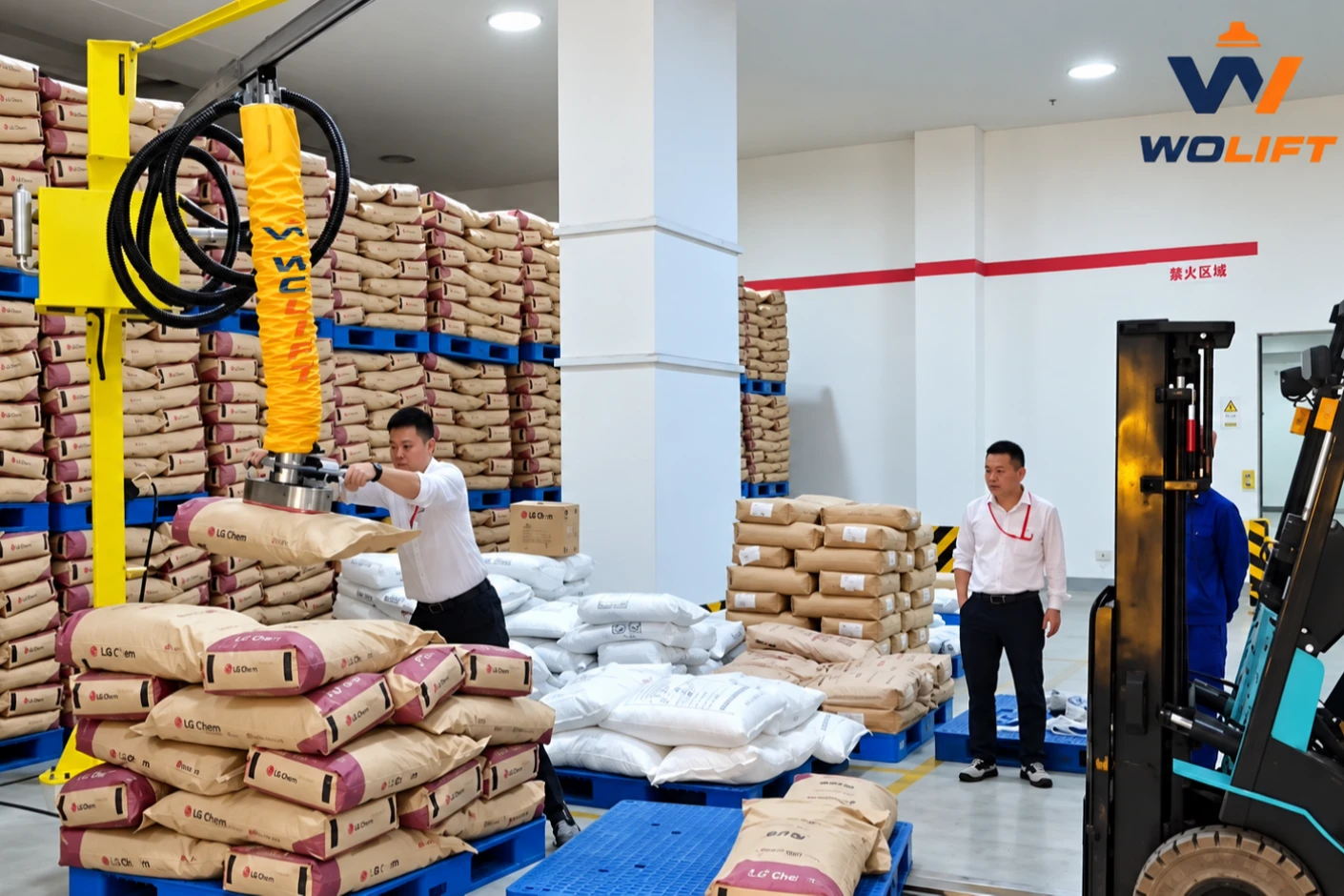
A warehouse customer in Spain installed a WOLIFT WO-QGDD140 vacuum tube lifter in 2025 to assist with bag depalletizing and internal pallet transfer. The configuration combines a 60 kg rated tube lifter, a single 205 × 370 mm suction head, a vacuum blower and a fixed column jib crane with a 3,000 mm arm. The representative handling task involves 50 kg bags; the customer also uses the equipment for the other bagged materials described below.
The application addresses repetitive manual lifting during sorting, order preparation and internal transfer. The project video demonstrates pallet-to-pallet bag transfer. Customer-supplied information also identifies depalletizing as an actual use of the equipment.
Project at a glance
| Item | Project configuration or reported operation |
|---|---|
| Customer industry | Warehousing and bagged-material handling |
| Location and project year | Spain, 2025 |
| Actual tasks | Depalletizing, internal transfer, sorting and order preparation |
| Video demonstration | Pallet-to-pallet bag transfer |
| Representative bag weight | 50 kg |
| Tube lifter model | WO-QGDD140 |
| Rated lifting capacity | 60 kg for the configured equipment |
| Suction head | One stainless steel head, 205 × 370 mm |
| Seal material | Nitrile rubber |
| Vacuum source | High-flow vacuum blower; nominal airflow 165 m³/h |
| Support system | Fixed column jib crane with aluminium rail |
| Column height / arm length | 3,300 mm / 3,000 mm |
| Jib swing / suction head rotation | 270° / 360° |
| Suction head height above floor | Approximately 200–1,900 mm |
| Effective vertical travel | Approximately 1,700 mm |
| Typical reported stack height | Approximately 1,500 mm above floor, including the pallet |
| Recommended stacking height for this configuration | No more than approximately 1,600 mm above floor, including the pallet, subject to bag sag and clearance |
| Reported transfer cycle | Approximately 5–10 seconds per bag, depending on layout and operator movement |
Why the warehouse needed assisted bag handling
The customer previously moved bags manually. Heavy bags and repeated transfers created substantial physical effort during warehouse operations. The work included removing bags from pallets, sorting them and preparing loads for subsequent internal movement or order fulfilment.
A single fixed lifting station was selected to assist handling within the jib crane's working area. Operators guide the bag using the control handle while the tube lifter supports the load. This is an operator-controlled handling system, rather than an automated sorting or palletizing line.
Different bagged materials require different handling checks
The customer's inventory includes grains such as rice, flour and corn; animal feed; fertilizers; construction powders such as putty powder and cement; and chemical raw materials. Packaging varies, and some bags are air-permeable. The customer also reports that the bags are generally resistant to tearing.
The customer confirms that the equipment is actually used for these bagged materials. The table provides examples of the bag specifications supplied for this project. The video shows a representative transfer rather than every material type.
| Customer-reported actual use | Reported bag dimensions | Reported weight or packaging detail |
|---|---|---|
| Rice | 950 × 550 mm | 50 kg |
| Fertilizer | Approximately 930–950 × 600 mm | Weight not specified; organic fertilizer bags may be longer |
| Chemical raw materials, unlined packaging | 550 × 860 mm | Weight not specified |
| Magnesium chloride, lined packaging | 620 × 1,000 mm | Weight not specified |
| Potassium chloride, lined packaging | 570 × 950 mm | Weight not specified |
| Putty powder | Not specified here | 35 kg; woven bag |
Bag dimensions alone do not establish lifting suitability. Selection also needs to account for actual filled weight, bag permeability, seams, folds, liner construction and the available suction contact area. A bag suitable for one configuration should not be treated as proof that all bags containing the same material can be lifted.
Why this configuration uses a vacuum blower
The project uses one suction head connected to a high-flow vacuum blower with a nominal airflow of 165 m³/h. This is the blower specification, not a measurement of airflow at the bag surface. WOLIFT selected this arrangement because the warehouse handles some air-permeable bags. Air leakage through porous packaging makes vacuum-source selection and seal contact particularly relevant.
The 205 × 370 mm stainless steel suction head has a nitrile rubber seal. Compatibility depends on whether the actual filled bag provides adequate contact and whether the configured vacuum source can maintain the required operating vacuum. Neither the equipment's 60 kg rating nor a blower's nominal airflow alone confirms suitability for every porous bag.
For other bag materials or bag sizes, see WOLIFT's vacuum tube lifters for bags.
Handling sequence and jib crane coverage
For the transfer demonstrated in the video, the operator positions the suction head on a bag, establishes a grip, lifts the bag, moves it towards the receiving pallet and lowers it into position before releasing it.
The suction head can rotate through 360° to help align the bag. This rotation does not imply a powered flipping function. The fixed column jib crane has a reported 270° swing and a 3,000 mm arm with aluminium rail. Pallet positions must remain within the usable working area, allowing for surrounding obstacles, the operator's position and the geometry of the suspended equipment.
The crane's swing angle and arm length should therefore be considered together with the actual warehouse layout. See WOLIFT's crane systems for supporting arrangements suited to different workstations.
Why 1,700 mm of travel does not mean a 1,700 mm stack
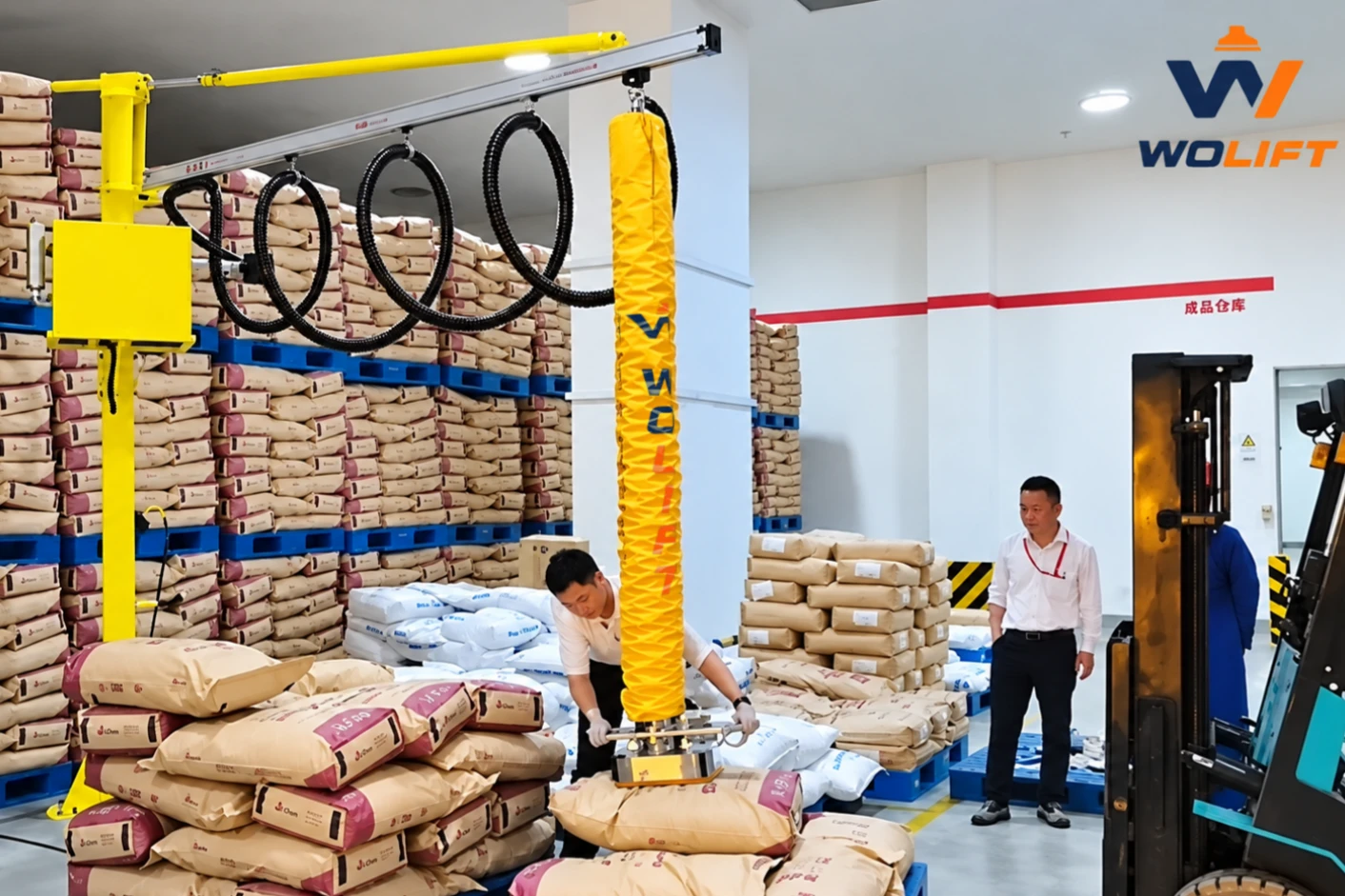
The suction head operates from approximately 200 mm to 1,900 mm above the floor, giving approximately 1,700 mm of vertical travel. These measurements refer to the suction head, rather than the bottom of a suspended bag.
A filled bag hangs below the head and can sag during lifting. The operator also needs clearance to move the bag over the receiving stack. For this project, the customer reports a typical stack height of approximately 1,500 mm, and WOLIFT recommends keeping stacking height at or below approximately 1,600 mm for this configuration. Both heights are measured from the floor to the top of the stack and include the pallet.
This recommendation is specific to the supplied arrangement and bag geometry. Final stack-height planning should account for pallet height, filled bag depth, bag sag and transfer clearance.
Hover settings and operator control
The configuration allows adjustment of unloaded and loaded hover positions. Unloaded hover sets the resting position of the suction head and control handle between lifts. Loaded hover allows the operator to hold an attached bag at a selected working position.
These settings help adapt the handle position to pickup and placement tasks. The operator still controls movement and guides the bag throughout the cycle.
Reported handling time and disclosed project cost
WOLIFT reports approximately 5–10 seconds for an individual bag transfer, depending on pallet placement, transfer distance and operator movement. This is a task-level estimate, not a measured continuous hourly throughput or a guaranteed production rate. Pallet changes, sorting decisions and interruptions also affect overall output.
The disclosed historical project cost was:
| Cost item | Amount |
|---|---|
| Equipment | USD 6,125 |
| Disclosed CIF transport charge | USD 260 |
| Total of disclosed charges | USD 6,385 |
These figures relate to this 2025 project and its quoted scope. They are not a current price list or a guaranteed final delivered cost for other locations. Additional destination charges or services, where applicable, need to be checked against the quotation.
No quantified reduction in injuries, staffing requirements or overall warehouse throughput has been provided for this case.
Selecting a bag lifter for warehouse handling
Assess the actual filled bags, including their weight, dimensions, packaging permeability and available suction contact area. Select the suction head and vacuum source together to suit the bags used at the workstation.
Check pallet positions, transfer distances, maximum stack height and crane coverage. Allow clearance for bag sag during movement, and confirm that the quotation includes the required lifting equipment, supporting crane, controls and installation scope.
Watch the warehouse bag transfer video
The 32-second project video demonstrates bag pickup and pallet-to-pallet transfer at the customer site. It supports the handling sequence shown, rather than independently verifying every inventory item, cycle-time estimate or reported operational use.
Frequently asked questions
Can the same vacuum tube lifter handle different warehouse bags?
Yes. The customer reports actual use of this equipment for bags of grains, feed, fertilizers, construction powders and chemical raw materials. Suitability for another warehouse still depends on its actual filled bags, weights, packaging and lifting configuration.
Can a vacuum tube lifter handle porous bags?
Some porous bags can be handled with an appropriate suction head and vacuum-source configuration. This project uses a high-flow blower because some bags are air-permeable. The achievable operating vacuum and the actual bag contact conditions determine suitability.
What is the lifting height in this project?
The suction head reaches approximately 200–1,900 mm above the floor, providing approximately 1,700 mm of vertical travel. The recommended maximum stack height is approximately 1,600 mm above the floor, including the pallet, for this configuration because the bag hangs below the suction head and requires movement clearance.
Does the video demonstrate depalletizing and order sorting?
The video demonstrates pallet-to-pallet bag transfer. Depalletizing, sorting and order preparation are customer-reported uses; the video does not document each complete workflow.
What information is needed for a similar warehouse project?
Provide filled bag weight and dimensions, packaging and liner details, pickup and placement heights, pallet layout, transfer distance and expected handling frequency. Photos of representative bags and the workstation help determine the lifting and crane configuration.
Plan a warehouse bag handling workstation
Start with WOLIFT's bag vacuum tube lifter range and the matching crane systems. For an explanation of the lifting principle, read what a vacuum tube lifter is.
To assess a specific warehouse layout and its bag types, contact WOLIFT with the application details.
Project information supplied by WOLIFT. Technical review: WOLIFT Engineering Team. Project year: 2025.
Discuss a similar handling requirement
Share the workpiece data and site conditions for an initial engineering review.