


50 kg Flour Bag Palletizing with a Vacuum Tube Lifter in New Zealand
A flour manufacturer in New Zealand selected a WOLIFT WO-QGDD140 vacuum tube lifter to move filled 50 kg flour bags from a packing line onto pallets. The 2026 project uses a 60 kg rated lifting configuration, a vacuum blower and a jib crane to assist repeated end-of-line handling.
WOLIFT reports that an onsite test achieved approximately 160 bags palletized per hour. The customer reported that this met the line's operating requirements. This result describes the tested workstation; it is not a guaranteed handling rate for every flour packing line.
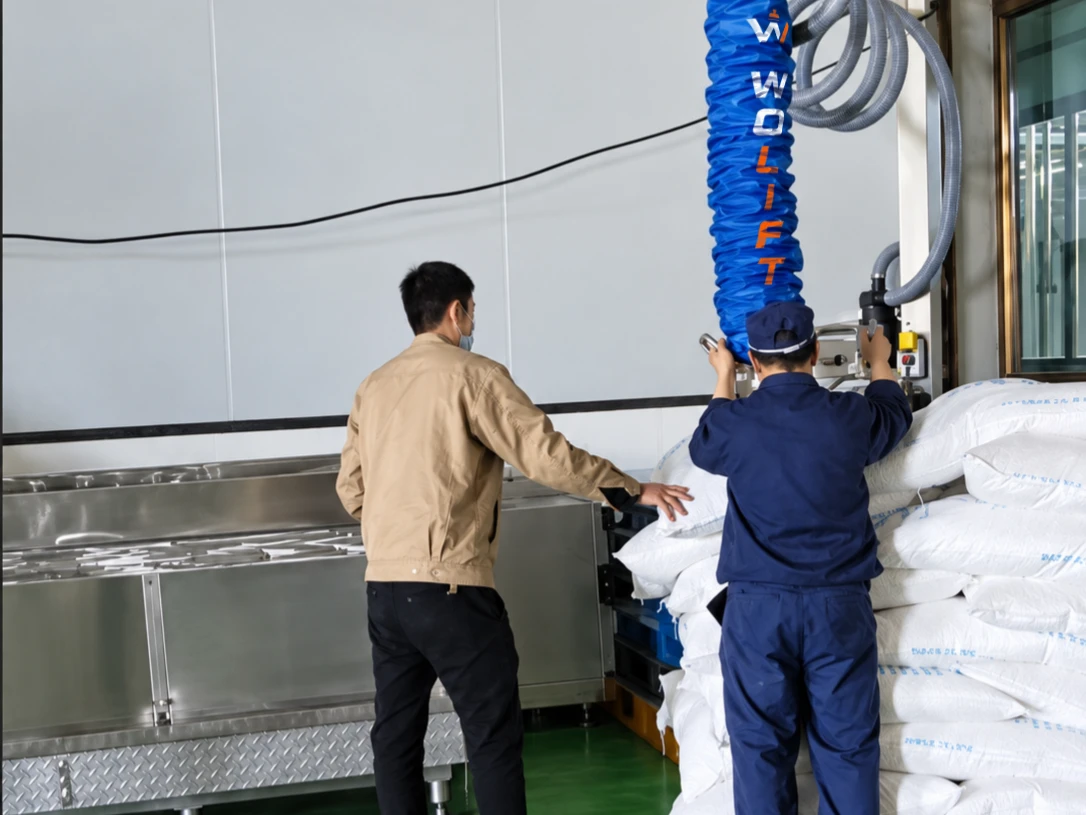
Project specifications
| Item | Supplied project information |
|---|---|
| Customer | Flour manufacturer |
| Location / year | New Zealand / 2026 |
| Application | Filled bag transfer from packing line to pallet |
| Bag weight | 50 kg |
| Reported filled bag thickness | Approximately 100–120 mm |
| Packaging | Woven bags with either a separate liner or a film layer laminated into the bag material |
| Contact surface | Uneven; packaging reported to be largely airtight |
| Tube lifter | WO-QGDD140 |
| Rated lifting capacity | 60 kg |
| Vacuum source | Vacuum blower; nominal airflow 135 m³/h |
| Electrical supply | 415 V, 50 Hz, three-phase |
| Suction arrangement | One oval stainless steel suction head, 205 × 370 mm, with nitrile rubber seal |
| Reported crane configuration | Column jib crane; 3,300 mm column height, 3,000 mm arm; aluminium rail |
| Conveyor height | 1,300 mm above floor |
| Pallet dimensions | 1,300 × 1,100 mm |
| Reported stacking pattern | Five bags per layer, ten layers; 50 bags per completed pallet |
| Maximum reported stack height | 1,500 mm above floor, including the pallet |
| Suction head height range | Approximately 200–1,900 mm above floor |
| Effective vertical travel | Approximately 1,700 mm |
| Bag alignment | Suction head rotates through 360° |
| Holding positions | Adjustable unloaded and loaded hover settings |
| Onsite palletizing result | Approximately 160 bags per hour, reported by WOLIFT |
The handling problem at the end of the flour packing line
Before the installation, workers moved the filled bags manually. Repeated handling of 50 kg bags created high physical demands, particularly as operators transferred bags from the conveyor and positioned them at different pallet heights.
The project aimed to provide lifting assistance for this repeated task while retaining operator control of bag placement. Workers guide the suction head and bag through the control handle; the vacuum tube lifter supports the load during transfer.
Bag construction and suction contact
The customer uses two packaging constructions: bags with an independent inner liner and bags with a film layer laminated into the outer bag material. The packaging is reported to be largely airtight, although the filled bag surface is uneven.
For this application, selection needs to account for both air leakage and contact geometry. A lined bag can still present folds, seams or areas where the outer material does not make adequate contact with the suction seal. The selected head must grip the actual filled bag at the intended pickup position.
The project uses one oval stainless steel suction head measuring 205 × 370 mm, with a nitrile rubber seal and a vacuum blower with nominal airflow of 135 m³/h. Blower airflow is a component specification, rather than a measurement of airflow at the bag surface or an independent lifting-capacity rating.
For other packaging constructions and bag weights, see WOLIFT's vacuum tube lifters for bags.
Conveyor-to-pallet handling sequence
The operator positions the head on a filled bag at the packing line, establishes suction, lifts the bag clear of the conveyor, guides it towards the pallet and lowers it into its intended position before release.
The conveyor is approximately 1,300 mm above the floor. The receiving pallet measures 1,300 × 1,100 mm. The supplied layout uses a jib crane with aluminium rail to support movement between pickup and placement positions.
The suction head's 360° rotation helps the operator orient bags for the reported five-bag layer pattern: two bags arranged in one direction and three in the perpendicular direction. The reported stack comprises ten layers, giving 50 bags per completed pallet. Filled bag thickness is approximately 100–120 mm. This is guided orientation during placement; no bag-flipping operation is specified for this project.
Crane coverage should be selected around the conveyor, pallet positions and operator access. See WOLIFT's crane systems for supporting configurations.
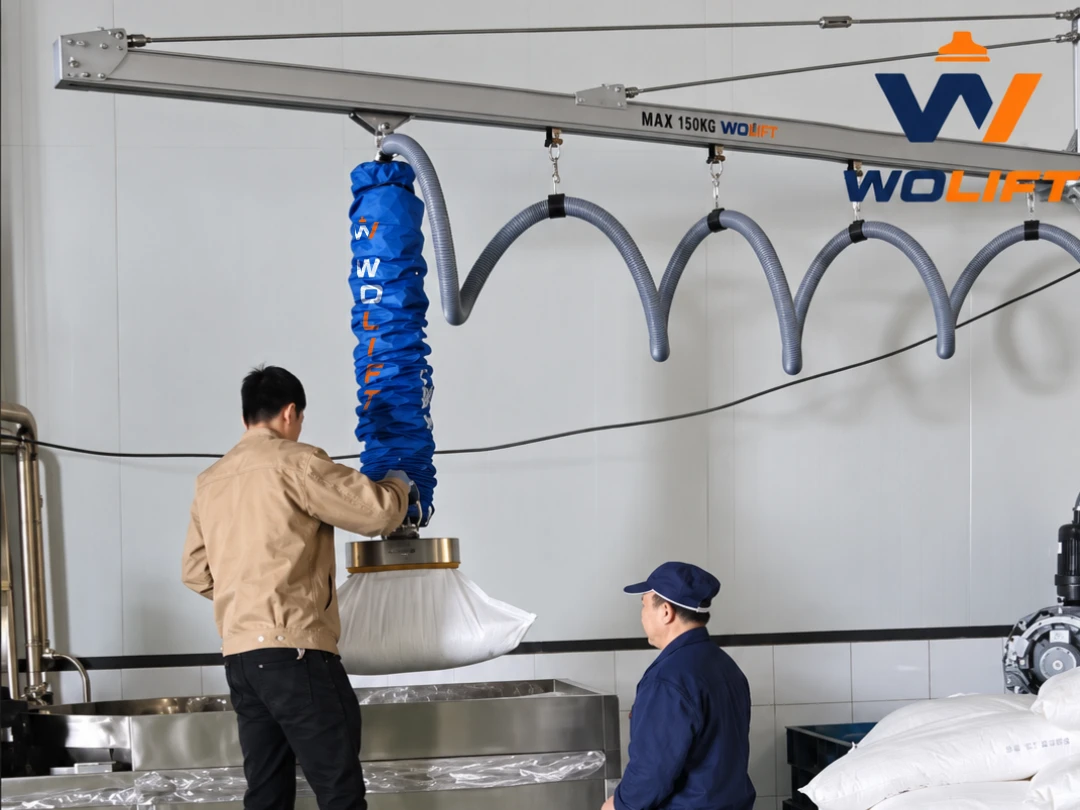
Lifting travel and usable stacking height
The project information specifies a suction head range of approximately 200–1,900 mm above the floor, providing approximately 1,700 mm of vertical travel. The maximum reported stack height is 1,500 mm, including the pallet. The reported ten-layer arrangement uses bags approximately 100–120 mm thick; actual stack height depends on filled bag shape and compression as well as pallet height.
The suction head height and stack height are different measurements. A filled bag hangs below the head, and moving it over a stack requires clearance for the bag's depth and sag. Available travel should therefore be assessed against the filled bag geometry and the required placement height.
The operator can adjust unloaded hover to set the resting height of the head between lifts. Loaded hover allows an attached bag to be held at a selected working position. These adjustments help accommodate changing pallet heights during operation.
Interpreting the onsite handling result
WOLIFT reports approximately 160 bags palletized during a one-hour onsite test. At 50 kg per bag, this represents approximately 8,000 kg of bagged flour handled in that hour. It is an arithmetic total for the reported test, rather than a separate continuous-duty capacity specification.
The filling line is reported to complete one bag every 20 seconds. If it operates continuously without interruption, that interval corresponds to 180 bags per hour. The reported palletizing result is 160 bags per hour, so the two figures should not be treated as identical sustained rates.
The customer reported that the installation met its actual production needs. Sustained operation at a different line rate should be assessed with the real bag arrival pattern, pallet changes, transfer distance and available buffering. The information supplied does not include a complete timing log of these factors.
Disclosed project cost
| Item | Historical project amount |
|---|---|
| Equipment | USD 5,930 |
| Disclosed CIF freight charge | USD 270 |
| Total of disclosed charges | USD 6,200 |
The figures describe this project's quoted scope and transport arrangement. They are not a current price list or a guaranteed final delivered cost for other destinations. Destination charges and any additional services should be confirmed in the applicable quotation.
Selecting a configuration for flour bag palletizing
Select the suction head and lifting capacity for the actual filled flour bags, accounting for liner construction, surface folds and the available suction contact area.
Assess conveyor height, filled bag depth, maximum stack height and crane coverage together to provide clearance for each pallet layer. Evaluate sustained palletizing output against the line’s actual bag arrival rate, including pallet changes and operating pauses, and confirm compatibility with the site’s electrical supply.
Project video
The supplied 36-second vertical project clip accompanies this case. The hourly test result and project specifications are WOLIFT-supplied information; the short clip does not independently establish sustained hourly throughput.
Frequently asked questions
Can a vacuum tube lifter handle lined flour bags?
This project uses the equipment for 50 kg woven flour bags with independent liners or laminated film layers. Suitability for other bags depends on their filled weight, surface contact, seams, folds and packaging construction.
What was the onsite palletizing rate?
WOLIFT reports approximately 160 bags per hour during an onsite test. The customer reported that this met its actual operating needs. A filling interval of 20 seconds corresponds to a theoretical uninterrupted rate of 180 bags per hour, which requires separate assessment if sustained continuously.
How high were the bags stacked?
The reported maximum stack height was 1,500 mm above the floor, including the pallet. The suction head's upper position was approximately 1,900 mm; these measurements refer to different parts of the handling arrangement.
Is the palletizing process automatic?
The operator guides pickup, movement, alignment and placement using the control handle. The lifter provides lifting assistance and adjustable hover positions.
What power supply was used?
The supplied vacuum blower uses 415 V, 50 Hz, three-phase power, with nominal airflow of 135 m³/h. Electrical selection for another site needs to match that site's supply.
Plan a flour bag palletizing workstation
Explore WOLIFT's bag vacuum tube lifters and supporting crane systems. For a different bag handling workflow, see the warehouse bag depalletizing and transfer case in Spain.
To review a similar packing line, contact WOLIFT with filled bag details, conveyor height, pallet layout and required sustained output.
Project information supplied by WOLIFT. Technical review: WOLIFT Engineering Team. Project year: 2026.
Discuss a similar handling requirement
Share the workpiece data and site conditions for an initial engineering review.