


We Tracked an 8-Hour Depalletizing Shift. Tube Lifters Cut Deep Bends by 85%.
A two-week field comparison at an East China logistics warehouse showed that vacuum tube lifter assist reduced deep forward bends from about 2,160 to 320 per 8-hour shift, while helping operators keep afternoon throughput stable.
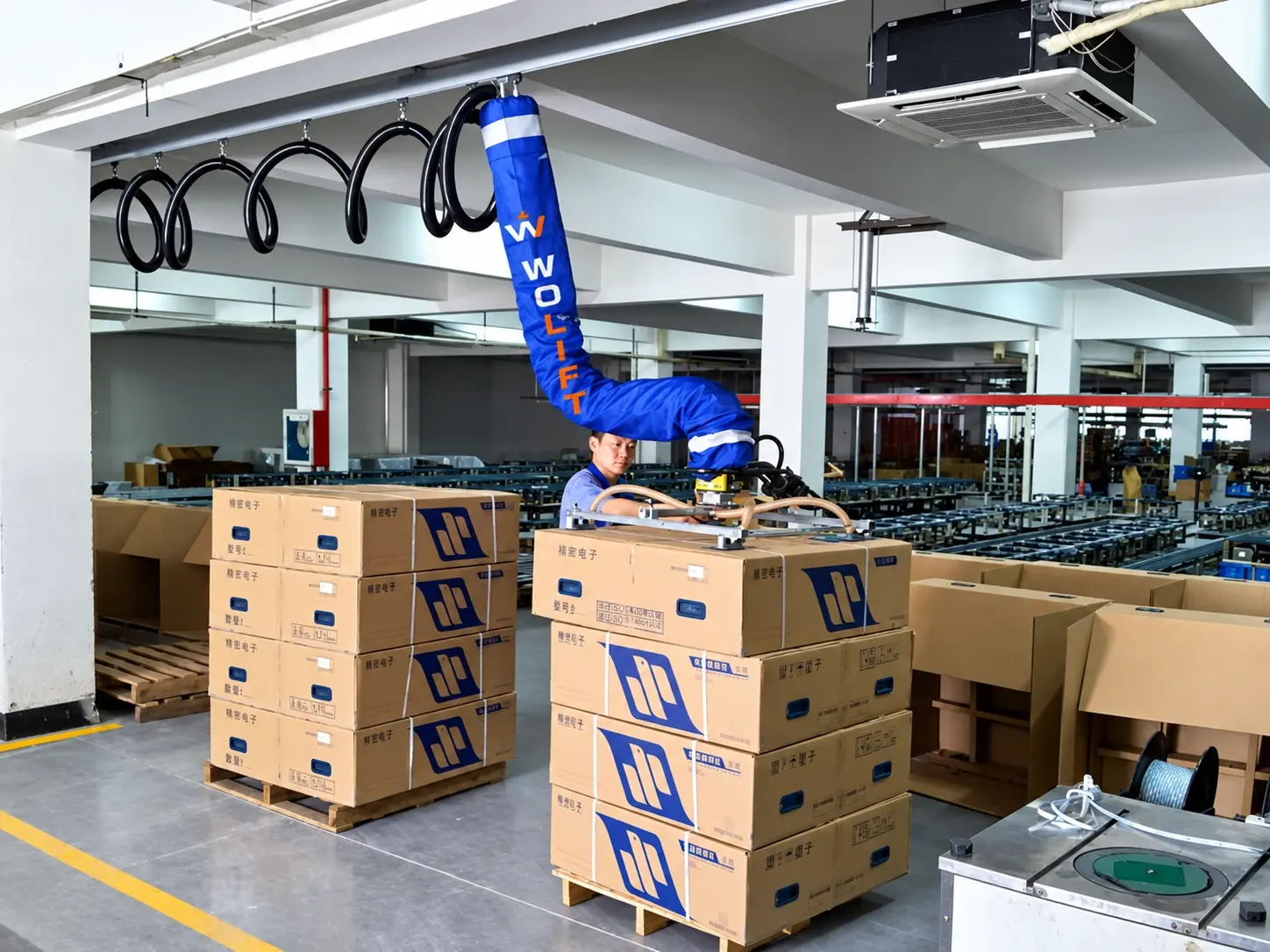
The Problem Was Not Worker Strength
At the warehouse, operators worked from 8 a.m. to 6 p.m. with two hours of breaks. The task looked simple: lift cartons from pallet layers and place them onto a conveyor line. In practice, the bottom layer sat around 300 mm from the floor, forcing repeated deep bending, while top layers required shoulder-height reaches.
One experienced worker had already started taking pain medicine before shifts. The position had gone through four workers in six months. The supervisor was not trying to push people out; the job itself was putting repeated load on the lower back.
What the Back Is Actually Dealing With
A standard depalletizing loop is bend, grip, lift, turn and place. A skilled worker may handle 6-10 cartons per minute. Across six effective working hours, that can exceed 2,000 forward bends per day.
With a 15 kg load and the torso bent forward, lumbar compression rises sharply. Biomechanical models can put peak compressive force above 3,400 N per lift. Repeating that motion thousands of times in one shift creates a cumulative load on discs, ligaments and supporting muscles.
How the Vacuum Tube Lifter Changed the Motion
A vacuum tube lifter uses a suction pad to grip the carton surface while the lifting tube carries the load. The operator guides the carton with the handle instead of lifting the full weight by hand.
- Bottom-layer picks: The suspension system lowers the pad to carton level, helping the operator stay upright.
- The lift: The tube pulls vertically, reducing the operator's handling force to light guidance force.
- Transfer and placement: The worker guides the carton horizontally without twisting the torso to throw the load.
8-Hour Field Data: Manual Handling vs. Tube Lifter Assist
| Metric | Manual Handling | Tube Lifter Assist | Change |
|---|---|---|---|
| Deep forward bends per 8-hour shift | About 2,160 | About 320 | 85% reduction |
| Peak lumbar compression with 15 kg load | 3,400-4,200 N | Under 600 N, mainly body weight plus guidance force | Extra lifting load largely removed |
| Erector spinae tension time | About 5.5 hours | About 0.5 hour | Load shifted away from the lower back |
| Hour 6 throughput vs. peak | Down 20-30% | Maintained | More stable afternoon performance |
| Borg RPE fatigue score | 13-15, hard | 7-9, light | Subjective fatigue dropped sharply |
Three Findings Stood Out
Deep bends nearly disappeared
Workers still leaned slightly, but the angle stayed under 15 degrees in most cycles. The deep flexion seen in manual handling dropped from roughly 360 times per hour to fewer than 50.
The afternoon efficiency drop disappeared
During the first four hours, manual handling could match or even beat the tube lifter because a hand grab is instant. By hour five, manual speed dropped as workers adjusted stance and rested their backs. The tube lifter pace stayed flatter across the full shift.
Fatigue moved away from the lower back
Operators reported more work in the forearms and shoulders, but those muscle groups recover faster and do not carry the same cumulative injury risk as the lumbar spine.
The Cost Logic
For many warehouse managers, the question is not whether back pain exists. The question is whether equipment cost is justified while manual labor is still moving cartons.
In the client's rough cost sketch, sick leave, temporary labor, lost productivity, turnover and retraining could easily exceed 50,000 RMB per year for a four-person cell. A tube lifter system sized for one depalletizing station typically pays for itself in 8-14 months.
Equipment is a fixed asset. Back injuries are a running cost.
When Tube Lifters Fit Best
- Weight per item: Usually 15-80 kg.
- Product type: Cartons, appliance packaging, bagged grain, chemical bags or other items with a reasonably airtight surface.
- Work rhythm: High-frequency and continuous handling, often hundreds of units per day.
If loads are consistently below 15 kg and handling is sporadic, manual work may still be reasonable. But when turnover, sick leave or chronic back pain already appear, the urgency is real.
Closing
An 8-hour depalletizing shift is a direct conflict between repetitive load and human physiology. A tube lifter does not remove the need to move goods. It changes who carries the danger. The worker stops being the lifter and becomes the guide.
For depalletizing stations, a one-hour motion study is often enough to start the business case. Count the deep bends. That number can explain the ergonomic risk more clearly than any slogan.
Discuss your handling requirement with WOLIFT
Share the workpiece data and site conditions for an initial engineering review.