

The Gripping Challenge in Heavy Industry Sheet Metal Handling: How Vacuum Suction Lifters Achieve Stable Adhesion on Oily, Curved, and Heavy-Tonnage Workpieces?
In automotive manufacturing, aerospace, and metal processing, sheet metal parts are rarely clean, flat, dry, and easy to grip. WOLIFT focuses on vacuum lifting systems that keep adhesion stable even when workpieces are oily, porous, curved, textured, or extremely heavy.
Why standard vacuum lifters struggle with real sheet metal
Steel sheets in stamping shops may be covered with drawing oil. Laser-cut parts can have sharp edges and oxide scale. Aircraft skins may be three-dimensionally curved aluminum alloy sheets. Titanium plates can have fine surface textures, while composite sheets often have porous structures. Their weights range from a few tens of kilograms to several tons.
Through extensive engagement with heavy industry clients, WOLIFT has found that standard vacuum suction lifters often underperform in these scenarios. Conventional suction cups work reliably on smooth, dry surfaces such as glass or cardboard, but once confronted with oil films, pores, or complex curvatures, suction force can drop significantly or fail entirely.
The true value of an electric vacuum sheet metal lifter is not simply that it can pick up a plate. The more important requirement is maintaining stable suction and reliable handling under harsh surface conditions and heavy loads.
Oily surfaces: seal failure is the biggest enemy
Stamped steel plates, rolled aluminum coils, and rust-prevented metal sheets commonly have oil films on their surfaces. These oil films reduce friction between the suction cup and the workpiece, making the cup more prone to slipping under lateral force. Oil can also penetrate the microscopic contact interface between the cup and the workpiece, breaking the vacuum seal and causing negative pressure to drop gradually.
WOLIFT addresses oily surfaces with a three-layer approach. First, suction cup material is selected carefully. Nitrile rubber and polyurethane cups have good resistance to mineral oils, so they do not swell or harden easily and can maintain stable elastic deformation in oily environments.
Second, the lip design matters. Deep lips or multi-bellows structures allow the cup to create a sufficient sealing area even when oil blocks part of the contact zone. Third, the vacuum source must be configured for leakage compensation. Micro-leakage on oily surfaces is inevitable, so WOLIFT sheet lifters for heavy industry typically use high-pumping-speed vacuum pumps or high-flow vacuum generators to maintain vacuum while leakage is being compensated.
In practical tests, standard silicone cups on steel plates with drawing oil can allow vacuum to drop from -0.08 MPa to below -0.04 MPa within 5 minutes. After switching to oil-resistant nitrile deep-lip cups with a high-flow vacuum pump, vacuum remained stable above -0.075 MPa for more than 30 minutes under the same conditions.
Porous materials: vacuum is not one-size-fits-all
Composite sheets, foam-core panels, sintered metal plates, and rough castings all contain micropores or open channels on their surfaces. When a conventional suction cup is applied, air continuously enters the cup cavity through these pores, making it difficult to build adequate negative pressure.
For these applications, WOLIFT typically uses two approaches. The first is high-flow, low-pressure-differential compensation. By choosing high-volume blowers or large-flow vacuum pumps, the equipment can maintain usable negative pressure even with continuous leakage between the cups and the workpiece.
The second approach is zone sealing. For sheets with uneven pore distribution, a soft sealing gasket can be added around the outer edge of the suction area to block external air ingress, while the vacuum source compensates for minor leakage inside the gripping zone. This structure has been applied in composite processing projects for carbon fiber prepregs, FRP honeycomb panels, and other materials that were previously handled manually or with mechanical grippers.
Curved surface gripping requires adaptive structures
Aircraft skins, fairings, aerospace door structures, automotive roof liners, inner fender panels, bent tubes, and formed sheet metal parts often have distinct curved surfaces. Standard suction cups are rigid and can only conform to flat surfaces or very slight curvature. When the workpiece curve is more complex, cup edges lift away from the surface, the seal becomes incomplete, and suction force drops.
WOLIFT custom sheet lifters use adaptive suction cup structures for curved handling. One option is to combine bellows cups with ball-joint mountings, allowing the cup body to pivot and follow the workpiece surface angle. Another option is a spring-loaded floating cup holder, where each cup moves independently and adjusts to local height differences as the beam lowers onto the workpiece.
For free-form surfaces or large curvature, WOLIFT can also use an array of small-diameter cups. Multiple small cups cover the curved surface, so even if a few cups do not seal perfectly, the overall holding force can still meet handling requirements.
Heavy-tonnage handling depends on load distribution and redundancy
Large automotive covering molds, aerospace structural parts, and thick steel plates can weigh over 1 ton each. At this scale, suction lifter design is no longer only about whether the cups can hold the workpiece. The system must remain stable under extreme conditions, center-of-gravity shifts, and changes in lifting posture.
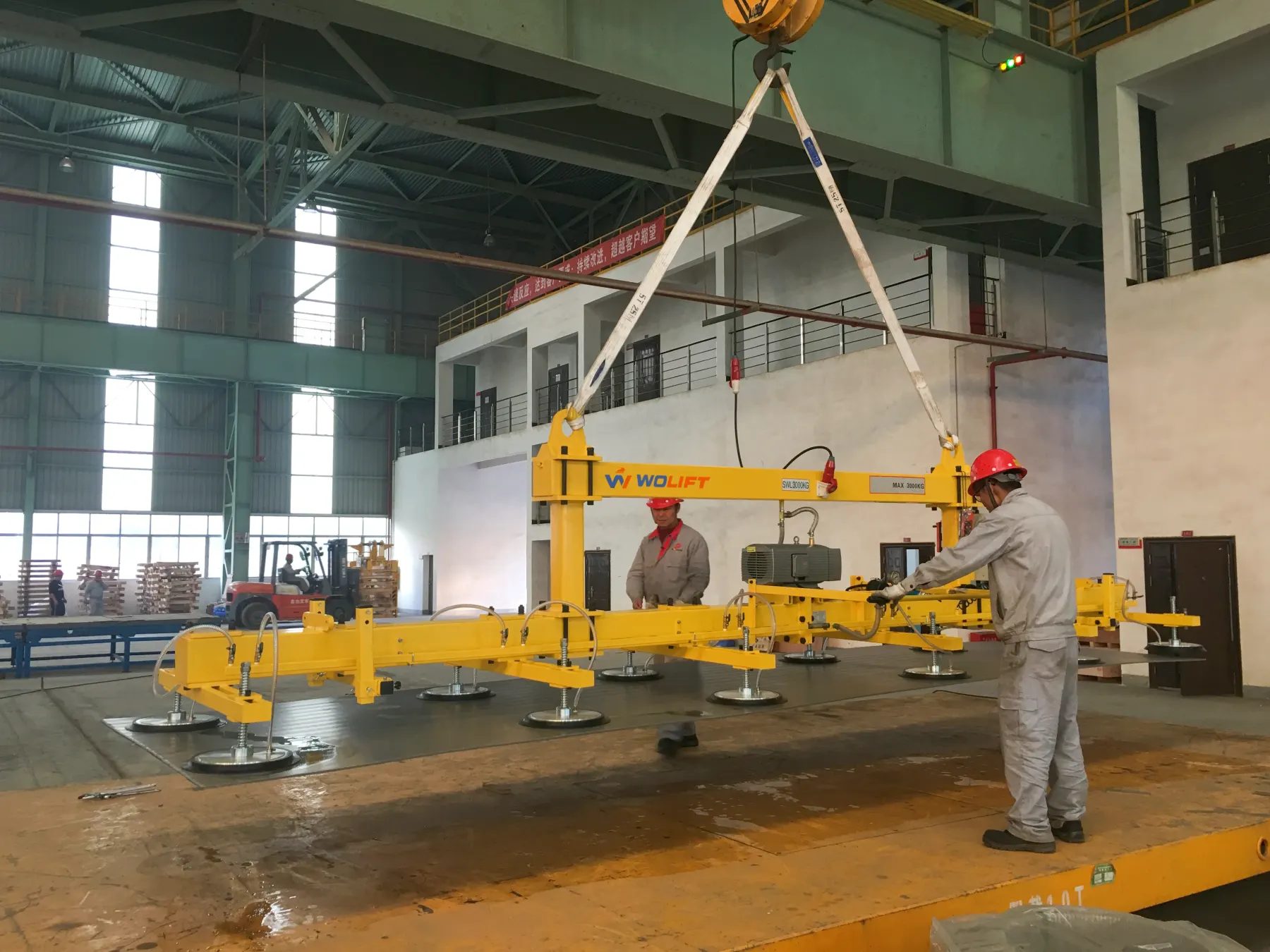
Heavy-tonnage sheet lifters must address load distribution and fail-safe protection. Load distribution means the force across all suction cups should be as uniform as possible. WOLIFT can incorporate multiple articulation points in the beam structure, allowing the beam to adapt within a defined range so that the cups share the load more evenly.
The vacuum circuits are also grouped independently, with each group having its own vacuum accumulator and check valve. If one group fails, the remaining groups can still provide short-term support. For additional safety, WOLIFT equips heavy-tonnage models with mechanical anti-drop devices that engage when vacuum falls below the safety threshold.
Custom equipment starts with the process, not only the suction cup
The core competitiveness of sheet lifters and custom equipment lies in understanding the user's process scenario. Stainless steel behaves differently before and after stamping. Rolled aluminum plates are different from castings with rough surfaces. Composite prepreg before curing is different from rigid laminate after curing. Each state requires a different cup material, sealing method, and vacuum strategy.
In custom projects, WOLIFT begins with material characteristics analysis, including surface roughness, porosity, oil type, temperature range, workpiece dimensions, and weight distribution. Based on this information, the engineering team selects cup type and layout, then validates the solution through sample suction tests. Only solutions that pass verification on actual materials proceed to production delivery.
Heavy industry customers do not only need a standardized vacuum hoist. They need a handling partner that understands production rhythm, safety requirements, and the surface conditions that make sheet metal difficult to grip. WOLIFT's work is to turn those difficult conditions into stable, safe, and efficient lifting solutions.
Discuss your handling requirement with WOLIFT
Share the workpiece data and site conditions for an initial engineering review.