

High-Frequency Loading and Unloading in Glass Processing Plants: How Pneumatic Glass Suction Lifters Solve Efficiency and Safety Challenges
Glass processing plants handle hundreds of sheets per shift across cutting, edging, tempering and insulating glass lines. Pneumatic glass suction lifters help match that rhythm while reducing manual strain, glass damage and safety risk.
Handling Is the Most Frequent Operation
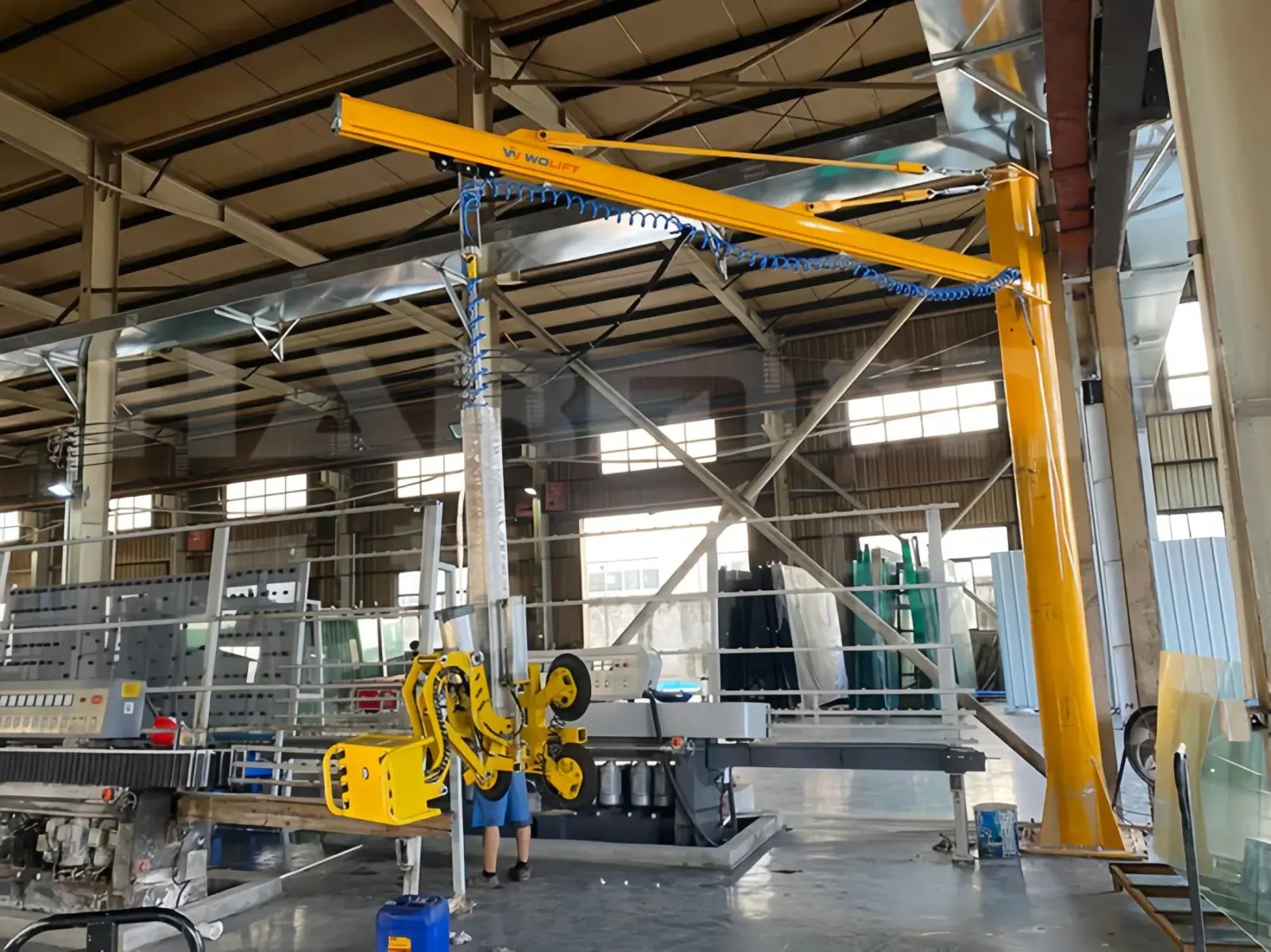
In a glass processing plant, the most frequent operation is not cutting, edging or tempering. It is handling. Glass moves from storage racks to cutting tables, from cutting tables to edging machines, from insulating glass lines to laminating lines, and from tempering furnaces to downstream support racks.
Glass sizes can vary from thin 2 mm sheets to panels over 19 mm thick, and from small pieces to sheets more than six meters long. If every transfer is manual, efficiency drops while scratches, edge chipping and breakage risk rise with every cycle.
Through multiple glass processing projects, WOLIFT has seen workshops where cutting machines already process several sheets per minute, but loading and unloading still rely on two workers with manual cups or simple crane-hung vacuum tools. A pneumatic glass suction lifter is built for this gap: high-frequency handling using the workshop's existing compressed air supply.
Why Plants Prefer Pneumatic Systems
Most glass processing workshops already have compressed air pipelines for cutting table air flotation, edger cooling, pneumatic clamps and other equipment. A pneumatic glass suction lifter can connect directly to this air supply without major electrical upgrades or large control cabinets.
Pneumatic vacuum generators use compressed air passing through a Venturi nozzle to generate negative pressure. With no moving parts, they offer rapid start and stop response, which fits intermittent glass loading and unloading. In dusty or humid glass processing environments, pneumatic systems can also reduce maintenance pressure compared with fully electric pump systems.
WOLIFT pneumatic glass suction lifters are commonly configured for workshop air supplies of 0.6-0.8 MPa. Each unit includes an independent filter-regulator-lubricator to reduce moisture and oil mist entering the vacuum system. For coated or Low-E glass lines, higher-precision air filtration can be selected.
Safety Redundancy for Air and Power Loss
Indoor glass processing plants do not face the same wind risk as curtain wall installation, but high-frequency indoor handling has its own sudden hazard: compressed air failure. Compressor breakdowns, pipeline leaks or accidental valve closures can cause immediate air loss.
WOLIFT glass suction lifters can use dual-circuit redundancy and accumulator pressure-holding design. Two independent vacuum circuits connect to separate suction cup groups. If one circuit is affected by air fluctuation or blockage, the other circuit can continue holding.
In a practical test, a medium-sized WOLIFT pneumatic glass suction lifter held a 300 kg glass panel at an initial vacuum of -0.08 MPa before a simulated total plant air shutdown. The vacuum took more than 8 minutes to drop from -0.08 MPa to -0.05 MPa, giving the operator time to lower the glass to a rack or floor support.
Ergonomics and Surface Protection
The loading and unloading rhythm in glass processing plants is faster than curtain wall installation. A cutting station may process hundreds of sheets per shift, leaving only seconds for each pick-and-place cycle.
With manual handling, workers bend, lift and twist. Large panels require multiple people, increasing coordination risk and strain on the lower back, shoulders and wrists. Uneven force from manual cups can also create local stress near glass edges, leading to chipping or micro-cracks.
A pneumatic glass suction lifter allows the operator to bring the cups to the glass, start vacuum, and guide the sheet with light force. For large panels over 100 kg, the lifter can be paired with a column-mounted cantilever or track system to cover the workstation and reduce multi-person lifting risk.
For surface protection, WOLIFT selects silicone or nitrile rubber cups with soft contact surfaces. For coated glass, shallow-lip cup designs help reduce film damage. Gradual release lets the glass settle smoothly instead of dropping suddenly when vacuum is released.
Rapid Adaptation to Multiple Glass Sizes
Glass processing plants handle many sizes in the same shift. A small 800 x 600 mm sheet may be followed by a 6 m x 2 m panel, with thickness changing from 4 mm to 12 mm or more. If cup positions are fixed, every changeover costs time.
WOLIFT pneumatic glass suction lifters use modular suction beam structures. Cups can be adjusted by quantity and spacing according to glass dimensions. For extra-long glass, two beams can be connected in parallel to increase support points.
Each vacuum circuit can be controlled independently, so the operator can choose the number of suction cups according to glass area and weight. This avoids excessive suction on smaller sheets and unstable holding on larger panels.
Maintenance and Air Supply Management
Pneumatic systems are relatively straightforward to maintain, but compressed air quality is critical. WOLIFT recommends three-stage filtration at the equipment air inlet for water removal, oil removal and dust removal, with filter element checks every two weeks.
Suction cups are consumable parts. Depending on use frequency and glass surface condition, they are usually replaced every six months to one year. If the cup edge shows cracks, hardening or local wear, it should be replaced before suction performance declines.
Pneumatic vacuum generators consume compressed air while suction is active. With an energy-saving vacuum holding valve, air supply can stop once the set vacuum level is reached. The check valve and accumulator maintain vacuum, and air is supplied again only when vacuum drops. Some WOLIFT models can reduce compressed air consumption by 30%-50% during continuous operation.
Conclusion
The handling challenge in glass processing plants is a balance between efficiency and safety in a high-frequency, multi-size and damage-prone environment. Pneumatic glass suction lifters use existing compressed air resources to provide a flexible alternative to manual handling and heavier electric systems.
Dual-circuit redundancy and pressure holding reduce dependence on a single component. Modular suction cups and quick-change structures keep the equipment responsive to product changeovers. Proper cup materials help protect glass surfaces from marks, scratches and breakage.
For workshops moving hundreds or thousands of glass sheets each day, the right balance means fewer breakages, less manual intervention and a more sustainable production rhythm.
Discuss your handling requirement with WOLIFT
Share the workpiece data and site conditions for an initial engineering review.