

Three What-Ifs on a 50-Story Curtain Wall Site: How Glass Vacuum Lifters Hold the Safety Line
A 50-story curtain wall project review showed why glass vacuum lifter safety is not just about rated load. It depends on dual-circuit vacuum isolation, power-loss pressure retention and wind-load engineering when site conditions go wrong.
The Three Questions That Matter
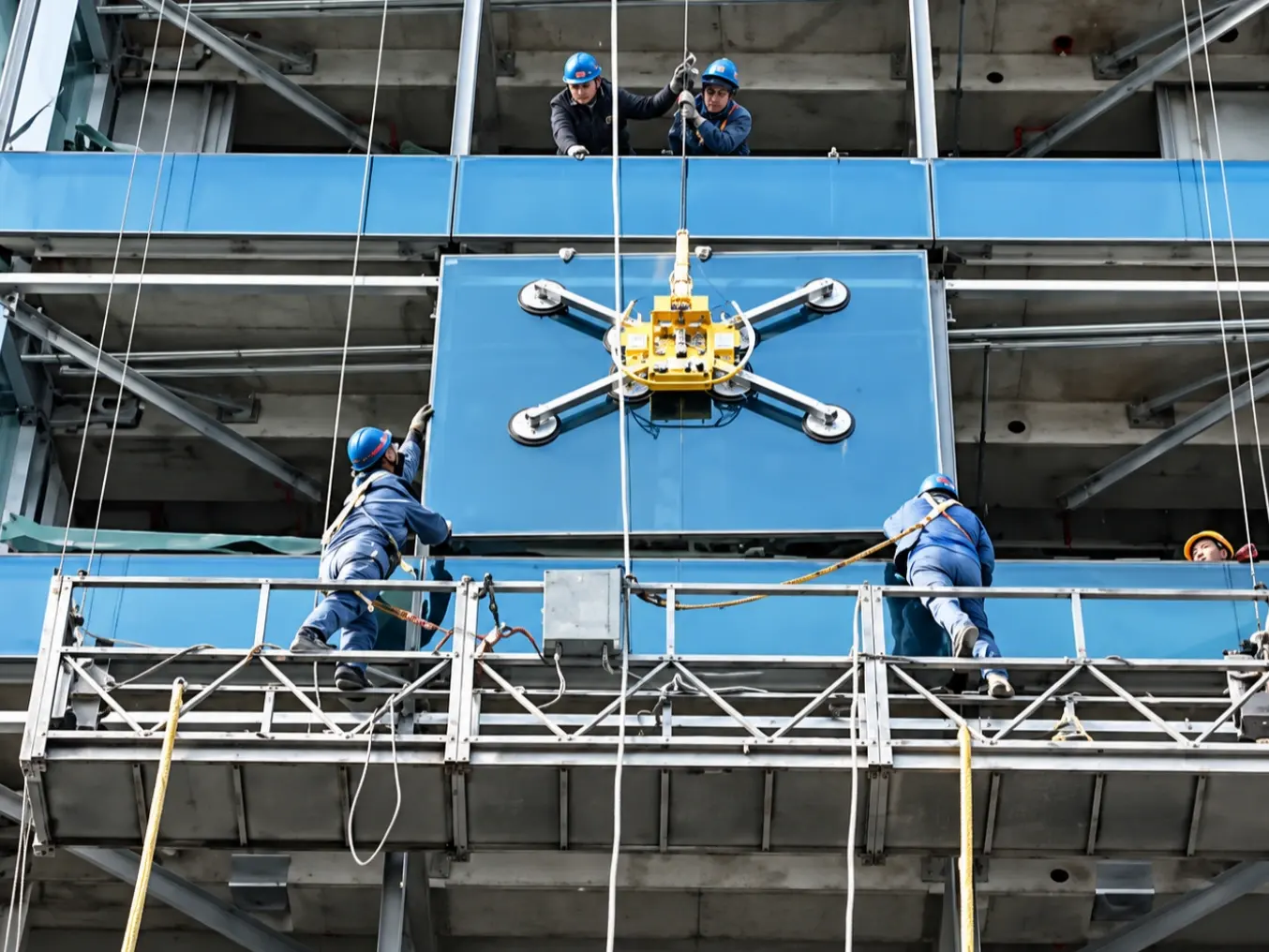
Last year, WOLIFT bid on a 50-story commercial complex curtain wall project. The safety engineer opened the meeting with three questions: what if power cuts out, what if the vacuum pump fails, and what if wind gusts exceed the forecast?
Those questions go directly to the real safety line for glass vacuum lifter systems. The issue is not only whether the equipment can pick the glass. It is whether the equipment can keep the glass controlled when one part of the site plan fails.
A 6 m x 2.5 m insulated glass panel can weigh more than 800 kg and cost tens of thousands. Once it is hoisted from ground level to 150 meters, there is no room for optimistic assumptions.
Dual-Circuit Vacuum: When One Leg Breaks, the Other Keeps Running
Dual-circuit vacuum does not mean simply installing two pumps. The core concept is failure isolation. Two independent air circuits should each have their own pump, check valve, filter, sensor and pad group. Under normal conditions, both circuits evacuate together. If one fails, the other must be sealed off.
The critical component is the check valve. If one line ruptures or one pump stops, air from the failed circuit must not backflow into the healthy circuit. Without that isolation, one failure can pull the whole vacuum system down.
WOLIFT uses dedicated check valves and pressure switches for each circuit. When pressure drops in one circuit, the control system triggers an audible and visual alarm while the healthy circuit continues holding. The operator has time to lower the glass to a safe position instead of facing a sudden drop event.
Power-Loss Pressure Retention: Read the Decay Curve
Power-loss pressure retention is one of the hardest safety metrics. When external power fails, accumulators and check valves must lock in negative pressure and keep the glass from dropping.
In one WOLIFT test, a 400 kg glass load started at -0.08 MPa before the main breaker was pulled. After 10 minutes, vacuum remained above -0.05 MPa, delivering at least 60% of rated holding force. Since actual glass weight on site often runs below the machine's rated capacity, this gives the operator a practical response window.
The data sheet matters as much as the number. Every machine should leave the facility with a simulated power-cut test and a vacuum decay curve. That curve lets the safety engineer calculate real response time for emergency protocols.
Wind Load: At Force 8, Glass Does Not Just Feel Gravity
Curtain wall installation faces one variable that indoor handling does not: wind. A 6 m2 glass panel in Force 8 winds, roughly 20 m/s, can see more than 1,500 N of lateral force across the panel. That force creates an overturning moment that can pry pad edges loose.
A design that only looks at vacuum level while ignoring lateral wind load is incomplete. Under rated wind load, the combined effect of pad friction coefficient, pad spacing and vacuum level must provide a sufficient anti-overturning safety factor.
For high-rise and coastal projects, WOLIFT also recommends mechanical locking pads, wind-stabilizing arms and guide-rope anchor points. These accessories do not replace vacuum holding force, but they provide secondary protection and reduce panel swing caused by gusts.
Safety Is Not Stacking Parts. It Is Calculating Probability.
Safety redundancy on a glass vacuum lifter is about reducing the probability that a single-point failure can cause a dropped panel. Each layer responds to a different failure mode.
- Dual-circuit vacuum: Protects against pump or line failure.
- Power-loss retention: Protects against electrical failure.
- Wind-load design: Protects against environmental spikes.
- Mechanical locks and wind accessories: Provide last-line defense under extreme site conditions.
The hardware only works if it is checked. WOLIFT requires batch inspection records for safety-critical components including check valves, pressure switches, accumulators and pads. Before each lift, a short pad pressure check and system self-test should be part of the site routine.
Factory testing matters, but field inspection is the last living line of defense.
Closing
Curtain wall glass hoisting is not ordinary indoor material handling. It is a mid-air negotiation with gravity, wind and sudden mechanical failure. The three questions from the safety engineer map directly to the most likely failure modes on site.
Dual-circuit vacuum, power-loss test data and wind-load engineering do not promise zero risk. What they do is turn "what if" into "even if" by building a measured response into the equipment design.
When reviewing safety protocols for a curtain wall hoisting project, ask for power-loss decay curves, wind-load calculations and inspection records before the machine reaches the site.
Discuss your handling requirement with WOLIFT
Share the workpiece data and site conditions for an initial engineering review.