


Why Bagged Materials Wreck Backs Faster Than Boxes: A Fertilizer Warehouse Field Study
A fertilizer warehouse retrofit showed why bagged-material depalletizing can create higher back strain than carton handling, and how a properly configured vacuum tube lifter reduced deep forward bends by 89%.
Why Bags Hurt More Than Boxes
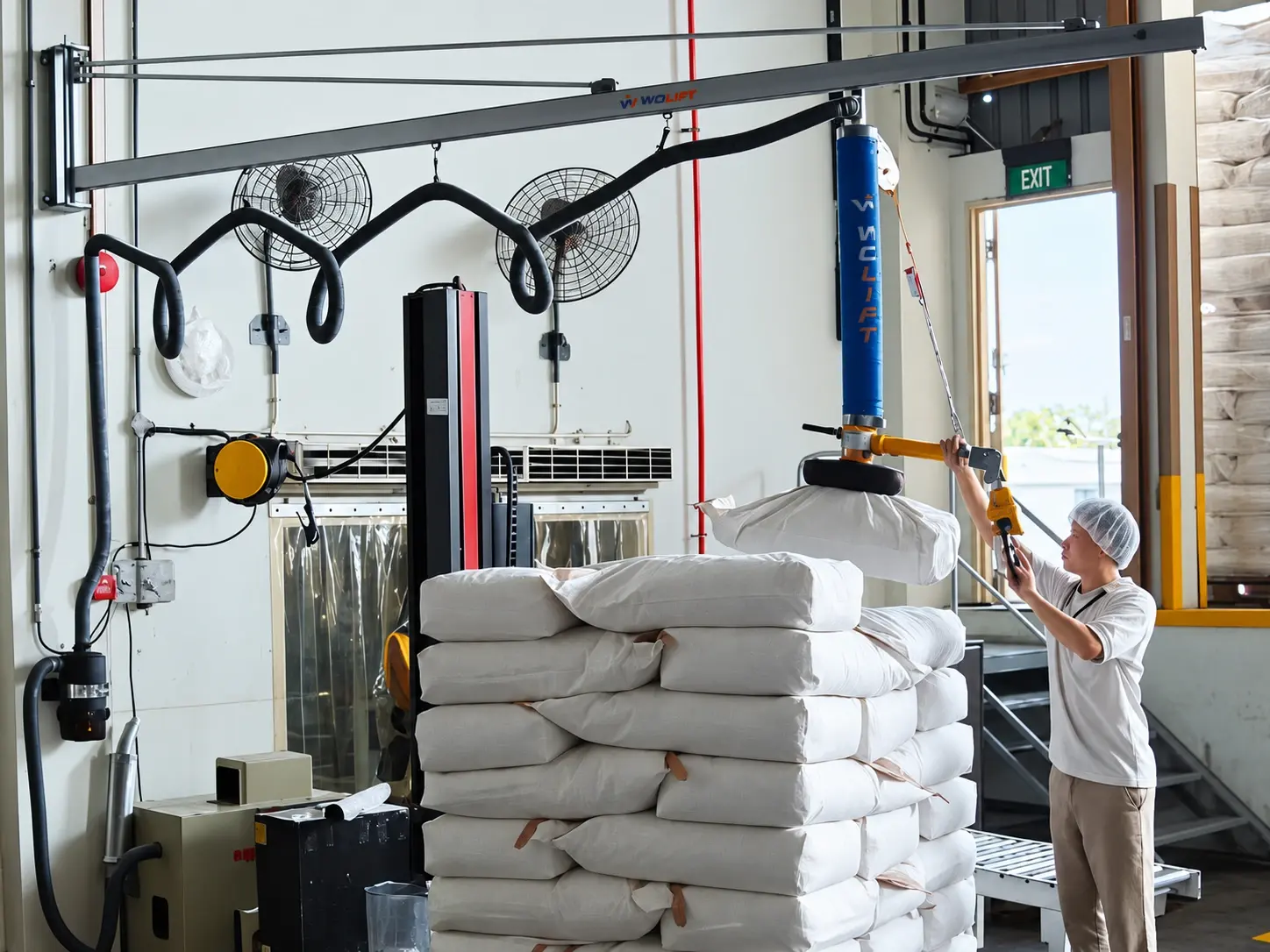
Last year, WOLIFT retrofitted a fertilizer warehouse where six veteran operators were working on a depalletizing line. Five of them had pain-relief patches on their lower backs. The bags were not dramatically heavier than cartons, but the handling motion was much worse.
Cartons are predictable. They have rigid edges, flat faces and a center of gravity that stays close to the body. Bags are soft, deformable and difficult to grip. Workers often have to kneel, hook their fingers under a corner and twist their spine to pull the load free.
The Grip Problem Is the Real Problem
A standard 25 kg fertilizer bag can sit almost flush with the pallet deck. On the bottom layer, the worker may need to drop to one knee or deeply flex the hips before dragging the bag out. During the lift, the bag's center of mass can drift away from the body's midline, adding torsional load to the lumbar spine.
Surface condition makes the motion even less predictable. Leaked powder or oil can make a bag slippery, and workers often respond by holding their breath and jerking upward. That rushed motion can create a sharp instantaneous load spike.
In the field study, peak lumbar compression during a 25 kg bag pick spiked past 4,000 N, nearly 20% higher than an equivalent carton lift. Combined with deeper bending and more trunk rotation, the lumbar risk index was significantly higher for bagged goods.
Can a Vacuum Pad Hold a Leaking Bag?
This is the first question many warehouse managers ask, and it is a fair one. Woven bags, paper bags and some PE liners are microporous, so a standard suction cup can leak air.
The solution is not a generic suction cup. For bagged goods, the system must be configured around flow rate, sealing area and dust protection.
- Vacuum source: A high-flow generator or pump maintains stable negative pressure even when the bag surface leaks air.
- Suction pad: A larger pad with a deeper lip provides more contact area and sealing redundancy on rough or wrinkled surfaces.
- Filtration: Fertilizer, cement and chemical powders require inline filters and regular cleaning to protect the vacuum system.
In field tests, a properly configured vacuum tube lifter reliably handled 25-50 kg multi-ply kraft bags and standard woven bags. A light dusting of powder on the surface did not cause mid-lift drops.
Field Data: Manual Bag Handling vs. Tube Lifter Assist
| Metric | Manual Handling | Tube Lifter Assist | Change |
|---|---|---|---|
| Deep forward bends per 8-hour shift | About 720 | About 80 | 89% reduction |
| Moderate forward bends | About 1,500 | About 200 | Major reduction |
| Peak lumbar compression | 4,000-4,800 N | Under 600 N | Extra lifting load largely removed |
| Hour 4 throughput vs. peak | Down 25% | Less than 5% drop | Stable afternoon curve |
| Monthly back-discomfort reports | 11 incidents | 2 incidents | Sharp drop |
Three Findings From the Floor
Manual handling gets riskier when workers rush
Operators often speed up to reduce time under tension, but rushed picks created the highest compression readings in the study. The tube lifter made the motion more consistent because the operator could set the pace without fighting the full bag weight.
The equipment enforces safer posture
With an overhead rail or column-mounted jib, the tube lifter defines a vertical lifting path. The worker guides the bag instead of swinging it with the lower back, which helps maintain safer mechanics even during repetitive work.
Speed does not have to suffer
A common concern is that vacuum handling of soft bags will slow the line. In this comparison, a skilled operator with a tube lifter matched 90-100% of manual hourly output and overtook manual handling by hour three because there was less re-gripping, stance adjustment and dropped product.
Implementation Traps to Avoid
- Test the actual bag: Material, surface roughness and air permeability vary widely. Sample bags should be tested before pad and vacuum parameters are finalized.
- Control dust: Fertilizer, cement and chemical powders can damage vacuum equipment. Filters and cleaning schedules are required.
- Check bag integrity: Torn or severely porous bags are a packaging-quality problem, not a lifting-equipment problem.
- Plan for exceptions: A few burst or damaged bags will always appear, so the line should keep a manual fallback method nearby.
The Hidden Return: Keeping People
Three months after the retrofit, four of the five operators who had been using pain-relief patches were still on the line with quieter backs. The fifth left for family reasons rather than pain.
Before the installation, the position turned over one to two people per month. After the retrofit, the crew stabilized and throughput rose by 12%. The supervisor did not remember the exact equipment cost, but he remembered hiring six fewer people that year.
Most injuries do not come from one super-heavy lift. They come from thousands of slightly wrong repetitions.
Closing
Bagged-material handling is often treated as unavoidable heavy labor, but the data shows that the real risk comes from repeated unstable movement. A vacuum tube lifter changes the job: the vacuum grips the bag, the operator steers, and the lumbar spine moves out of the danger zone.
For high-turnover or high-sick-leave bag lines, the practical first step is a live adhesion test with the actual product. Grip performance, bag surface, dust load and handling rhythm should all be measured before deciding whether a tube lifter fits the application.
Discuss your handling requirement with WOLIFT
Share the workpiece data and site conditions for an initial engineering review.